
At present I own 4 cameras: 2 Sony A1, 1 Sony A7CM2 and 1 Panasonic GH7.
With the exception of Fuji Xtrans I have practically shot any mirrorless and DSLR from MFT to Full Frame.
The race to more megapixels continue and right now you can get 25 Megapixels even from a Micro Four Thirds. My 3 models have 25, 32.7 and 50 Megapixels.
The thing with resolution tests is that they are based on flat charts while an image has 3 dimensions and depth is as important as horizontal and vertical resolution.
When you look at camera tests you get very excited because you see some really high values for spatial resolution on two axis. Some websites like Optyczne still test matrix resolution, here some charts for the 3 cameras I own or their closest proxy.
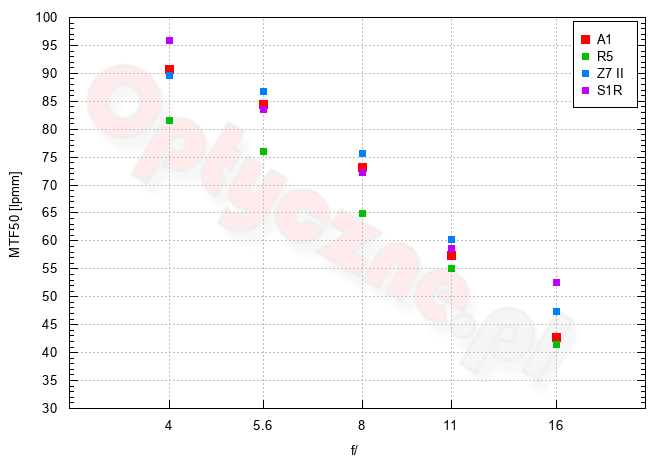

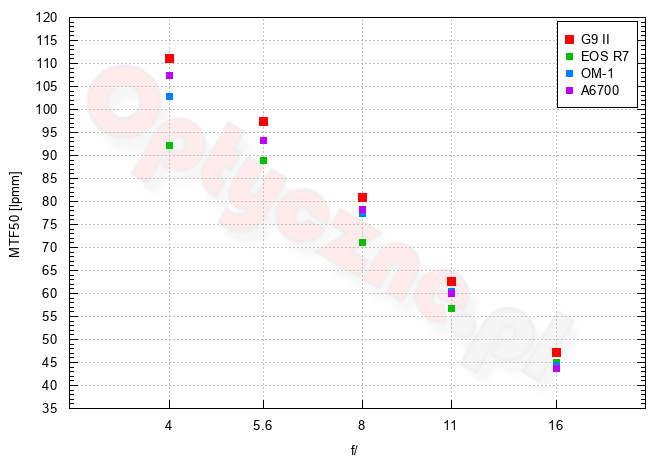
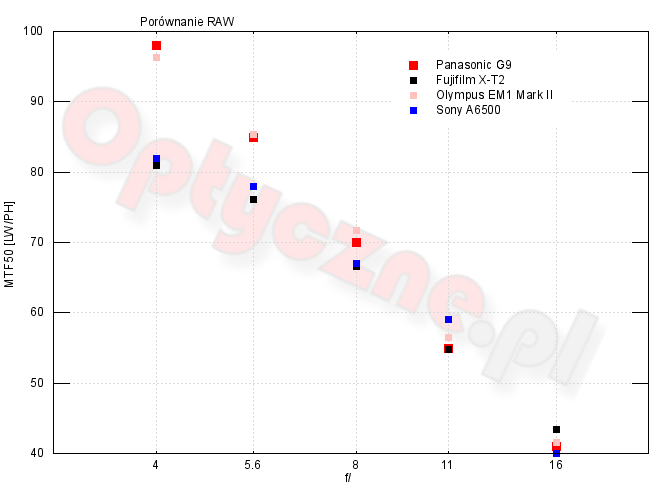
Those graph are expressed in line pair per mm so in terms of resolution at f/4 this means in Line Pairs per Picture height
A1 4368 LP/PH
A7CM2 3456 LP/PH
GH7 2886 LP/PH
GH5M2 2548 LP/PH
The A1 has 1.71x the resolution of the GH5M2, 1.51x the resolution of the GH7 and 1.27x the A7CM2. The GH7 has 1.13x more than the GH5M2 we are however omitting the third important dimension which is depth.
When we look at the shallow depth and compare f/8 on full frame to f/4 on MFT the benefit still holds for the A1 but it disappears for the A7CM2
A1 3504 LP/PH (f/8)
A7CM2 2880 LP/PH (f/8)
GH7 2886 LP/PH (f/4)
GH5M2 2548 LP/PH
In practical terms if we are interested in shallow depth of field more pixels and larger sensor matter. There is no benefit having less pixels on any sensor.
Let’s have a look at the landscape Sunny 16 scenarios
A1 2064 LP/PH (f/16)
A7CM2 1920 LP/PH (f/16)
GH7 2106 LP/PH (f/8)
GH5M2 1820 LP/PH (f/8)
We observe two things the benefit of more pixels on the full frame sensor has dropped to 10% practically halved. The benefit to MFT has reduced or even reversed.
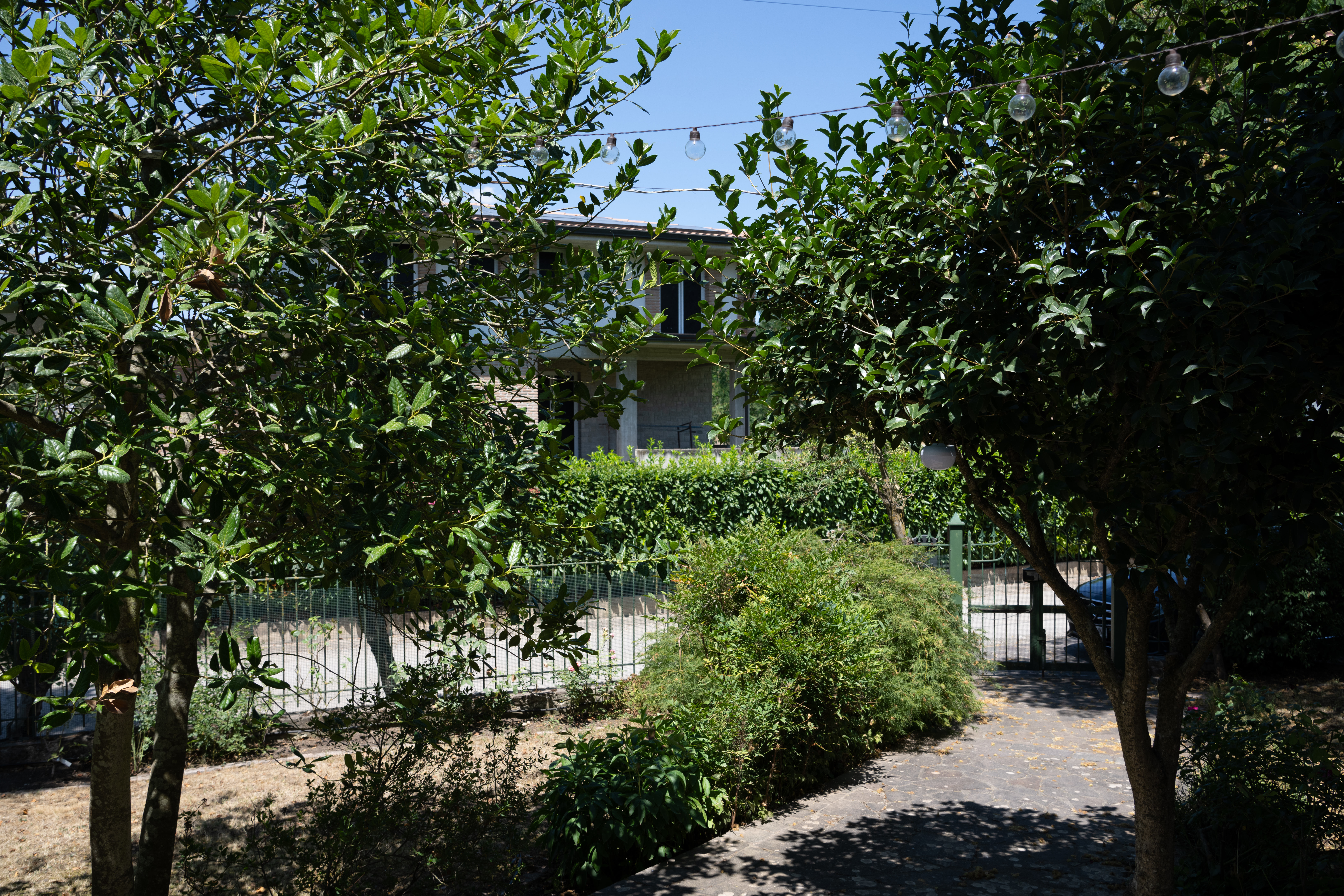
Some example shots to prove the point all scaled to A1 resolution with lightroom standard jpeg export



We can put another camera in the mix

Again for the value at f/11 2160 LP/PH
Conclusion
What does all of this tell us? Essentially two things
At same sensor size more pixels increase resolution however the benefit drops at smaller apertures. There is no reason to get a camera with less pixels in any format. This of course does not take into account the fact that at identical sensor technology less pixels read faster.
With different sensor size and equal depth of field large sensor have an edge at wide apertures or shallow depth of field but the benefit drops at small apertures.
Certain type of photography have a clear requirement for shallow depth of field for example people and portrait photography.
Othere have a clear requirement for high depth of field for example macro (not flat surfaces) or underwater photography.
Smaller cropped sensor with lots of pixels can be very useful because they can read reasonably fast and provide lots of depth of field with acceptable image quality.
I have the housing for the GH7 and will be taking it in water in the next two weeks. I expect performance to be superb with rectilinear wide angle lenses as well as fisheye zoom. Macro is not my specialty there the most important consideration is autofocus first tests on land show that the focus speed is heavily dependant on the lens.
 Interceptor121 Photography & Video Workshops