Category Archives: autofocus

Panasonic GH7 Review for Underwater Photography – Image Quality and Housing Ergonomics

This is my second post on the Lumix GH7. After discussing in detail autofocus which was for me top priority I want to cover more in detail image quality and ergonomics.

Image Quality 

The GH6 was not a step forward in terms of image quality from the GH5M2. I have owned all the models GH5, GH5M2, GH6, GH7 and from a photography point of view the pinnacle has been the GH5M2 which was a more significant step forward from the original model most people think. I have provided test data to photonstophotos for all the follow up models and this graph summarises the situation when it comes to RAW PDR.

What this tells you is that both the GH5M2 and GH7 are a step forward from the original GH5 while the GH6 was an improvement only from ISO 800. Considering that underwater on micro four thirds you will always be shooting ISO 100-200 the GH6 was not really adequate for photo performance. It is true that the GH5 has been really the target of video shooters however GH stands for Hybrid cameras and the series has been made of models that could do very good video and photos. The GH6 was really a video beast the GH7 that has the same body is back on the GH5 tradition of top performing hybrid camera.

A few key improvement over the GH5 include:

  • Increased resolution 25 Megapixels vs 20.2 
  • New RAW files with 16 bits depth
  • Dual Gain Output Circuit
  • Back illuminated sensor

The GH7 does have some interesting topside features like the ability to record pre-burst images and reach 60 fps with continuous autofocus but those are more for the bird shooter and not applicable to underwater use. Panasonic declares that image quality may drop for shutter speed slower than 1/15 at ISO 100 and therefore this should be your slowest setting also underwater. I do not see this as a limitation even for panning shots.

Many users confuse resolution and megapixels. Spatial resolution is computed on a single dimension in line per millimetre. Therefore the increase in resolution compared to the GH5 and GH5M2 is only 11.4% (5776/5184) this is not exactly life changing but more pixels are always better than less pixels bearing in mind that pixel size and image overall noise are NOT related.

With regards to the dual gain output circuit the increase in peak dynamic range compared to the GH5M2 is only 0.3 Ev (10.17 vs 9.87) and is entirely due to the fact that base sensitivity is now ISO 100 instead of 200. 

In the ISO range between 200 and 2500 the GH7 is not better than the GH5M2 and from ISO 3200 it gets better in virtue of noise reduction. Again we are never going to shoot ISO 3200 underwater so this is for us of limited interest.

Perhaps the most interesting feature of the GH7 are the new 16 bits RAW files.

A typical wide angle image has a size of 38 MB which is rather large considering the 25 Megapixels, for reference Sony A7 IV files are around 42 MB. There are several discussion about the efficiency of Panasonic compression but we are not going to go and deep dive on this. What matters to use is how much beating the raw files can take.

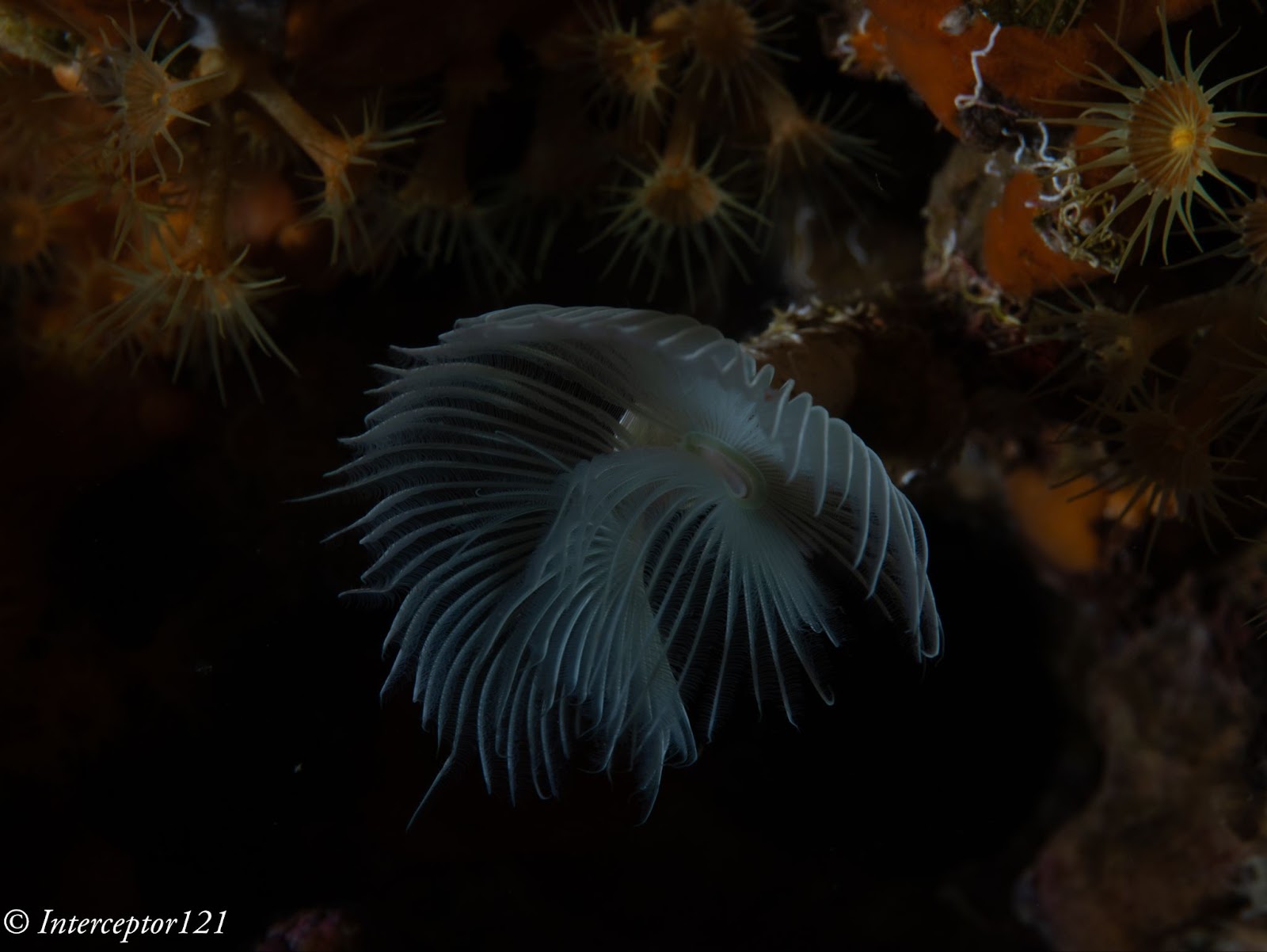
Modern cameras exhibit peak dynamic range when underexposed 3 stops from a grey card (I know this sounds strange but is a fact). The way to assess how much beating a file can take is to select one image where your strobe did not fire or was too weak for the situation and increase exposure three stops and see the resulting image.

This is an underexposed image as an example where I had forgotten to turn up the strobes.
This is the image applying +3 exposure and other corrections.
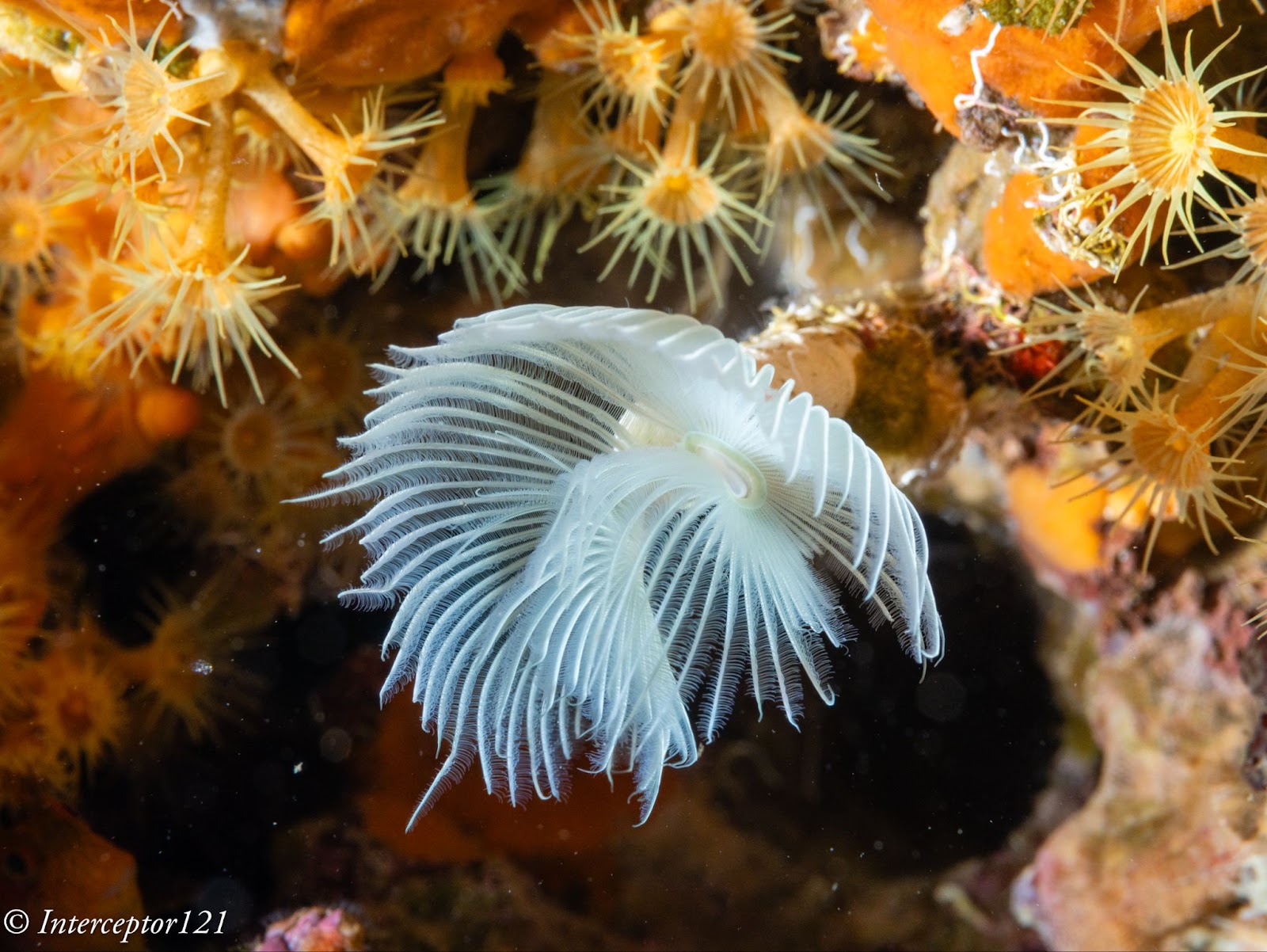
The camera can easily take +3 adjustment as well as shadows up to 100% which is an excellent result.

The other aspect of image quality is of course the lens and we can here use the excellent canon 8-15mm in the entire zoom range.

Compared with my A1 in a similar shot I can say that at the edges the GH7 is superior and in the centre the difference in actual resolution is small to non-existent despite half the pixels.
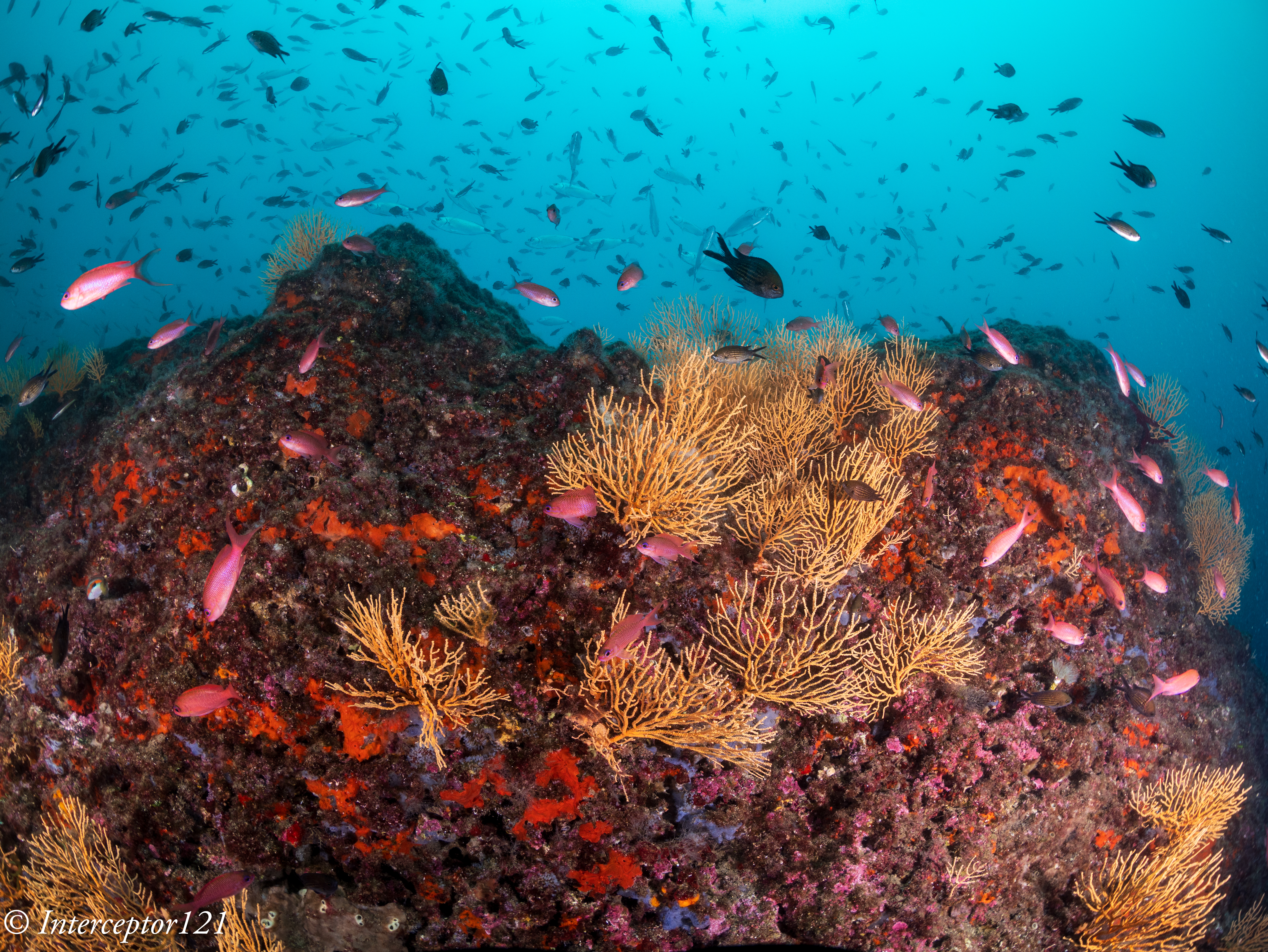
Full resolution shot GH7
Full resolution shot A1

This is because the lens shot at f/16 drops considerably in resolution compared to f/8 which are the equivalent apertures in full frame to micro four thirds. The files are full resolution I let you do the pixel peeping.

This resolution chart shows the underlying reason when the lens goes from f/8 to f/16 looses 30% of the resolution. Taking into account the smaller pixels of the GH7 this could mean an additional drop to the point the images are indeed very similar.

All in all the RAW files of the GH7 can take a lot of beating without issues as long as you do not clip the highlights like any other camera.

In general terms I feel the RAW files of the GH7 are similar in handling to my A1 and A7C II.

Dive Guide

Housing Ergonomics

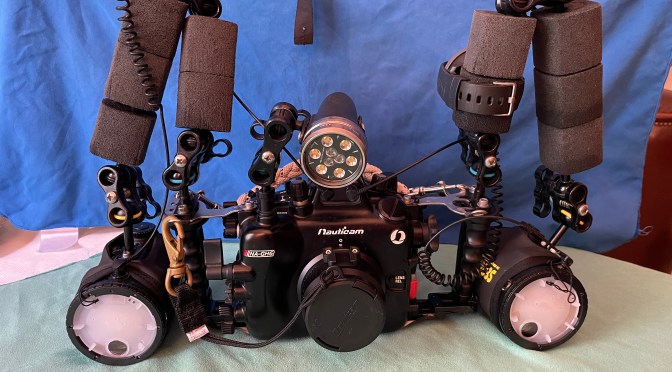
Lets’ first cover the drawbacks of the Nauticam housing.

As mentioned in the autofocus post the housing does not give you access to the joystick which is a drawback. There are other two issues with the housing, the handles are angled forward, something typical of the Nauticam GH series that I continue not to understand. Why would the GH5 be any different from other cameras?

Not all function buttons are accessible in particular the two on the left side of the camera are not. Those are to be fair not the most important buttons and there is already a variety of buttons and controls available so except the joystick there will not be an issue underwater.

The lever under the front ring controls the function buttons 2 and 3 that correspond to the front two buttons of the camera.

FN2 FN3

I recommend using one for constant preview, hitting will circle through aperture simulation, shutter simulation or nothing and the other can be used to recall the focus limiter which is very important for macro shooting as explained in the previous post. The function button on the back can be your fn 9 to recall the focus area movement useful if you want to move it.

In total you have access to 3 function buttons as well as white balance, ISO, exposure compensation, focus mode, operation lock, EVF/LCD, quick button, menu and the four arrows, delete, mode, shutter mode, playback, movie, af on so there is nothing really missing. 

FN button instead of joystick control can be used to move the focus area

One very important feature is that the handles position can be adjusted, I move out the left handle so that the lens is central to the handles, on my A1 I needed to buy an extension as the port is closer to the left handle.

The housing also has an M10 accessory port as well as the ability to host M5 like the A1, and two ports for monitor and vacuum valve in addition to a cold show

While nauticam recommends the M5 accessory personally I find the cold shoe and especially the M10 port more suitable for focus light and external monitors.

One awkward thing is the N120 to N85 adapter port has the release on the bottom of the camera but that is not a housing issue yet something to bear in mind. The housing is not small at 331x176x136 with a weight of 2.8 kg is indeed similar or equal to a full frame camera.

The final consideration is that the price of the GH6 housing that is compatible with the GH7 is very high, more than a Sony A7 IV, less than Sony A1 and way more than other smaller micro four thirds body as well as other full frame (the S5II housing costs less).

Who is the GH7 for?

The Panasonic GH7 is without a doubt one of the most capable hybrid mirrorless cameras on the market however due to the housing price is unlikely to be attractive to the masses. If you are cost conscious you can get the OM-1 for less due to the smaller housing, if you want performance several full frame cameras will incur similar cost. The real strength of the micro four thirds is the lens choice. You can cover everything with the Canon 8-15 or if you prefer with the Tokina 10-17 there are many wide and macro lenses and the huge depth of field means everything will be consistently sharp across the frame. The real strength of the GH7 though is hybrid use, if you want a camera equally capable of top range photos and videos you are looking at Sony A1 or Nikon Z8 or similar or the GH7 and here it becomes interesting for the latest Panasonic. In the near future I will provide some details of how the GH7 performs as a video capture device.
Panasonic GH7 Review for Underwater Photography – Autofocus

The GH7 is the first model of the GH line to feature Phase Detection Autofocus. This is probably the single most important feature for the underwater shooter and therefore I have thought of putting together this post to give my impression from shooting the camera both at wide angle and macro.

There will be a separate post on image quality to see how the camera performs and how far the files can be strecthed.

Please note that the camera focuses differently in video than it does for photos and therefore you should not draw any conclusion for video autofocus from this post except that due to phase detection the infamous DFD pulsing no longer occurs.

The GH7 is physically identical to its now phased out predecessor GH6 therefore the housing fits both the GH6 and GH7. I sourced a second hand Nauticam GH6 housing from my friend Pietro Cremone of Fotosub Italia. The GH7 uses the same Nauticam trigger as the GH5/6 series.

General Autofocus Settings for the GH7

If you look in the menu nothing has changed from the previous Panasonic cameras.

[SELECTING AF MODE]

You have a choice of focus areas as follows:

  • Tracking
  • Full sensor
  • Vertical
  • Zone
  • Single Area + (includes anything touching the focus area)
  • Single Area (limited to subjects fully inside the focus area)
  • Pinpoint

Pinpoint is only available for single autofocus and subject detection can be enabled for any zone. The camera can recognise humans, animals, motorcycles, cars, trains and aeroplanes. The Animal setting has a body only mode in which case it will detect multiple animals and eye and body in which case it will detect one animal. This detection method works with fish and if you want to use it I recommend animal body only for wide angle and eye body for fish portraits. What has changed inside is that now for continuous autofocus the camera uses phase detection while single autofocus still relies on Panasonic DFD which is a sophisticated contrast detection method. The camera defaults to single autofocus in low light and clearly indicates this in the display so that if you need continuous you know it is time to turn on your focus light. I did not get this indicator in open water once.

One issue I have is that the joystick is not available through the housing so I needed to set a button to highlight the focus area and press the arrows to move it when I needed it. This is a considerable handicap compared to the A1 which topside does not exist as the camera has a joystick that unfortunately the Nauticam housing cannot control.Not many Nauicam housing have a joystick but Sony full size bodies, Canon and Nikon top of the range do.

To resolve this and make operations quicker you need to customise your camera for underwater use. Change the joystick to Fn and assign focus area to the joystick. This will allow you to skip one step compared to focus area select where you need to navigate to access focus area.

[Joystick Setting]

character_default[D.FOCUS Movement] / [Fn] / [MENU] / [OFF]
Sets the joystick movement on the recording screen.
[D.FOCUS Movement]: Moves the AF area and MF Assist. (character_referenceAF Area OperationsRecord Using MF)
[Fn]: Operates as Fn buttons.
[MENU]: Operates as button_menu-set. Operations that can be performed by moving the joystick are disabled.
[OFF]: Disables the joystick.

You then go to the Function Button set up and set Fn9 to Focus Area Set.

Macro lenses tend to focus hunt and take a long time to move from infinity to your focus point, this is a problem in any format unless you use a focus limiter. The challenge when using a limiter on the lens is that in most cases once the camera is inside the housing and you have made a choice you cannot change it during the dive and therefore miss photo opportunities when the subject is outside your range.

The GH7 however has a software focus limiter feature that is extremely useful. You can set the focus between a near and far point and the camera will increase the focus speed significantly afterwards. This is also very useful to make sure that you do get close to fish.

[FOCUS LIMITER]

You can assign this feature to a function button to quickly turn it on and off.

For the purpose of my tests I did not use this feature as I wanted to stress the setup and thought of using it only if I had problems but I did not. I find this feature invaluable to ensure you get really close. I have discovered when using wet diopters that all the wet lens was doing was forcing me to get closer but indeed I could have used the naked lens to get the same shot. In consideration of the limited depth of field I rarely use wet diopters with dedicated macro lenses on micro four thirds as the imaging frame is as small at 17.3×13 mm in size.

One thing that may be worth for close up is to customise the AF settings, there are 4 different sets of parameters you can use and you can also customise the AF to be near or far in addition to recalling the focus limiter with a button.

[AF SETS]

In the future I will need to check more the tracking without subject detection that can be useful in some cases where the camera does not find a subject, however using a large single area and the cursor I could cover all shooting situations with no issues.

Wide Angle with the Canon fisheye 8-15mm

Let me start by saying that I am not a fan of shooting fisheye lenses with Continuous Autofocus as the depth of field is high and the focus range is so limited that rarely it matters.

With the GH7 I use the Canon fisheye 8-15mm using a metabones adapter and this in the past only supported single autofocus. I noticed some vignetting on the bottom side of the frame that I did not experience with the GH5 series and I need to double check but otherwise the setup is identical to what you see here on this website.

Metabones released firmware V4.10 on 12 July 2024 declaring continuous autofocus compatibility with the Panasonic G9M2 which has indeed the same AF system of the GH7.

The update also improves general performance. The link in case you do not have it is here.

I updated my adapter and I can confirm continuous autofocus works correctly with the Canon 8-15mm. Like it does with the Sony camera the focus is a bit wobbly however it works fine. Yet my preference unless you shoot a fish portrait with the fisheye is to use single AF.

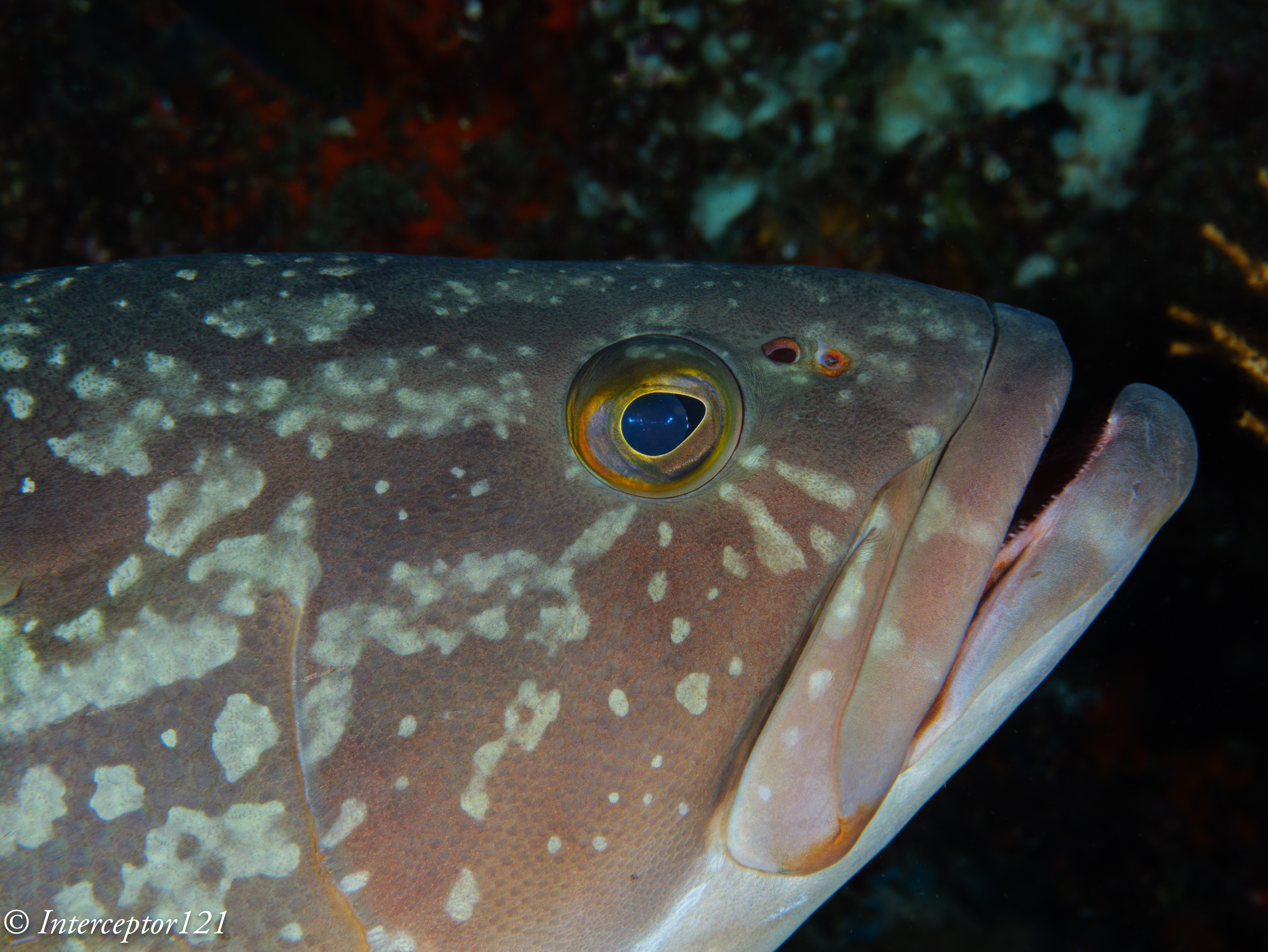
I used zone focus with subject detection, the GH7 does recognise fish and fish eyes so it did not have problem locking onto this grouper.

Fish was not always recognised, especially in those cases where only one eye was visible and the fish was on busy background, however the MFT camera combined with the 8-15 means there is always depth of field to fix any issues of focus at wide angle. A better option is to use animal detection without eye focus especially for schooling fish.

As I said before this was more academic so in the following dives I switched to single autofocus for wide angle because it is faster on the metabones, I do the same on the A1. The GH7 focussed very well. Few shots for illustration of the already known superb image quality of the Canon 8-15mm combined with the GH7.

Diver with Grouper
Sea Stars
Tube
Giant Clam

Close up work with the Panasonic 45mm Macro

For close up work I use the PL 45mm because it has the best rendering on the MFT landscape. Here I used continuous autofocus by norm using a single area or zone.

I have been advised by Panasonic not to use tracking functionality however topside tests indicate it may work ok underwater. Many people get confused between tracking and subject detection so it may be worth some explanation. Tracking works with or without subject detection and allows you to choose an area on the frame that may or not correspond to a detected subject and then the focus points follow this area. It is especially useful when the camera does NOT detect a subject. Subject detection works differently: it uses the camera live feed to scan for shapes using a deep learning algorithm when a shape is identified the location of the focus points is passed to the autofocus engine to take the shot. Strictly speaking the camera is not tracking an area of choice but detecting one or multiple targets across the frame. This has a risk when there are multiple targets as the camera may jump from one to another however in close up work this is not generally an issue. If the camera detection works there is no need to use tracking as the subject detection mechanism is quicker and more effective. 

I activated subject detection with Single Area + and the camera identified all fish with eyes, in my case groupers, gobies and blennies. For nudibranchs I got a shape around the body most times. The subject detection for fish is way more successful than my A1 but I do not know how it compares with the latest implementation of the A7R V that has more detection modes like insect that may be relevant.

I took 255 shots in a dive with the 45mm of which 5 did not have a subject in focus and of those 2 had no subject as the fish had run off the frame.

For Macro you may want to activate auto review for 0.5 seconds, now this allows you to see where exactly the camera focused.

The Panasonic PDAF system focuses like a DSLR with the lens wide open. This is different from other mirrorless systems like Sony or Nikon and it means that when you stop down the lens the camera takes longer to take the shot and can potentially have focus shift, this is mitigated by the significant depth of field of the cropped format.

The GH7 focus right on the eye of this large grouper

I had a very high success rate as mentioned and only in a few circumstances the focus was off the eye but more because the fish had moved too quickly and I was at close range.

This focus system is excellent for shots wide open and you can easily obtain nice bokeh with eyes in sharp focus.

Subjects like nudibranchs can move fast or be on little algae that is swaying in the current, the MFT system with the huge depth of field available means you can achieve the effect you want easily. Different shots at various f stop

F4
F5.6
F8

The GH7 like the GH5 and GH6 can sync with the strobes at 1/400 using the Nauticam trigger which also supports rear sync. This is a value only the A1 can match and is very useful for close up work as it easily gives you dark backgrounds in the right conditions.

Take into account that the depth of field even at f/11 on MFT equivalent to f/22 on full frame is 1 cm at close range therefore some really small critters may even need f/16 or more.

I did not have a single shot with focus on the background which for me is quite impressive.

The 45mm maintains good sharpness even at f/10 and further but I did not stress the set up in my tests.

I had a focus light but I never had to turn it on because the GH7 focuses wide open, my strobes have a pilot light but this is only useful if you aim at the subject which in most cases I actually do, again there was no need to use it.

Conclusion

The Panasonic GH7 performs very well both at wide angle with a dome port and at close range with a macro lens. Continuous autofocus is reliable and appears to work fine without a focus light even when the shooting conditions are not easy. Subject detection recognises fish and fish eyes and makes shooting easy. The only remark is the lack of joystick control on the Nauticam housing that would make it even easier to work with single area focus, the operation is still possible but requires two button presses. I would trust the GH7 as much as I trust my A1 with the reservation of very dark environments that I did not have time to test.

DSLR to Mirrorless Migration Paths

Recently many DSLR user have been moving to Mirrorless, while some are still waiting. The entire world of photography has practically abandoned DSLR but underwater photography is traditionally lagging and this is due to a combination of factors one of the most important being availability of appropriate lenses to fit specific use cases.

Unfortunately underwater use cases do not form part of the design criteria of lens manufacturers due to the tiny size of the market, so you need to hope something comes up that can fit that shooting situation you are trying to master. To date there is no native OEM fisheye lens for mirrorless for full frame. There are of course plenty of lenses for micro four thirds but this is only mirrorless so it does not form part of this evaluation because if you are on that format you have moved on already.

Full disclosure I am a Sony Mirrorless shooter but have owned and used Panasonic, Nikon, Canon and Fuji and I keep myself up to date with the latest innovations. This piece is based on data as you can see it not on opinions which I have little interest in.

Brand Loyalty?

One thing that is very important when making this step is to ignore entirely brand loyalty. This is somewhat difficult for the user that is accustomed to a certain menu system and look and feel or even color rendition of the camera but it is an imporant factor.

Let’s have a look at few examples considering the two main DSLR brands Canon and Nikon starting from the latter.

Nikon

Probably the market leader in underwater DSLR shooter has been delaying the transition to mirrorless and only recently catching up.

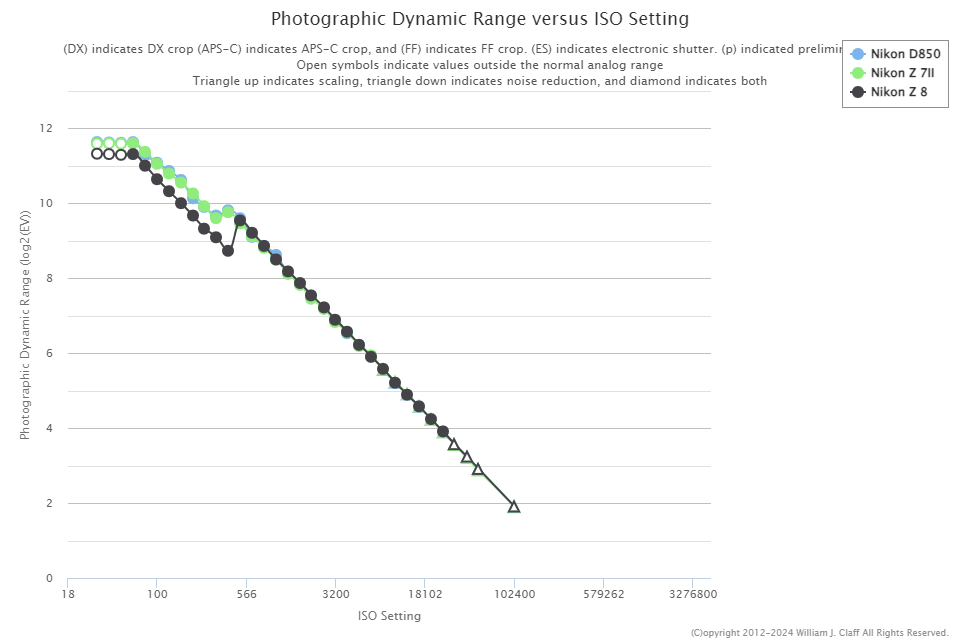
Nikon D850 vs Z8 vs Z7II

The D850 and Z7II have the same sensor and therefore identical performance, the Z8 has a new stacked sensor however according to a variety of sources the additional speed that is no doubt very useful to topside bird or sports shooters comes at price.

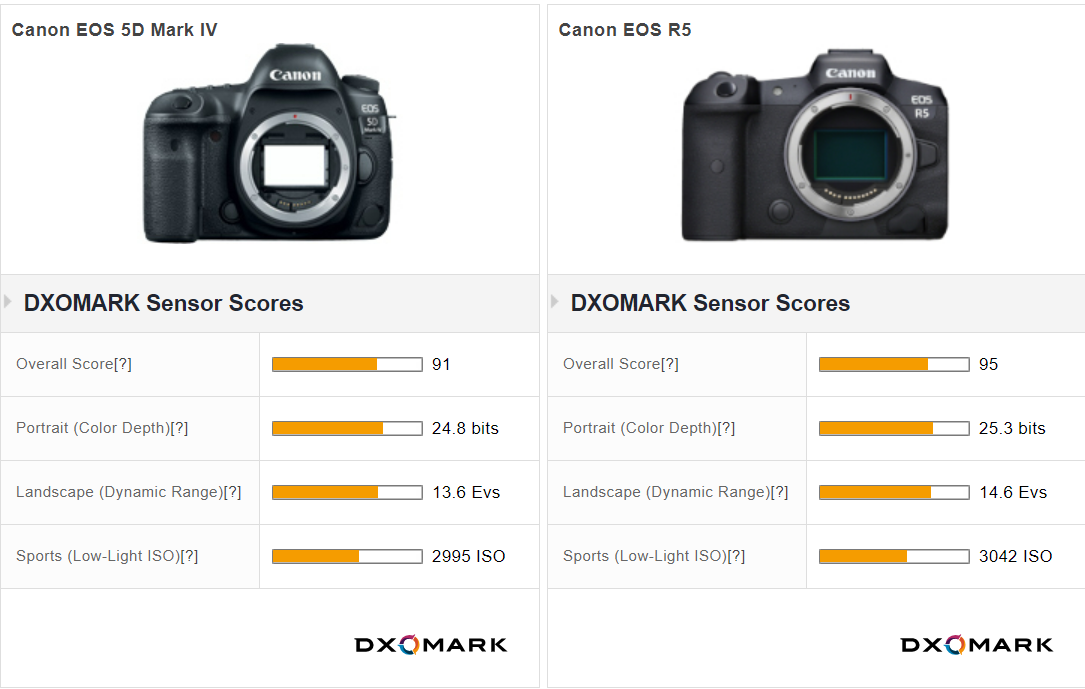
This is corroborated by DxOMark results

The Z8 has indeed less dynamic range and therefore scores less. Obviously this is only taking into account purely image quality however other factors are important namely the autofocus, ergonomics and the availbility of lenses.

The Z series has a limited amount of native lenses compared to the armory of FX lenses however you could say you can get by.

The autofocus has really improved in the latest Z8 while it is fair to say it was not as exciting in the Z7II.

In conclusion looking at Nikon full frame the transition from DSLR to Mirrorless looking purely at underwater use cases will not move your image quality forward and probably be on par on autofocus.

Nikon D500 vs Z50

When we look at Nikon DX format considering a transition from D500 to say Z50 the image quality is identical but here the lens assortment is even less therefore many users go full frame instead of staying on crop.

In conclusion I would say Nikon FX/DX to Z is not a really strong case and is penalised by Nikon being a total laggard in the transition to Mirrorless. Perhaps Nikon users should consider changing brand if they are keen to move forward due to topside use cases, or wait a bit longer.

Canon

Canon has been more decisive in moving to Mirrorless and it shows.

The RF series has an excellent display of macro and rectilinear lenses while it lacks a native fisheye overall the comparison is fair while certain niche lenses like the Nikkor 60 macro

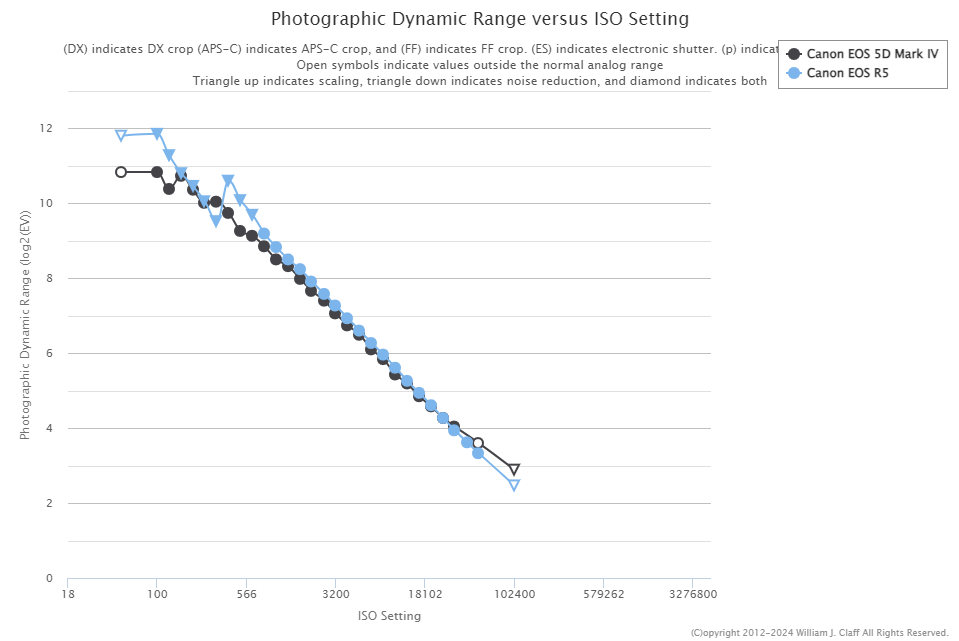
Looking at sensor performance the situation is also more favourable.

Here the improvement is across the field. When we look at the cropped format the EOS90D and R7 there is a smaller improvement, however a no regret situation.

Taking as thermomether the Nauticam port chart for RF system we can see that the selection is pretty decent for full frame, the same cannot be said for APSC where the number of supported lens is small but so is the topside selection.

In summary a Canon user wanting to be loyal to the current brand will find an improvement in full frame but not in APSC having to resort to older DSLR lenses for a small improvement in image quality.

Sony

Sony is the leader in mirrorless camera having been the first brand to embrace it for full frame. At present Sony Semiconductors Corporation provides image sensors to Nikon and Panasonic amongst other and only offers the most advanced solution to Sony Consumer Cameras unless the customer pays for a custom project.

Looking at full frame sensor performance of the fast models those preferred by topside wildlife shooters we can see that the A1 and Z8 are indeed very similar with the A1 having more megapixels and offering an edge on dynamic range and high ISO performance and the Z8 edging on color depth.

Those cameras make sense if you have a variety of topside use cases and also like to do some video or if you are really needing the last bit of strength from the superior autofocus.

When you compare the Z8 to the A7R V which is a ‘slower’ camera you see that the latter has an edge this is also true if you look at the A1 of course. An underwater shooter that does not need the speed of the A1 or Z8 should stick to a model like the A7R V and benefit from additional megapixels and sensor performance with a loss of speed that underwater does not mean much. This camera has a very slow burst rate and topside will be easily affected by rolling shutter and it is not a favourite for topside wildlife shooter but more a camera for landscape, architecture and portraits.

The selection of lenses for E-Mount is vastly larger than Z mount at present and there are adapters for both Canon EF and Nikon FX formats.

Sony full frame cameras tend to be smaller and the housing cheaper so you can see why some previous Nikon DSLR users have moved to Sony Mirrorless.

Canon users instead are not migrating to Sony because of lens selection and backwards compatibility and more importantly are also gaining on image quality and features moving to Canon mirrorless.

Micro Four Thirds

Some users have done differently and gone to a smaller mirrorless format. Micro Four Thirds is where mirrorless started long time ago and offers plenty of lens choices. Contrary to what people think Micro Four Thirds cameras can closely match the performance of APSC cameras the gap is more or less half stop and operating at equivalent depth of field can match both ASPC and Full Frame cameras.

While the increased depth of field has been a strenght of this format underwater the autofocus has been historically the biggest let down.

As of today there is not a single MFT camera that can match the simple tracking without subject detection that old Canon and Nikon DSLR and current Sony Mirrorless can do. Brands have been focussed on shooting people or birds and animals but this did not include fish and so far the simplest use case which is to shoot a fish portrait with a macro lens has been where this format has lagged.

Unless you are interested in the video features or you only shoot wide angle and don’t care about the autofocus issues Micro Four Thirds is typically not a path of choice for an existing DSLR user.

Panasonic

With a strong tradition in video, Panasonic has recently mastered autofocus and released the S5II with PDAF that is a very interesting camera at reasonable price point. L-Mount has started to offer a good selection and using the sigma adapter you have access to Canon EF lenses. The Nauticam lens chart for L-Mount shows a good selection.

While cost effective the S5II has only 24 megapixels and more importantly does not offer a solid tracking autofocus as Nikon, Canon and Sony do and therefore is a risky path to take unless you are also moving to the S5II for other reasons.

Conclusion

When I write pieces like this there is always someone that comes but at the end we took amazing pictures with film camera or with Camera X that had 8 megapixels. Well that is fine but at that time this is all you had.Or even better let’s look at some open water images to have a view, which of course can’t be done as conditions can never be replicated.

Today there are many options and choices and while having options is a good thing it does make decision making more complicated. While there are many factors that make the image at the end the photo needs to be in focus and have the appropriate quality.

This short write up covers both this factors and hopefully you will find it useful. If you are regularly on underwater photography trips you will also be able to compare this article with real life scenarios. While few years ago it was rare to see a full frame sony user on a trip today the numbers have largely increased as consequence of the migration of users to mirrorless cameras.

Going Macro with Sony A1 and 90mm Macro Lens

I must admit Macro photography is not exactly my favourite genre both underwater and topside however I do enjoy a bit of critter hunting.

I was sure that the A1 would be an absolute beast for topside wildlife and underwater wide angle, however I did not feel comfortable at all with the performance of the Sony 90mm Macro lens.

It has a reputation for hunting and a lot of focus breathing that make it hard to use for topside focus stacking.

I have been playing with the lens topside and I did see examples of both so I was somewhat skeptical taking it underwater.

Camera Settings

I was perhaps over worried so I set up the camera for the worst case scenarios:

  • Focus limiter set to 0.3 – 0.5 meter
  • CAF priority set to Focus
  • Aperture drive – Focus priority

I went in with autofocus set to tracking flexible spot.

Port and Focus Gear

I have always mixed feelings for focus gears and mostly I use it to make sure I am hitting the minimum working distance and therefore maximu magnification.

Nauticam 37147 SE90-F focus gear for Sony 90m f/2.8

The focus gear for this lens is a large item and does not allow to operate the focus clutch. The operation is quite easy as the focus ring does not have an excessive long run.

I already own the 45 Flat Port that I use for the Sony 28-60mm and also have the 35.5 N120 to N120 port adapter so I thought how do I make this 105mm long?

Nauticam 21325 N120 to N100 25mm port adaptor

Nauticam makes convenient adaptor rings of various length to go from N120 to N100 port size. I got the 25mm that resulted in a saving of £441-260=£181 which I used to buy another part.

The rig as assembled looks like this. In effect even the 110 port starts wider and gets narrower.

Sony A1 Nauticam Macro Rig

Before going to the pool I realised the housing does not have an M10 mounting point but you can adapt one of the points that go to the bars connecting the angle. Will be done at some point. So I went in without focus light in a very very very dark pool.

Pool Session

As I packed my props I realised I did not really have any good macro target however a friend came to the rescue. An instructor of a diving center that uses the same pool brought a small leopard and octopus that sank and were perfect targets.

As you probably know I am obsessed by obtaining the absolute maximum performance from each lens. And this for a macro lens means shooting at the best aperture, for this lens f/4-5.6 and stacking. However this is not available underwater. You need to pull your shot from a single image and this means the lens won’t be at the best performance.

I started at f/11 which gives a respectable MTF50 and to be honest I am impressed!

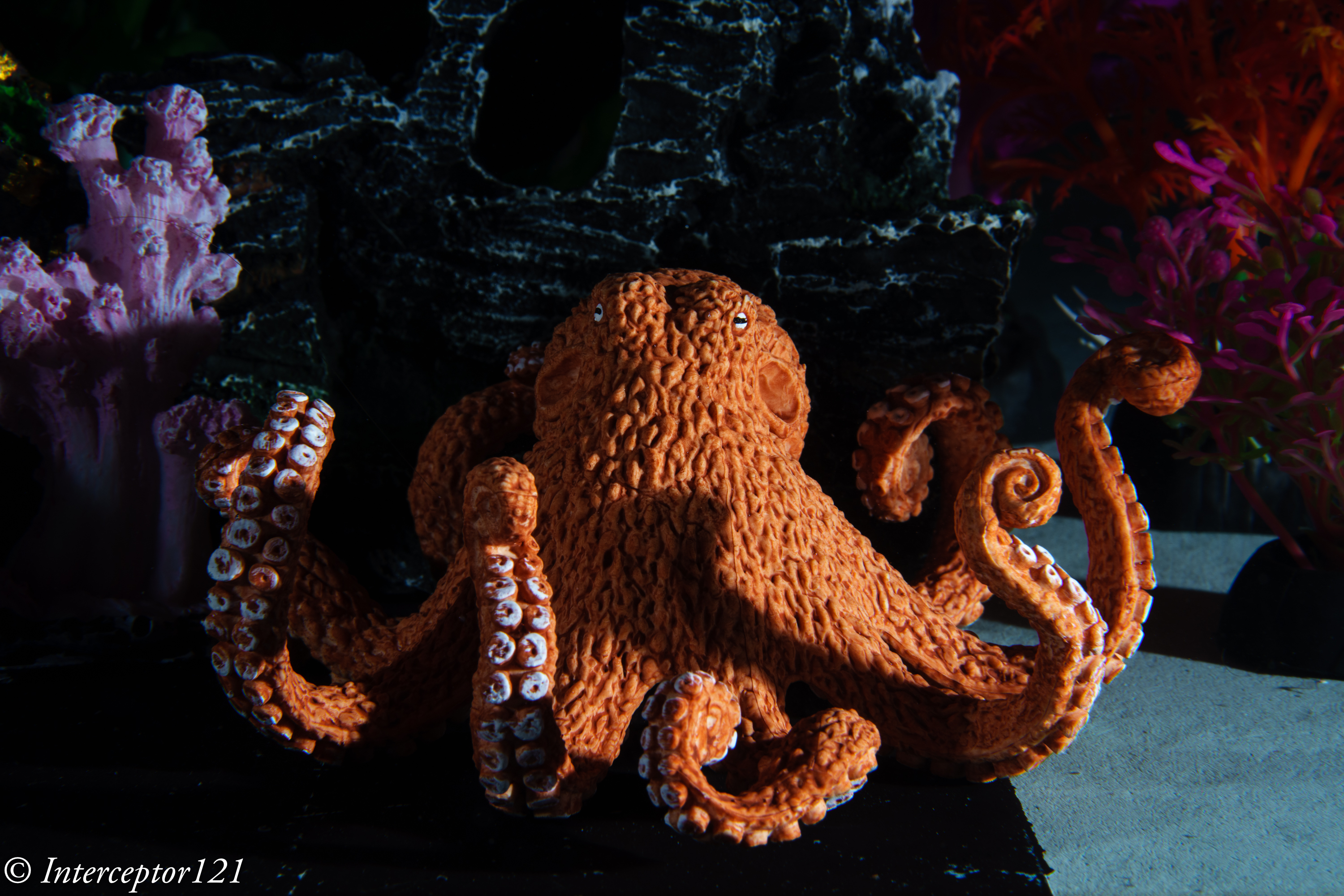
Octopus f/11 angle
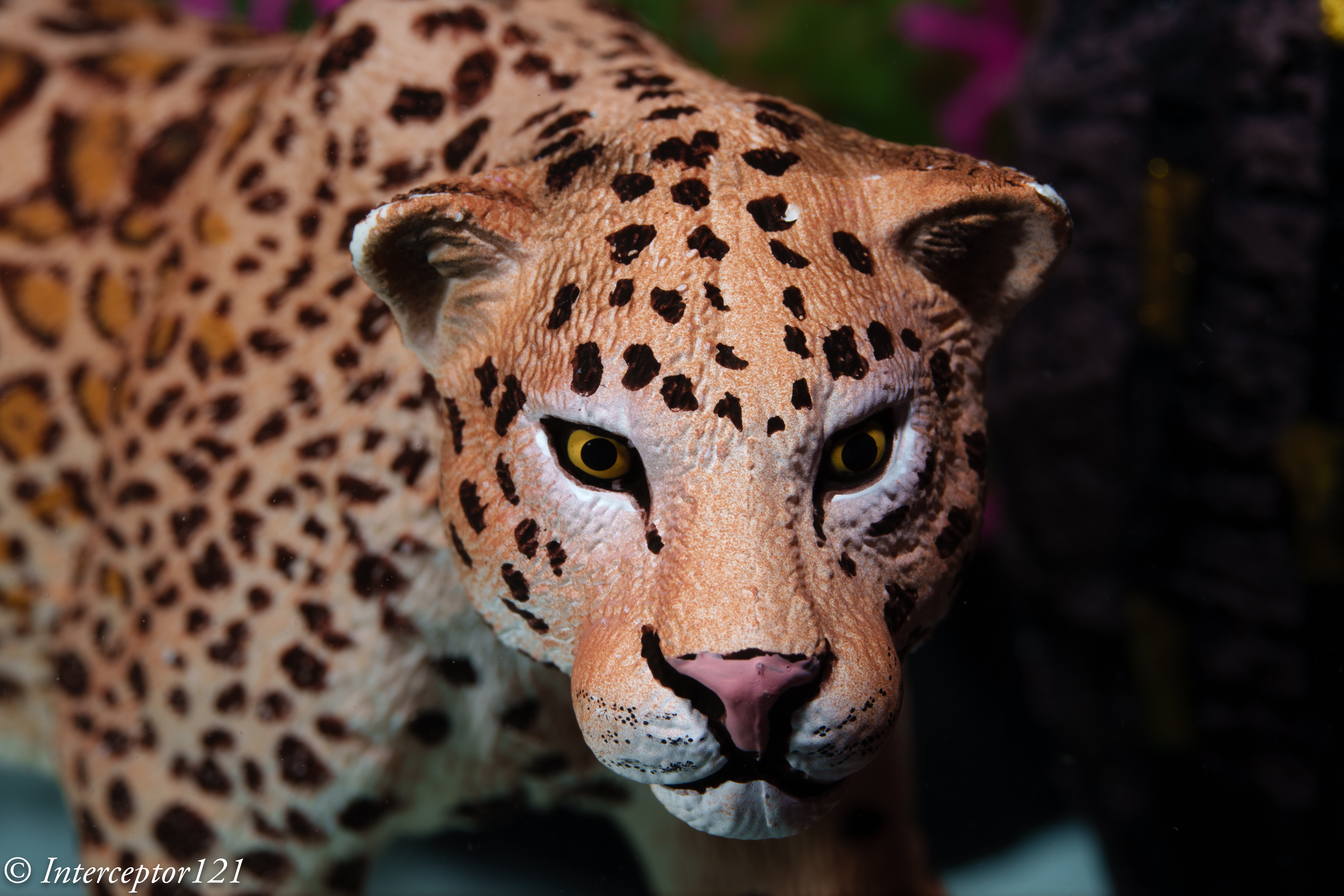
Tiger coming f/11

I then pushed the lens to f/16 I could see resolution dropping as depth of field was going up.

Octopus front f/16
Tiger side f/16

In order to get depth of field of an overall scene with the octopus I had to go all the way to f/22 diffraction zone.

Tiger f/22 side
Octopus wide f/22

Yes with the high resolution of the sensor those images are still ok or at least so they seem to me.

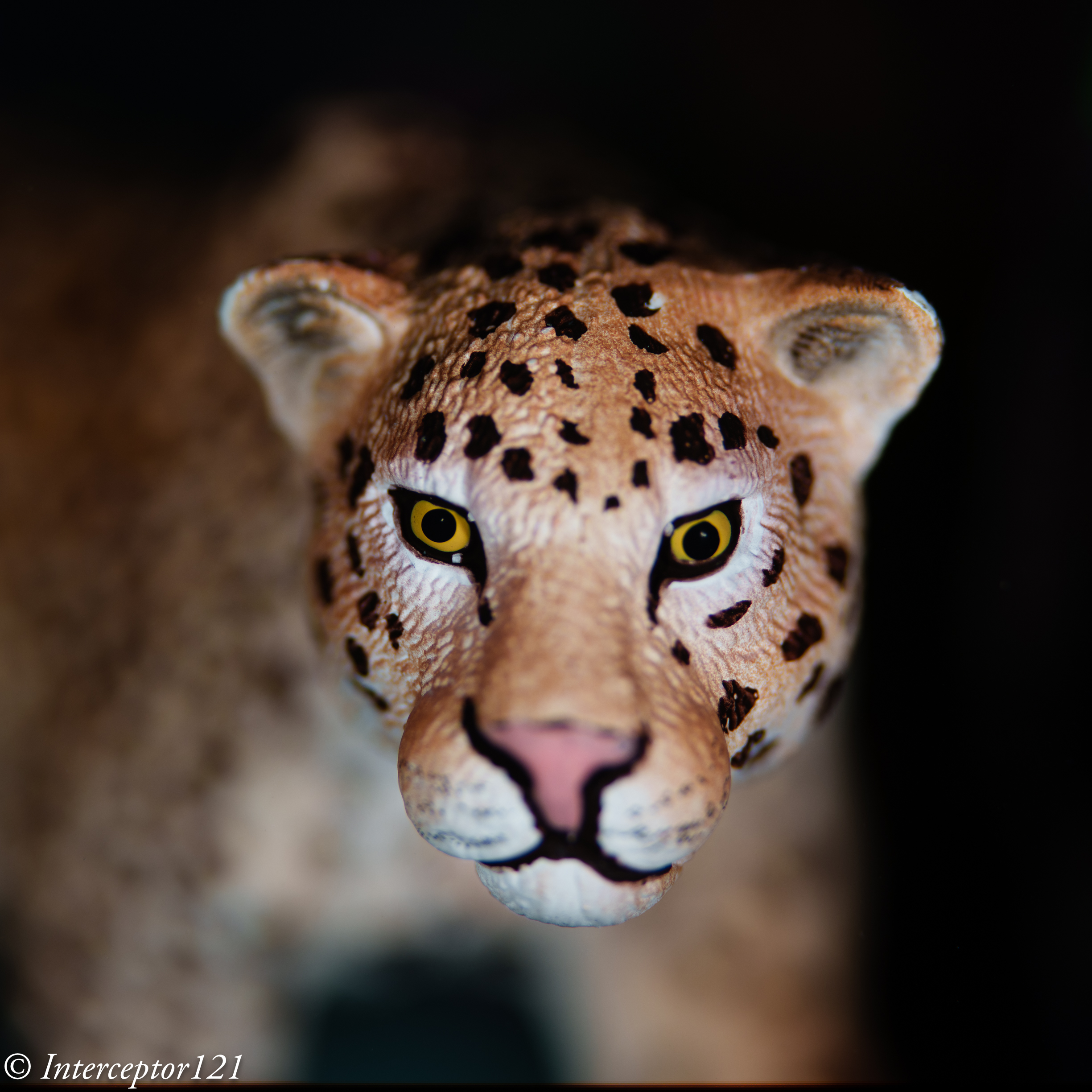
Tiger Bokeh f/2.8

I think this lens wide open makes an amazing bokeh that will probably be still there at f/4 so something to check.

Field Impression and Ergonomics

First of all I did not regret setting the lens to close range using the focus limiter. This will give you a frame 19 cm wide if you feel that is too small and you are just trying to get some fish portraits perhaps leaving this to full is a better idea. Likewise if your targets are bigger.

I did not get any hunting despite the dark conditions and I am not sure if this was due to this setting or if this helped.

CAF worked in all situations the A1 can practically see in the dark however in order to get focs tracking and eye detection working (it detected the eye of the leopard) I needed to switch on the focus light of the strobes.

I believe tracking and detection requires a level of scene brightness higher as the camera is effectively in video mode. When you half press the aperture drive meant it would focus thought it had not tracked anything. I got 2 shots not focussed on the subject because I moved.

The focus gear I believe is not required unless you want to do super macro or to make sure you are as close as you can get but I do not regret having it as the run is pretty short with the focus limiter is on.

Conclusion

Alex Mustard tried the 90mm with the A1 for blackwater and said it was better than the Nikon D850 with the 60mm which is a well known blackwater combination. My tests confirm this combination is very very powerful even in the dark and with a little bit of light it will focus on anything. If the lens goes back and forth is because you are close or over 1:1 reproduction ratio.

Overall my concerns apperad not justified and this combination is a solid performer. Probably next steps are getting an SMC magnifier to push this even further.

Autofocus Systems for Underwater Photography

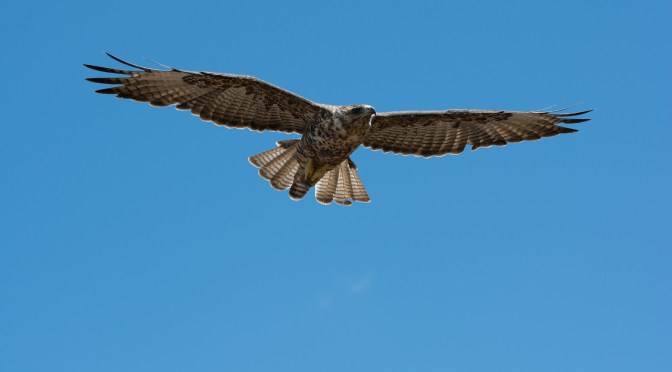
You will notice that the featured image is actually a bird in flight. When we think about fast autofocus birds in flights is what is really going to test performance.

This image was taken by my wife with a Nikon D7100 and a Sigma 70-200mm lens in the Galapagos Islands.

I also shoot birds with my Panasonic G9 and have a direct experience of focus systems for moving subjects and I can comfortably say that today AI has become more important than anything else for those kind of shots. Artificial intelligence predicts movement and ensures that once the camera has reached focus the first time it reacts automatically to movement without the need to refocus.

Let’s start from the basics first.

Types of Autofocus

There are two types of systems for auto focus in digital cameras:

  • Phase Detection
  • Contrast Detection

Both systems need contrast to focus despite the naming convention, so phase detection works on contrast too.

In situation of low light low contrast EVERY camera switches to contrast detection without exceptions.

Contrast Detection AF

This is the simplest and cheapest way to obtain focus and is what is typically implemented in compact cameras. Contrast detection moves the focus back and forth to find the maximum contrast and then locks on subject. This is sometimes perceived as hunting by the user when the camera fails to find focus.

Contrast detection is the most accurate method of autofocus as it looks for perfection without prioritising time. With exception of Panasonic no other major brands use contrast detection AF on high end or semipro models.

Phase Detection AF

With this technique the image goes through a prism and it is split then when the two parts match the subject is in focus and the focus locked.

Phase detection is less accurate than contrast detection in particular there are instances in which focus is achieved in front or behind the subject. This is the system implemented by Nikon, Canon, Olympus and Canon.

Hybrid AF

This system combines both methods, it starts with phase detect to determine the focus start and then uses contrast detect to make sure the focus is accurate. Sony is the main driver of this technology.

Low Light Focus

All autofocus methods need light to function without exception, when the scene is really dark cameras have some methods to achieve focus, this includes:

  • Using the lens widest aperture to focus
  • Bump the ISO and then adjust later
  • Auto focus illuminator and modelling lights

Generally low light is less than 1.25 Lux or candela per square meter representing a really dark scene.

Pro and Cons of Each System

If we look at the three systems each one has positive and negatives and depending on the subject this are more or less important.

SystemSpeedAccuracy
Phase DetectFasterLess accurate
Contrast detectSlowerMore accurate
HybridSlowestMore Accurate
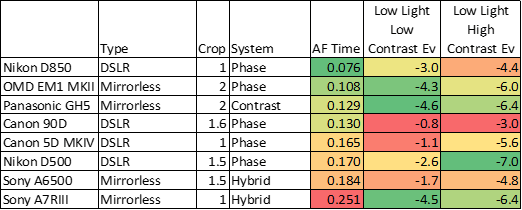
AF comparison Table

Performance Requirement for Underwater Photography

Many underwater photographer think that they need a system that focus fast, can track moving objects and work well in the dark, this system of course does not exist.

In particular considering the availability of focus lights the performance in low light is definitely not a show stopper. More important are speed and accuracy. For the purpose of a comparison I have included here some models from Sony, Panasonic, Olympus, Nikon and Canon with a variety of formats representing some popular choices among underwater photographers.

I have included 3 performance metrics for comparison:

  • AF time
  • Low Light Low Contrast Ev
  • Low Light High Contrast Ev

The first measure tells you how quick the camera focuses in normal conditions, this is in my opinion the most important parameter as generally underwater photography is not below 1 Ev.

The second measure is the number of Ev of low light the camera can still focus with a low contrast subject, and finally the third is still a low light scenario with a high contrast subject. Let’s look at the results that are build using test data from imaging resource.

AF comparison table

I have used conditional formatting so green is good amber is average and red is bad for each category.

AF Time

First observation is that hybrid AF is very slow, second contrast AF as implemented by Panasonic is faster than most of DSLR peers in this table. If we consider 0.2 seconds as acceptable the full frame mirrorless Sony A7RIII has unacceptable performance. While the Nikon D850 AF is in another league both MFT Olympus and Panasonic are faster than other APSC and even the canon full frame.

Low Light Low Contrast AF

Mirrorless cameras dominate this category, the Panasonic GH5 can reach focus at -4.5 Ev that is practically dark on a low contrast subject, second is the Sony A7 RIII and third the Olympus OMD-EM1MKII.

In a low light scenario phase detection fails sooner so some of those cameras switch to contrast detection to achieve focus.

Low Light High Contrast AF

All cameras are able to work at least at -3 Ev so this is not a distinctive category, it is worth nothing that some phase detect system that failed in the low contrast target scenario perform well in this category but generally performance is pretty decent.

Why are your shot blurred?

Some people that have the camera in the table still struggle to get shots, why is that? I have found that for most users do not read instruction manuals and to make it worse modern camera have far too many AF settings. My GH5 for example has 6 options of AF area, 4 options for AF Mode, 3 parameters for tuning the AI (artificial intelligence) engine, plus additional custom modes to select the 225 focus points in any random shape you like. The average person will skip all of this and select one option and then fail the shots.

Conclusion

Surprisingly for some if we look overall at the camera that has green in all categories we find two mirrorless micro four thirds. Even more surprisingly both those cameras are faster to focus than APSC DSLR from Canon and Nikon although it is not really a great distance.

Typically when it comes to comparison between camera there is someone that says but camera X gets the shots blurred so speed does not matter. I talk by direct experience with outdoor and birds not just fish and I can tell you that each system will miss shots in burst mode but more importantly underwater photography is nowhere near requirements for birds in flight.

I have performed tests with a light meter at less than 1 candela per square meter with my GH5 with a 60mm macro lens and with my surprise it focuses just fine without the AF illuminator. I have to admit I do not really trust auto-focus so in most situation I use back button and peaking however based on my recent findings I need to trust autofocus a bit more it seems!