Category Archives: Wet lenses

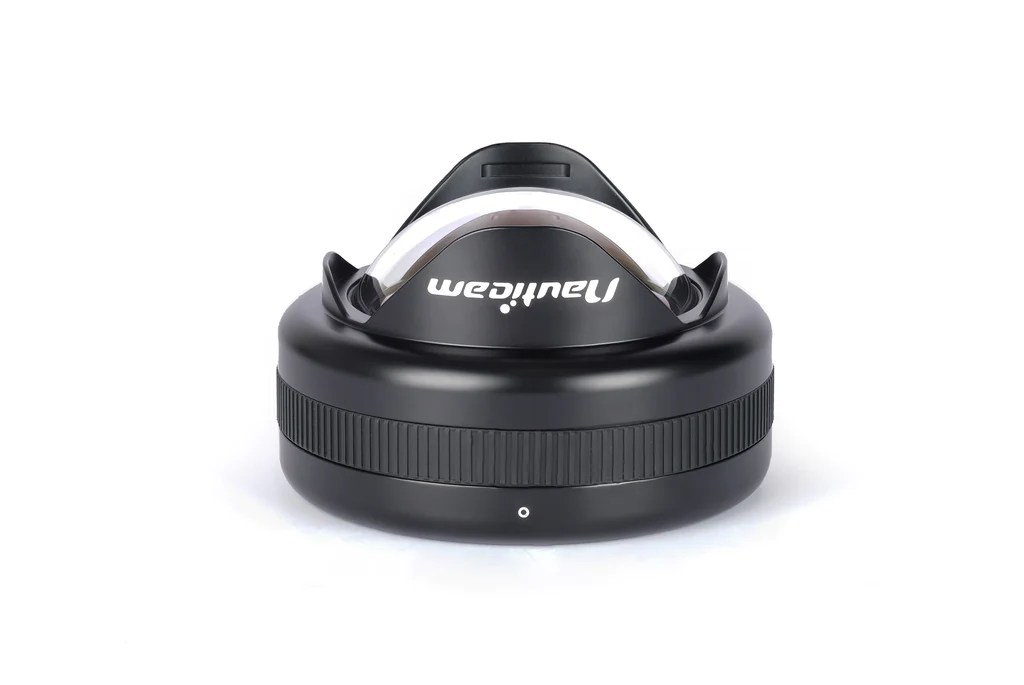
Underwater Wet Wide Angle Lenses – How do they work?

Water contact optics have existed in various forms since film cameras however in the last 20 years with the advent of digital compact cameras the emphasis has been on wet lenses.

A wet lens would be attached to the housing of the camera and be in contact with water.

Inon has been for a long time the champion of wet lenses but since 2015 the top performer has been Nauticam since the introduction of the WWL-1 which I reviewed in this article still using a compact camera. Originally wet lenses were only designed for small sensor systems however the WWL-1 was the first wet optic compatible with the Sony full frame E-mount system. The issue with large systems is that as the lens gets bigger the wet lens gets bigger at some point you need to move to a dry mount to avoid vignetting but the optical design remains unchanged.

Dry mount wet lenses existed long before Nauticam efforts; the most notable was the FIX dry mount for the canon G16 series.

How does a wet lens work?

All wet wide angle lenses are built as afocal (focal length equal to infinity) system with magnification smaller than 1 this means things look smaller than they are when you apply a wet lens on top of the camera lens.

This has a significant benefit for all lenses that have a minimum working distance that is not compatible with a dome port, which requires lenses to focus really close.

With an afocal lens designed similar to a laser beam extender: things look further away and therefore the system is able to focus right on the surface of the wet lens.

Historically wet lenses were not corrected for distortion and, as result of having this demagnified effect, they also have barrel distortion which is commonly accepted in underwater photography.

When we look at wet lens specifications, we are given the magnification of the lens alone for example 0.36x or 0.57x. This does not mean that if your lens is 28mm it becomes 28×0.36=10.08mm during the process.

What it means is that if something is at 1 metre from the wet lens this will indeed look as if it was 2.8 metres and therefore the field of view will be larger. This is a significant benefit if you compare to the same 28mm behind a flat port which is the starting point of the compact camera market those optics have been originally designed for.

When you combine the wet lens with your camera lens the demagnification effect may be affected  by  the distance between the two lenses, the length of the optical path inside the camera lens and body, and inside the wet lens.

As you work at distances that are much longer than the physical size of your system the magnification factor becomes a more accurate approximation, however as you get very very close to the point of touching the class the magnification actually increases and the effect of the wet lenses decreases.

WWL-1 on Sony 28/2

Wet lens operating at very close range the depth of field has dropped far away from the notional 130 degrees diagonal but the image remains very sharp.

And this brings to a fundamental difference and key takeaway: the field of view of a water contact system, composed by a camera system and a wet lens, changes with the subject distance.

Another important point is that due to the design, a system with a wet lens can indeed focus at infinity which is totally different from a dome port system, a system with a wet optic based on focal design does not require the lens to work at close focus but in most case will allow the lens to work within the specified MOD even when subjects are actually closer.

Why a water contact optic may work better than a lens in a dome?

We have read about the marketing that states that water contact optic A has a benefit of N stops in the corners compared to a rectilinear lens of the same field of view.

What does this mean and is it true? First, the majority of rectilinear lenses are unable to offer the same diagonal field or view of a wet lens combined with a longer optic so this comparison is a bit difficult. Second majority of dome ports on the markets are limited to 14mm widest focal length so a comparison to match the field of view is not entirely possible.

If your rectilinear lens has very poor close focus performance, which is what happens in a dome where a lens works in a  distance range around max 0.5 metres, and you compare it with a standard lens combined with a water contact optic which helps the lens to focus further away, you will find that on a resolution target the water contact optic may indeed offer much better sharpness as you move from the centre to the edges of the frame.

This is not an absolute truth as there are some modern mirrorless lenses that focus very close and in fact match or even beat an average lens combined with a water contact optic.

Sony 1635 F11

The Sony 16-35GMII in the example above offers superb corner sharpness and in fact wider field view at close range than the wet lens despite a smaller nominal field of view. This is due to the fact that the dome optic preserves the field of view at all shooting distances.

The 16-35GMII however costs more than the Sony 28-60mm and WWL-1 combined without accounting for the cost of the dome!

If we consider other solutions like the WACP-1 the dome solution costs become comparable or even lower.

Limitations of Water Contact Optics

Allowing the lens to focus further away than the subject may allow the lens to work in a better performing zone however this also comes with some drawbacks.

In situations where the subject is flat there are no issues with a water contact afocal system however reality is not made of flat subjects.

In this example we have our target at 1 metre and the reef at 0.5 metres while at 2 metres there is some background of interest. The examples are based on full frame system with a distance to the front of the wet lens of 19cm.

If we model a water contact optic we see that the aperture required to cover the depth of field while focussing on the target is f/8. This is based on the sensor virtual distances on the graphic.

However the f/stop goes to f/13 if our focus is very close or very far.

Take into account that in real like the magnification will be higher than 0.36 and therefore the values computed are best case scenarios.

With this type of adapter both focus position and field of view are based on the virtual image.

This is a classic example that shows the effect.
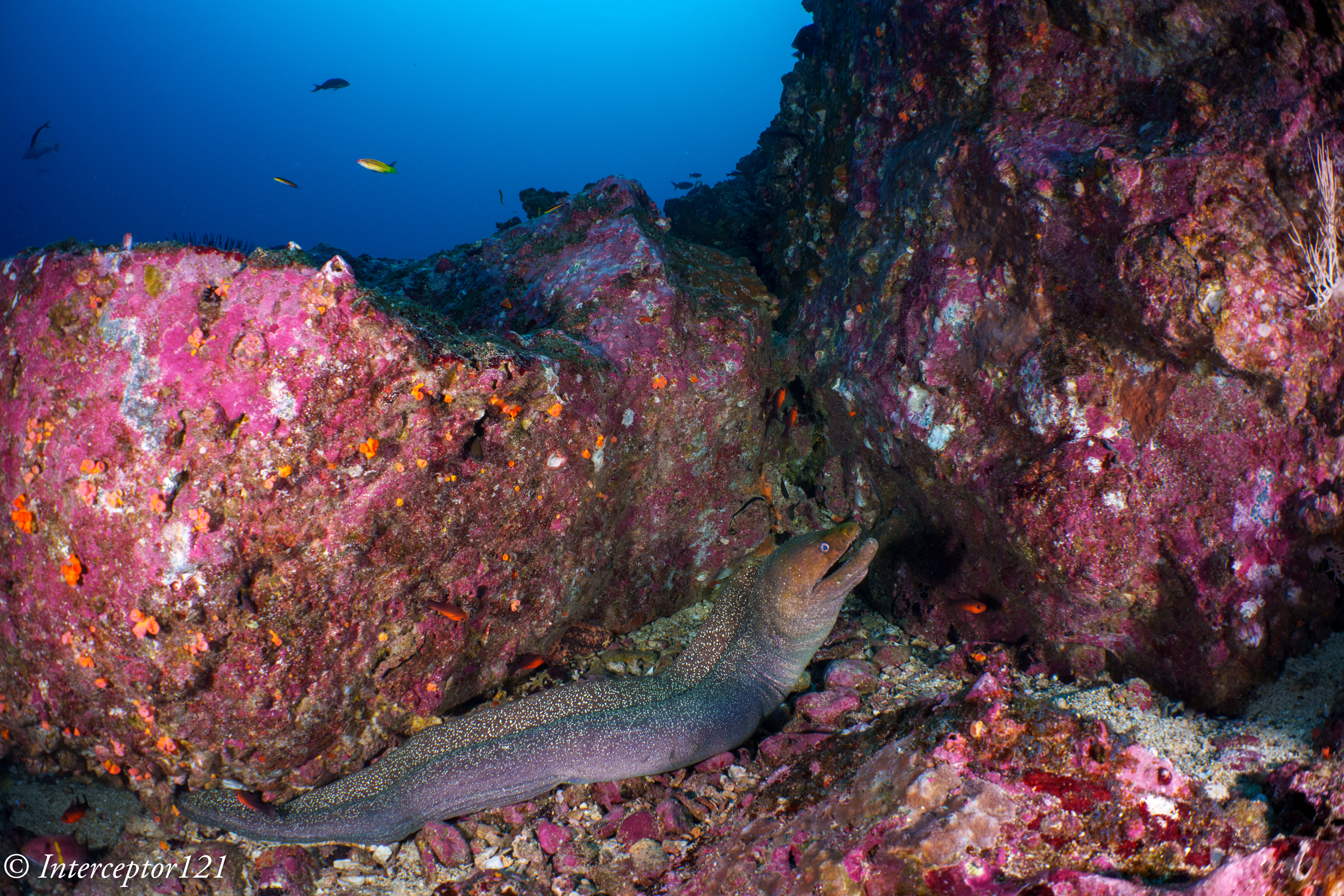
Moray on Red

The moray eel is at around 1.5 meters however the camera thinks the target is 5 meters away as result even shooting at f/11 results in soft edges and lack of depth of field in front of the subject.

If we do the same simulation with a lens housed in a 9” dome the results are very different due to dome port compression.

Remember that for a dome virtual image drives the focus position however field of view is based on real distances.

Example shot in a similar situation with a Canon 8-15 and teleconverter at f/11 the entire frame including the parts ahead of the coral block are sharp. The camera focus position is 27cm due to the dome port optic visual image, the dome size used is 69mm radius.

We can see that in terms of depth of field the dome system is much more effective despite the subject distance is very near, although this will be penalised by other aberrations and therefore more likely work at around f/8 still this is a benefit especially when we look at closer targets which don’t require the same small apertures of the wet lens system.

This other example with teleconverter at f/8 focal length 21mm shows decent depth of field even in the near edge. At f/11 this would have been sharp throughtout
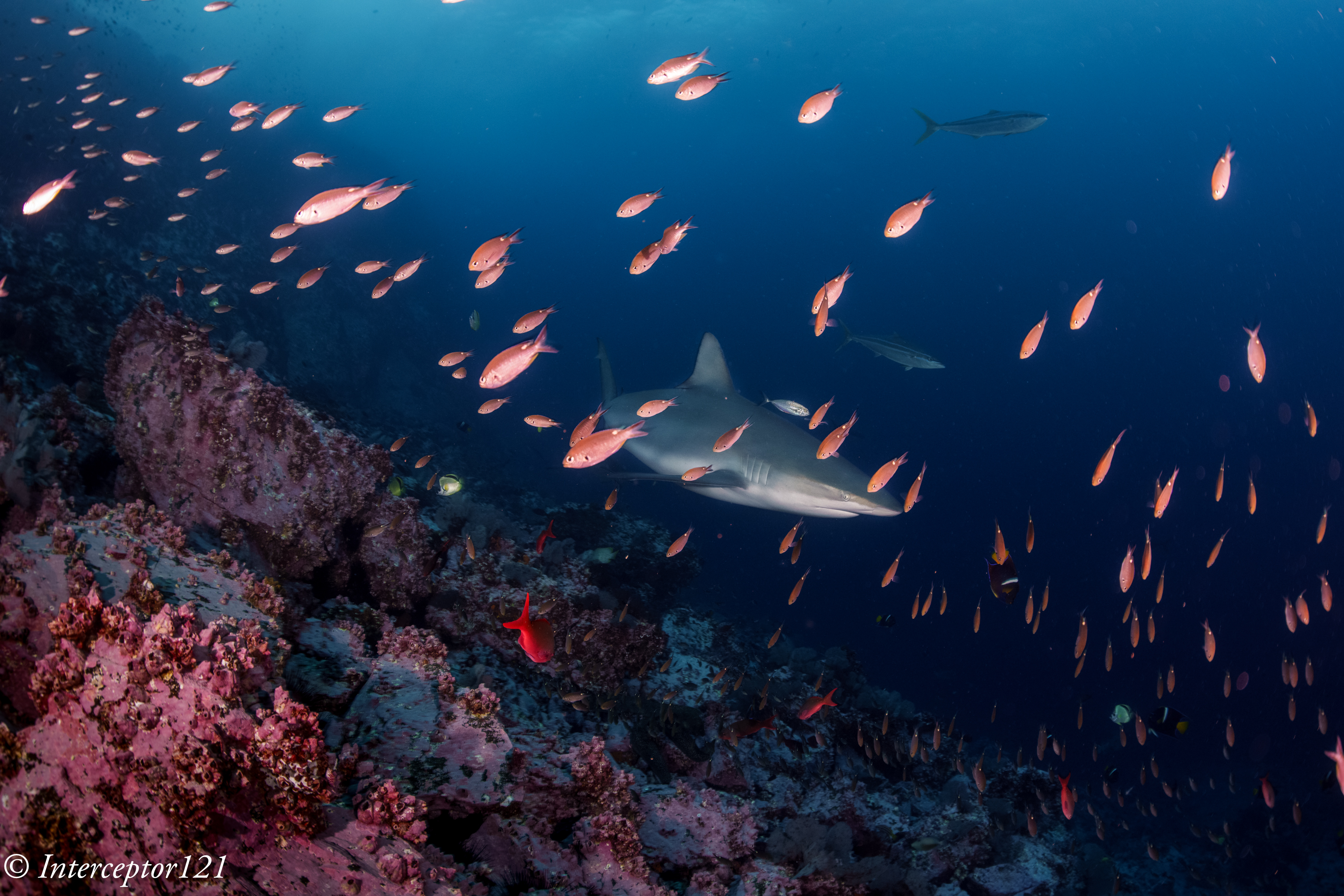
Red Raindrops

Therefore the water contact optic typically requires smaller apertures compared to a shorter lens of comparable field of view on the horizontal axis within a dome solution.

This reef scene shows a classic situation where you need to stop down the lens a lot to have everything in focus here shot at f/16 so that the coral in front of the fish is sharp.
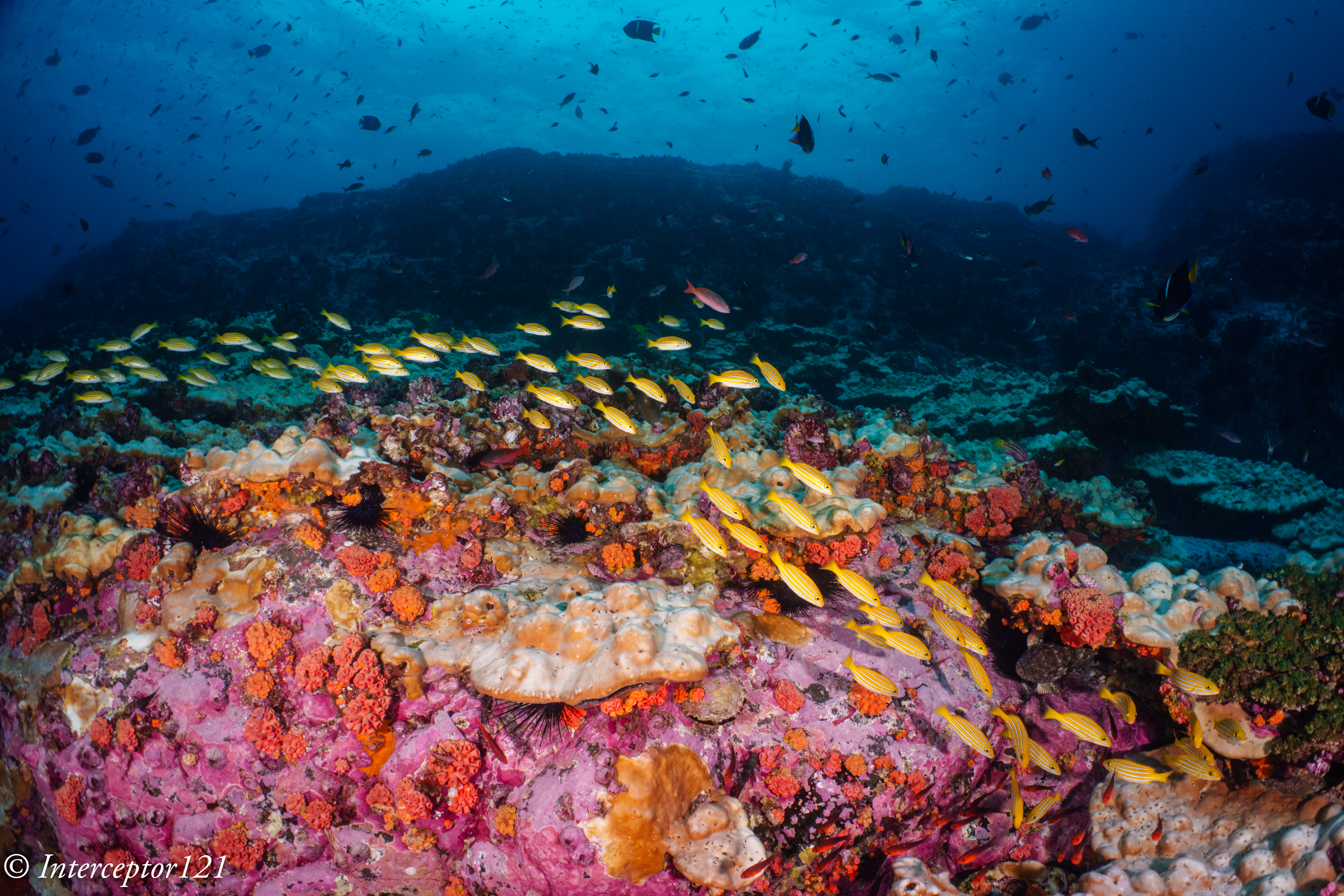
Sway

With f numbers going past f/11 there is a sensible drop in resolution of the overall system and therefore the water contact optic appears more suitable to situations where the main subject is ahead of anything else in the frame, for example schooling fish.

Staircase

A school of snappers in Malpelo makes the perfect target for a wet optic as the reef is behind and everything looks sharp across the frame at f/11.

Reading the exif of this image we see that the camera thinks the target was at 8.05 meters in reality it was less than 3 meter away.

Fish Shape

Summary

Water contact optic allow lenses to work in a more comfortable focus range, this is very advantegrous if we compared it to a flat port or to a wide lens that does not work well at close range.

However wet wide angle lenses are not suitable to all scenarios, in particular due to the issues of depth of field and also lower effect at close range are not particularly suited to close focus work without a significant loss of resolution on modern full frame mirrorless cameras. 

If your objective is to work at close range and have reef scenes that are not clean with elements before and after the focus target a fisheye with teleconverter may offer a more fitting solution than a 0.36x wet lens with a standard zoom because it does not loose magnification and ends up in comparable aperture numbers to achieve a similar depth of field.

For targets at far distance shorter focal lenght, in our case half (14mm vs 28mm) will offer superior depth of field because of the dome port optics however will need to be stopped down to fix other aberrations yet unlikely to require aperture smaller than f/11 or in some cases even f/8 and therefore providing a potential increase also in light gathering and resolution.

Ultimately on full frame cameras wet optics are not a silver bullet and solution for all shooting scenarios but just another option to be used for example to reduce drag, consider the effort of finning with a small wwl-1 compared to a 9″ dome port in 3 knots current.
Tamron 17-28 F2.8 for Underwater Photography Review

The Tamron 17-28mm F/2.8 Di III RXD is without doubt one of the best options for wide angle underwater photography.

As I wrote in a previous article this lens has several strengths

  1. Close minimum focus distance (19 cm wide – 26 cm tele)
  2. Lens does not extend when zooming
  3. Reasonably compact (99 mm and 420 grams)
  4. Good sharpness at the edges from f/4 onwards
  5. Low cost compared to other Sony lenses.

The lens will cost you $799 vs $2,299 of the Sony 16-35 GMII which is the best lens in this class however the price difference will convince most people especially those only using the lens underwater that the Tamron is the way to go.

Parts for Nauticam Housings

The Nauticam 18809 wide angle dome port is not a classic dome but has design without a flat base. The port has 11cm radius of curvature and is 85mm deep 180mm wide this means the entrance pupil needs to be 25mm behind the extension.

Nauticam 18809 180mm Wide angle dome port

Nauticam recommended extension is 40mm when combined with the 35.5mm N120 to N120 port adapter. Due to the shape of the lens this cannot be used with the N100 port as the zoom is close to the front of the lens.

Tamron 17-28mm with Nauticam zoom gear

Underwater housing manufactures unfortunately do not apply any science to the selection of domes and extension for a lens but out of pure coincidence the 40mm extension ring is what this lens requires.

Tamron 17-28mm 35.5 adapter and 40mm extension

With the 40mm extension the glass port will be exactly 11 cm from the entrance pupil and focus right on the surface.

The Nauticam parts will set you at $2,284 for the gear, extension and wide angle port.

Pool Session

I had already shot the Tamron in the murky waters of my local pool so I went to Luton that has a better filtration system and started with my usual shots.

I took shots from f/2.8 to f/22 obviously f/2.8 and f/4 are purely academic but decent results are obtained from f/5.6.

Tamron 17 2.8 Close

At F/2.8 most of the area outside centre is blurred.

Tamron 17 4.0 Close

By f/4 we have a substantial improvement.

Tamron 17 5.6 Close

At f/5.6 the lens is better than most already considering the very close shooting distance. Unfortunately at this stage I picked up a bit of debris on the dome and did not realise…

Tamron 17 8.0 Close

f/8 is very good and this is your default for shots that are not close when edges are not important.

Tamron 17 11 Close

f/11 is probably the best overall compromise between edges and centre.

Tamron 17 16 Close

By f/16 depth of field keeps everything in focus however the lens has dropped in the centre.

Tamon 17 22 Close

f/22 gives you a consistent frame but with evident resolution loss.

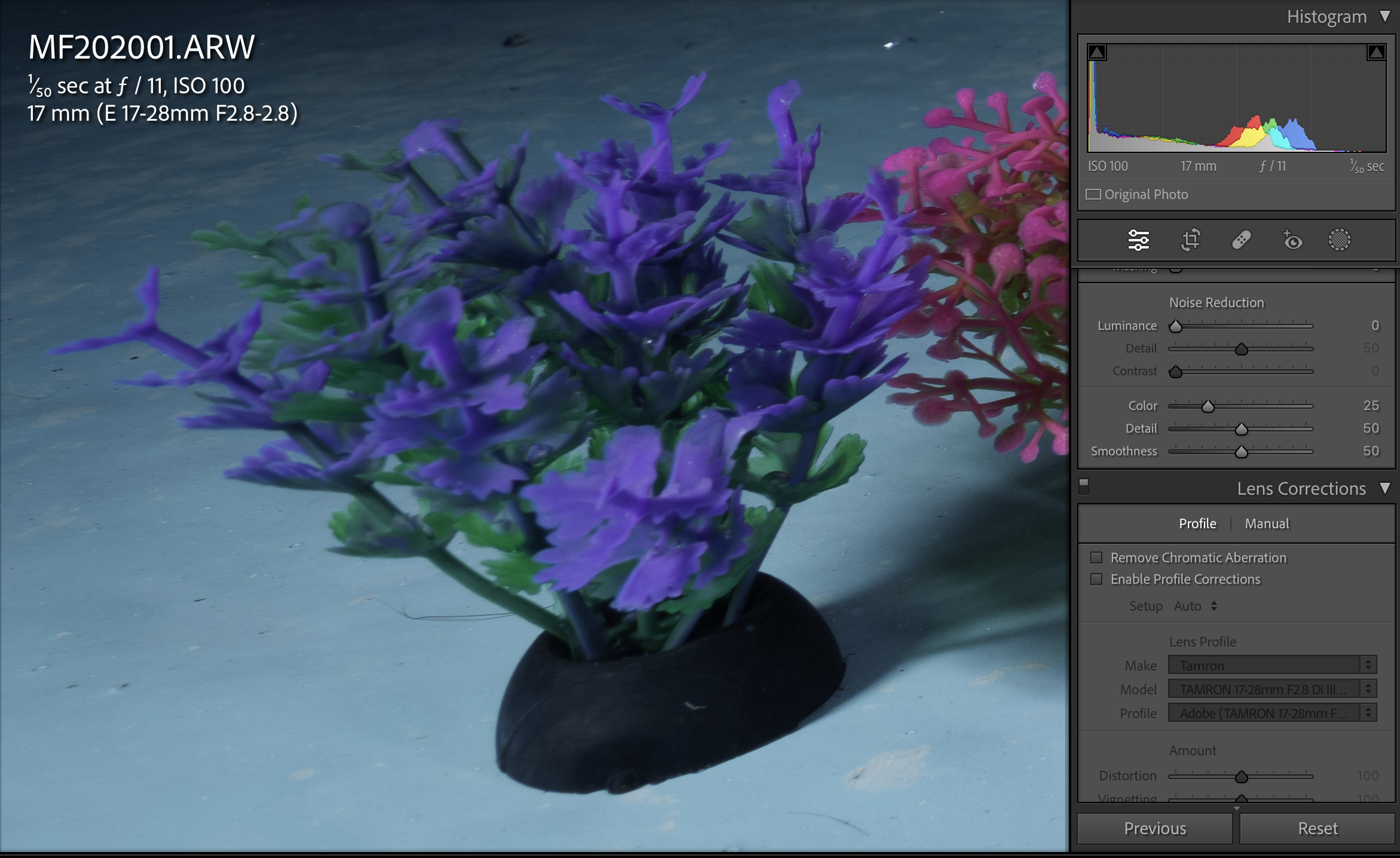
All the shots above have distortion correction deactivated.

I then went and shoot a tile wall to see how straight is the lens here lens correction is applied.

Tamron 17 5.6 Wall

At f/5.6 shooting from 1.8 meters performance is excellent.
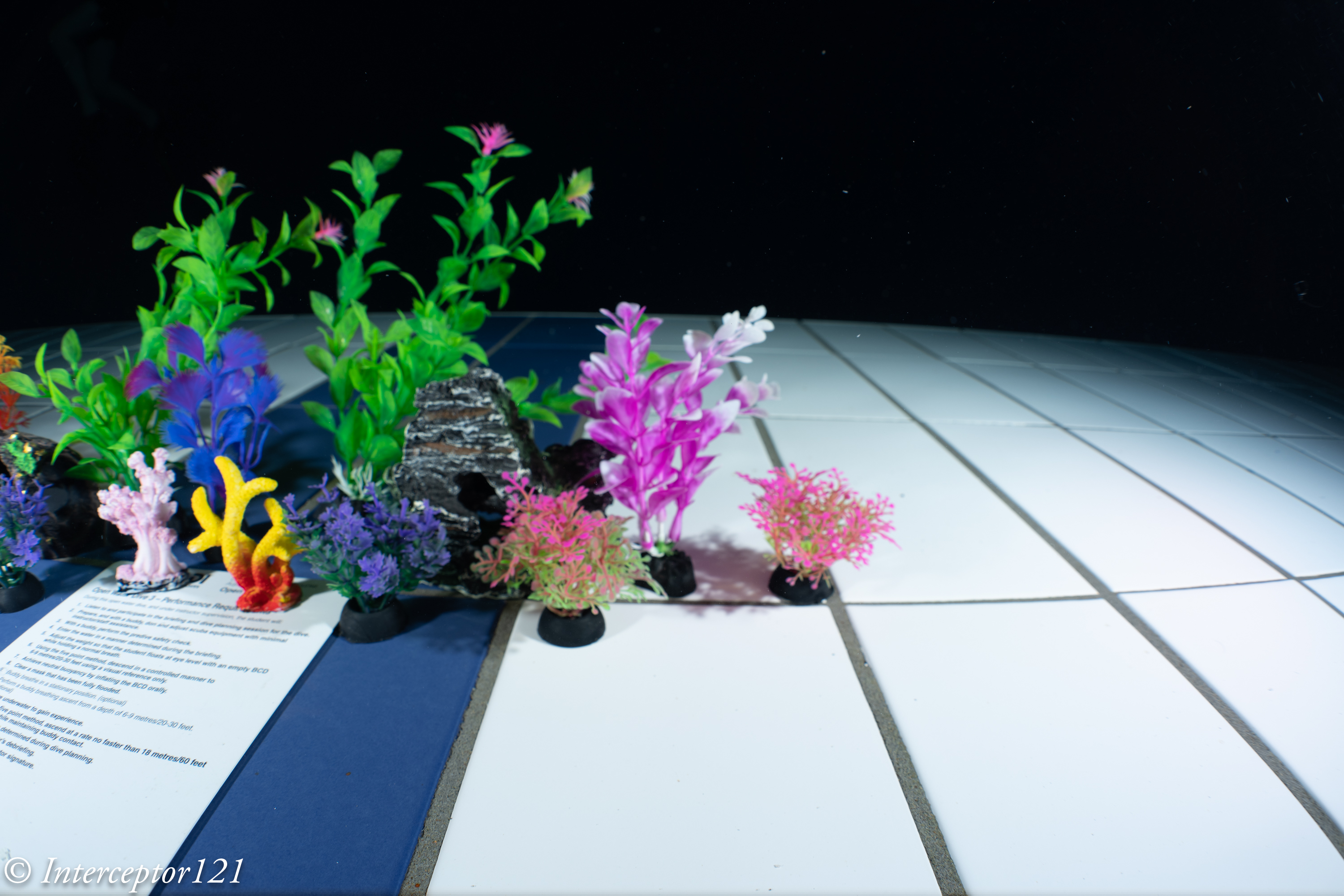
Tamron 17 8.0 Wall

f/8 is even better across the frame and is your default if depth if field is not essential.
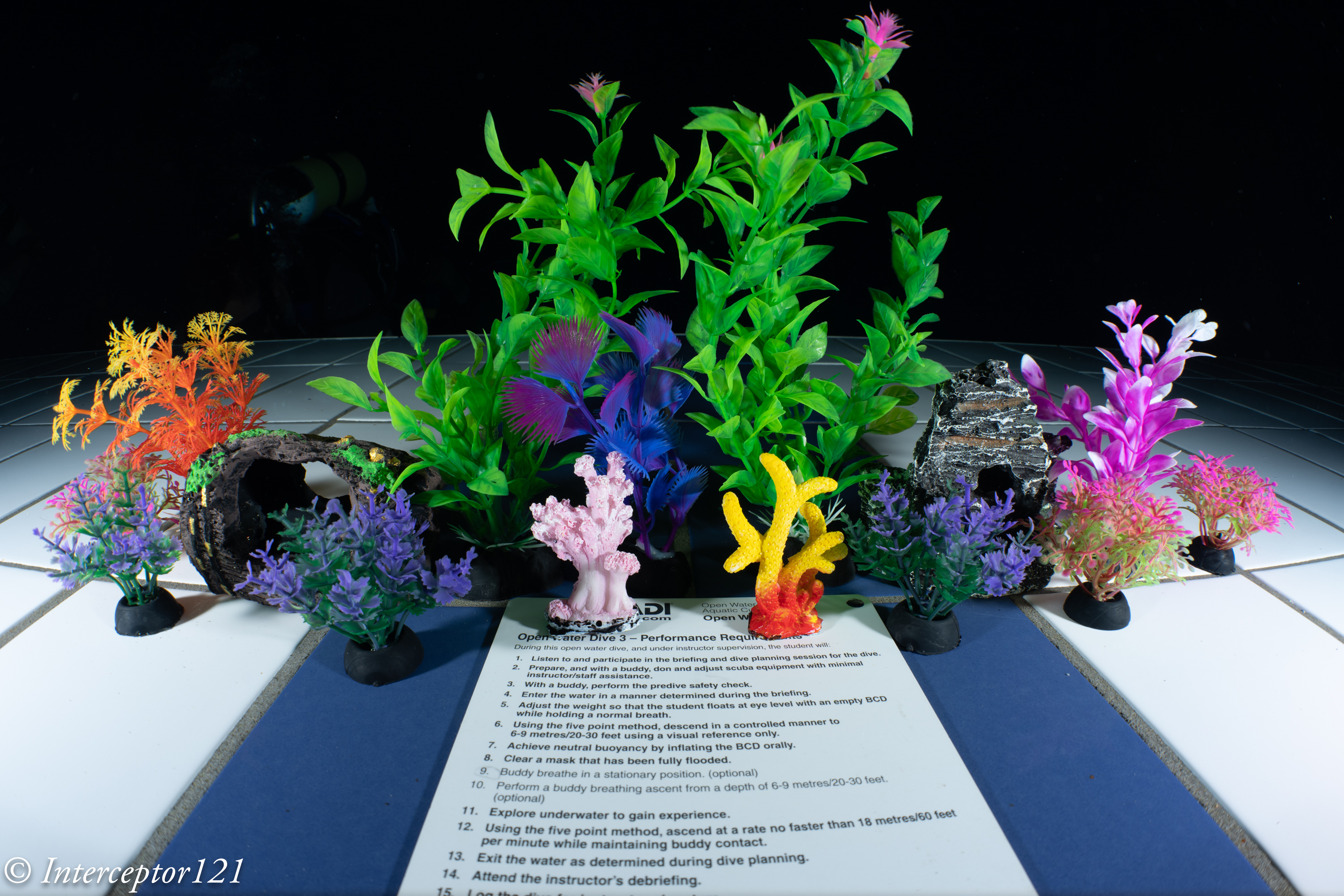
Tamron 18 11 Wall

f/11 is great

Tamron 17 16 Wall

f/16 and f/22 give consistent sharpness as expected again those apertures are normally not necessary.

Tamron 17 22 Wall

Shooting people with the Tamron

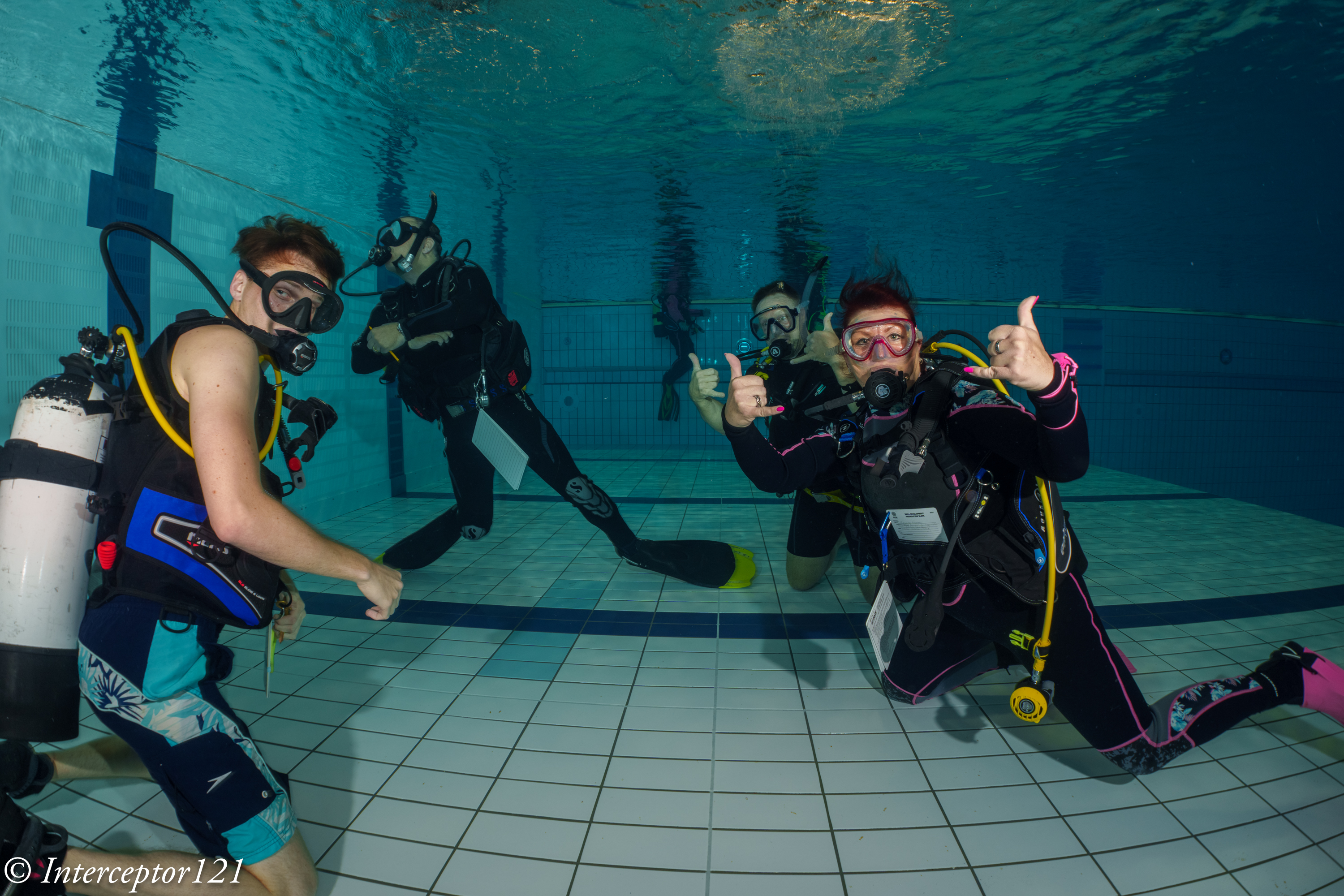
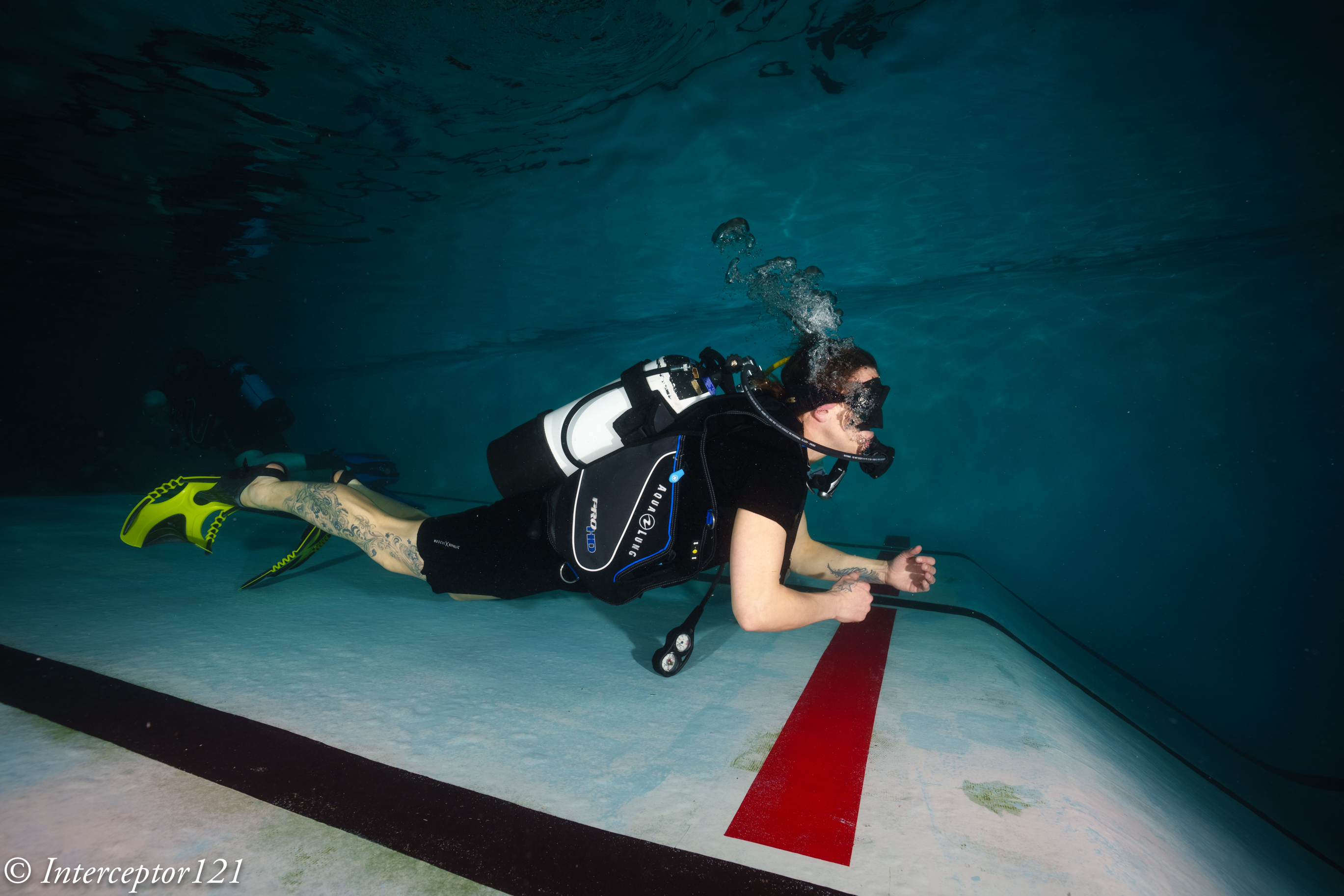
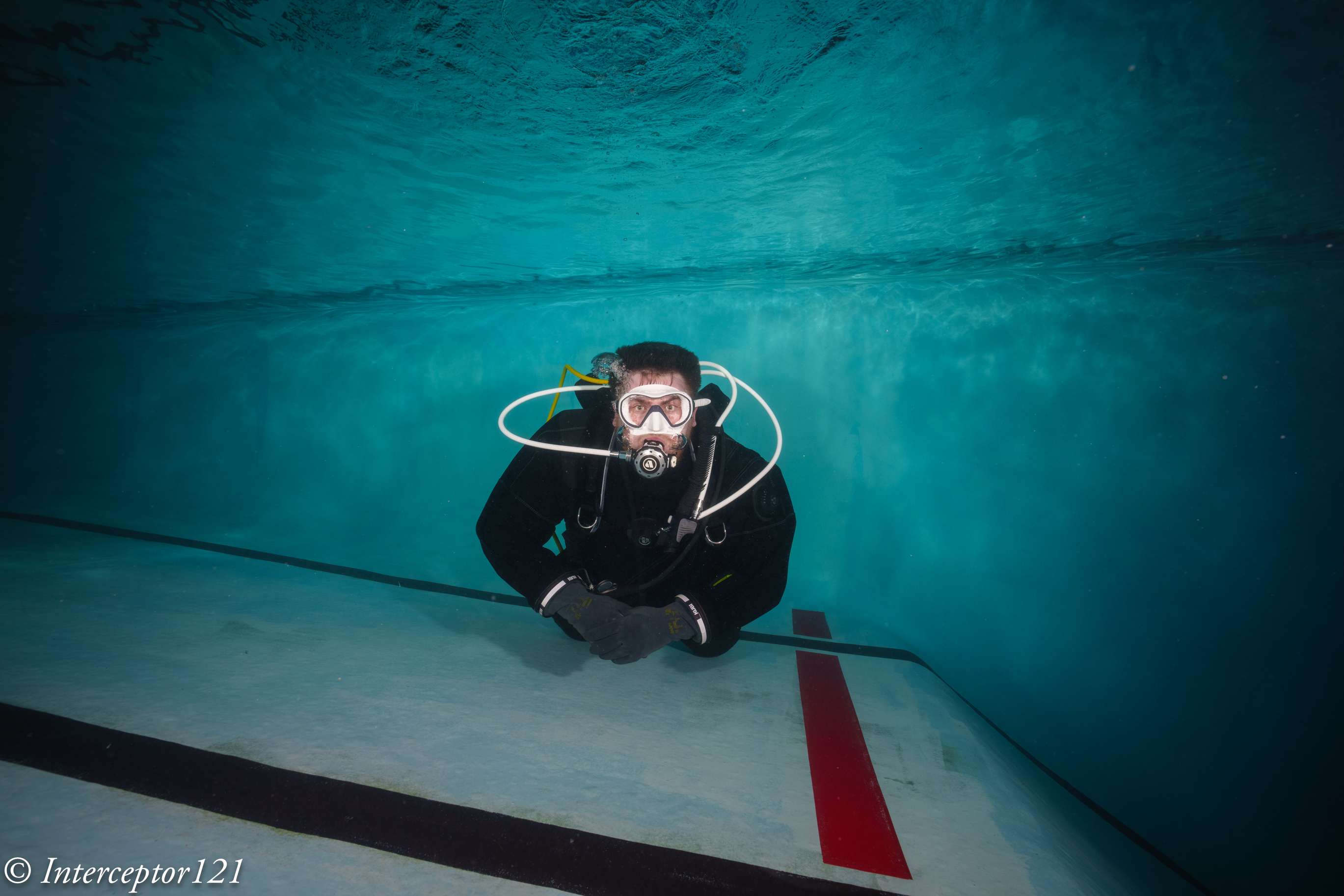
One of the things you do with a rectilinear lens is to shoot straight lines and correct proportion people and wreck interiors for example. The inside of the pool lends itself well to this.

Tamron 17 2 divers 8

With subject not close the lens has a great pop and rendering at f/8

Tamron 17 side 8

Even closer subject with not far background look great.

Tamron 17 diver 8

If you need the background to be sharper you can stop down.

Ascent 11

Again considering that even WWL-1 and WACPs really need f/11 this looks terrific.

Knee down 14

A final example shows that f/14 is enough to give you the depth of field you need when the subject is not too close.

Conclusion

There is no doubt that if you are in the market for a rectilinear wide angle and you are budget conscious this is the lens to get full stop!

Sony 28mm Prime vs 28-60mm Zoom with the Nauticam WWL-1

The Sony A7R2 was released in 2015 some time later Nauticam released the WWL-1 and I was told this wet lens would work with a Sony full frame using a 28mm prime.

Years later I own a Sony A1 and I have been considering the 28/2 prime as a complement to the Sony 28-60mm mostly to address sharpness issues at the edges.

There is no doubt that the 28-60mm is a great little travel lens and perfect companion of the A7C however performance at the edges is never quite right no matter how much you close down.

Build Comparison

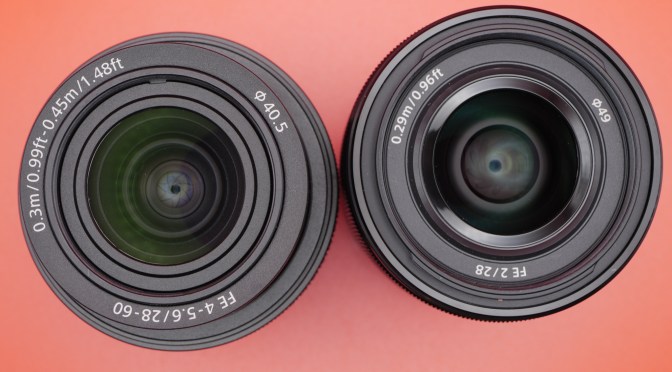
The 28mm prime is smaller than the 28-60mm when this one is extended but has a wider front element.
SEL2860 vs SEL28F20 Side

The side by side comparison shows that the 28mm is 9mm shorter when the zoom is at 28mm. The 28mm has a 49mm filter thread while the 28-60 has a 40.5. The 28mm is two stops faster than the 28-60mm but has a lot of vignetting.

DxoMark says the 28/2 will resolve 47 megapixels when coupled with the A7RIV 62 megapixel sensor.

The lens has quite a bit of distortion but not as much as the 28-60mm and also strong vignetting.

Sony FE 2/28 Mounted Front

On the A1 the lens looks small and well proportionate to the camera body. Not sure if I will ever use a 28mm prime but I got my copy from Wex photography using a discount code and it was open box.

Sony FE 2/28 Mounted Side

Port Required

The lens will vignette with the Nauticam flat port 45 and it requires the purposely designed flat port 32. This was released after the new generation of Sony housing as replacement of the flat port 37 used on earlier models.

Nauticam N100 Flat Port 32

Not much to say the port is obviously shorter and does not focus a knob.

Flat Port 45 vs 32 Perspective
Flat Port 45 vs 32 Side

Topside Comparison

Before taking the camera in water I wanted to make sure the lens was sharper than the 28-60mm and it is.

My assessment topside is that the lens is best at f/5.6 and the 28-60 never really matches it. At f/11 the resolution drops and the two lenses become comparable however there is no benefit shooting the 28mm at smaller apertures than f/8.

Sony SEL28F20 topside f/5.6
SEL2860 Topside F5/6

You can open the images in a new tab I spare the crop comparisons the 28-60 edges are blurry at f/5.6.

SEL28F20 Topside F8
SEL2860 Topside F8

By f/8 there is an improvement at the edges but the centre drops on the 28mm. Likewise on the 28-60mm where the edges become acceptable.

SEL28F20 Topside F11
SEL2860 Topside F11

At f/11 the lenses are almost identical. This is an important consideration as underwater this means shooting from f/11 and smaller aperture will not show substantial differences between the two lenses with the WWL-1.

Pool Tests

I set up my camera and went to Inspire Luton for a shooting session.

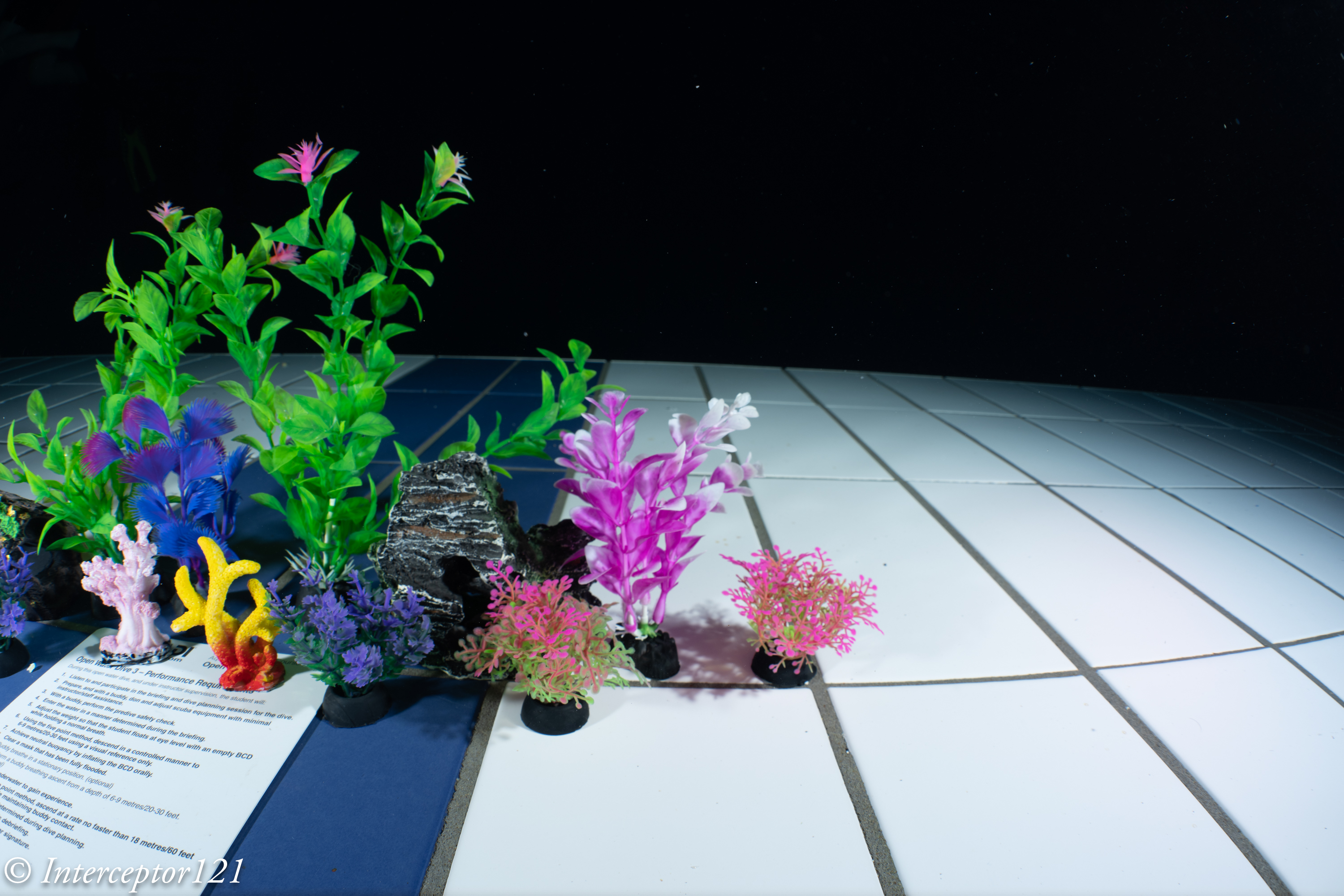
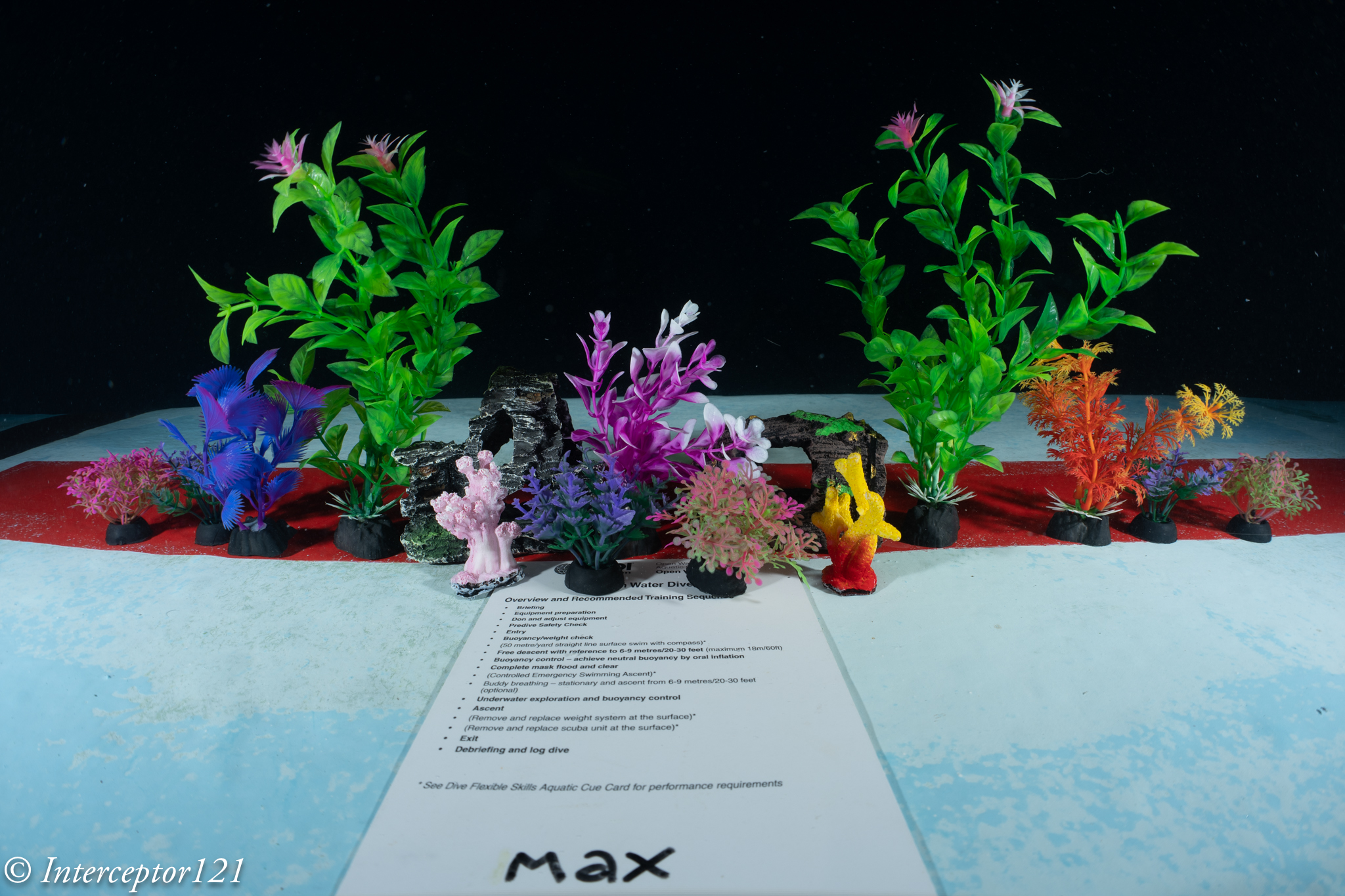
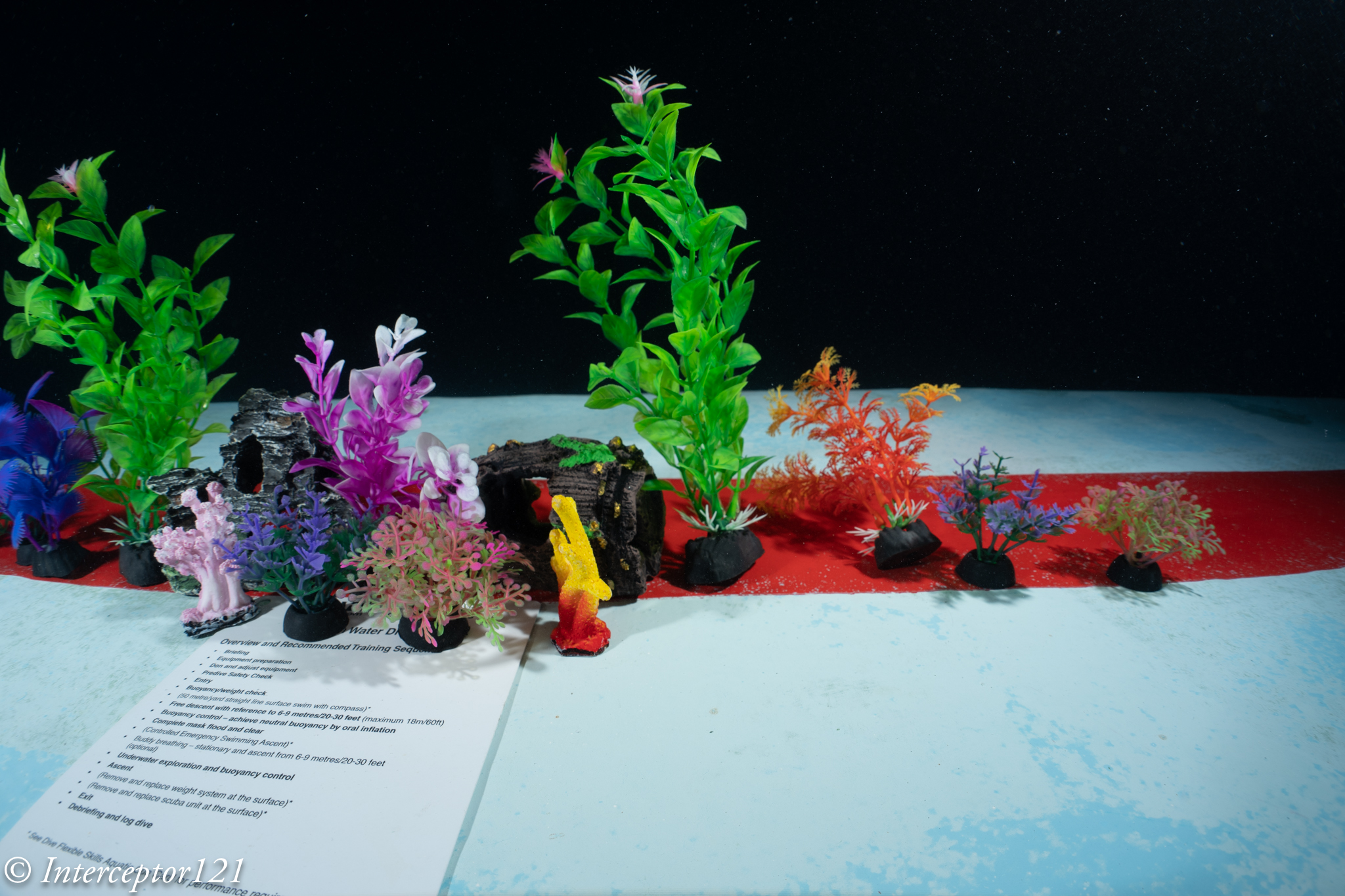
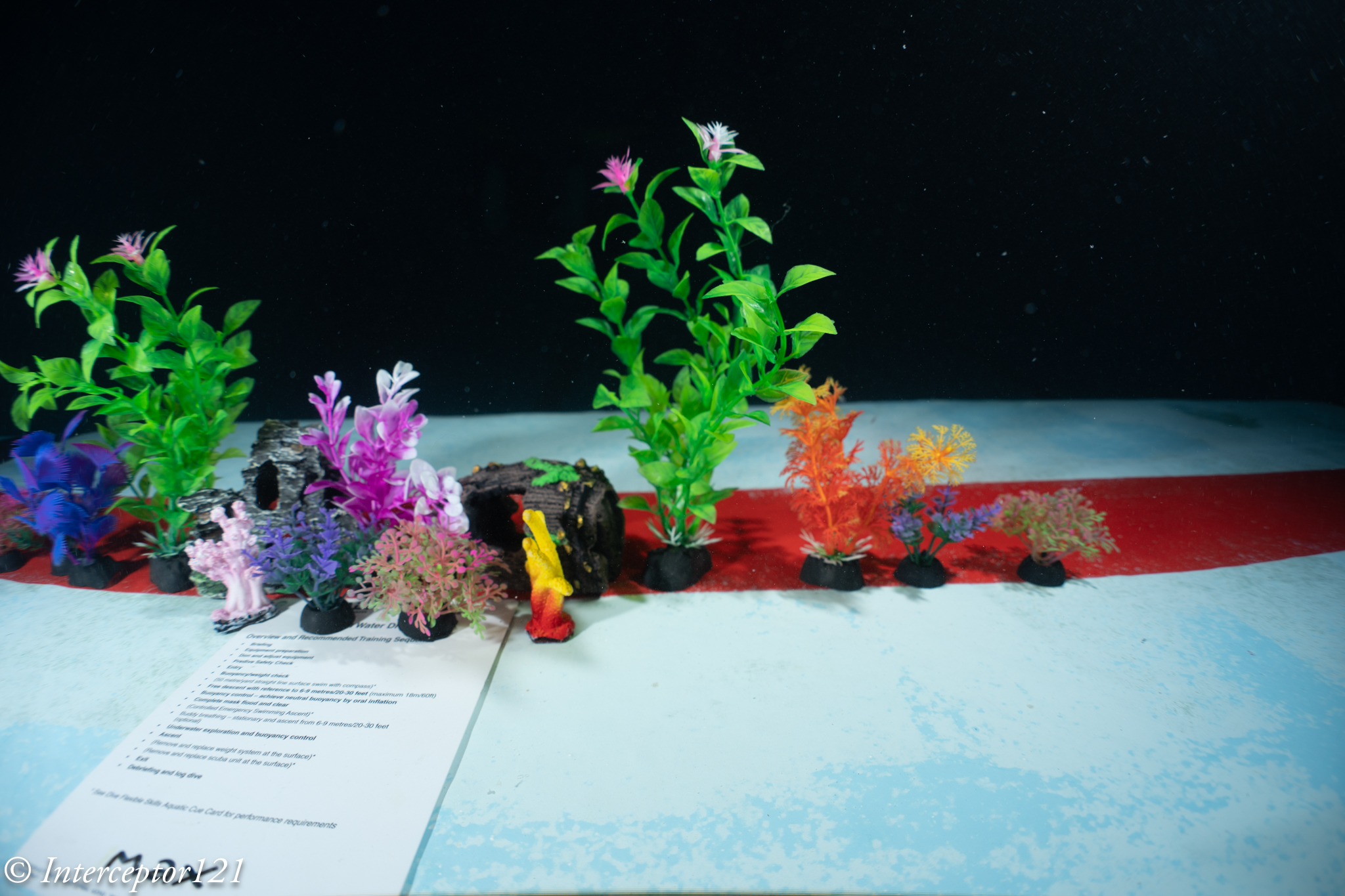
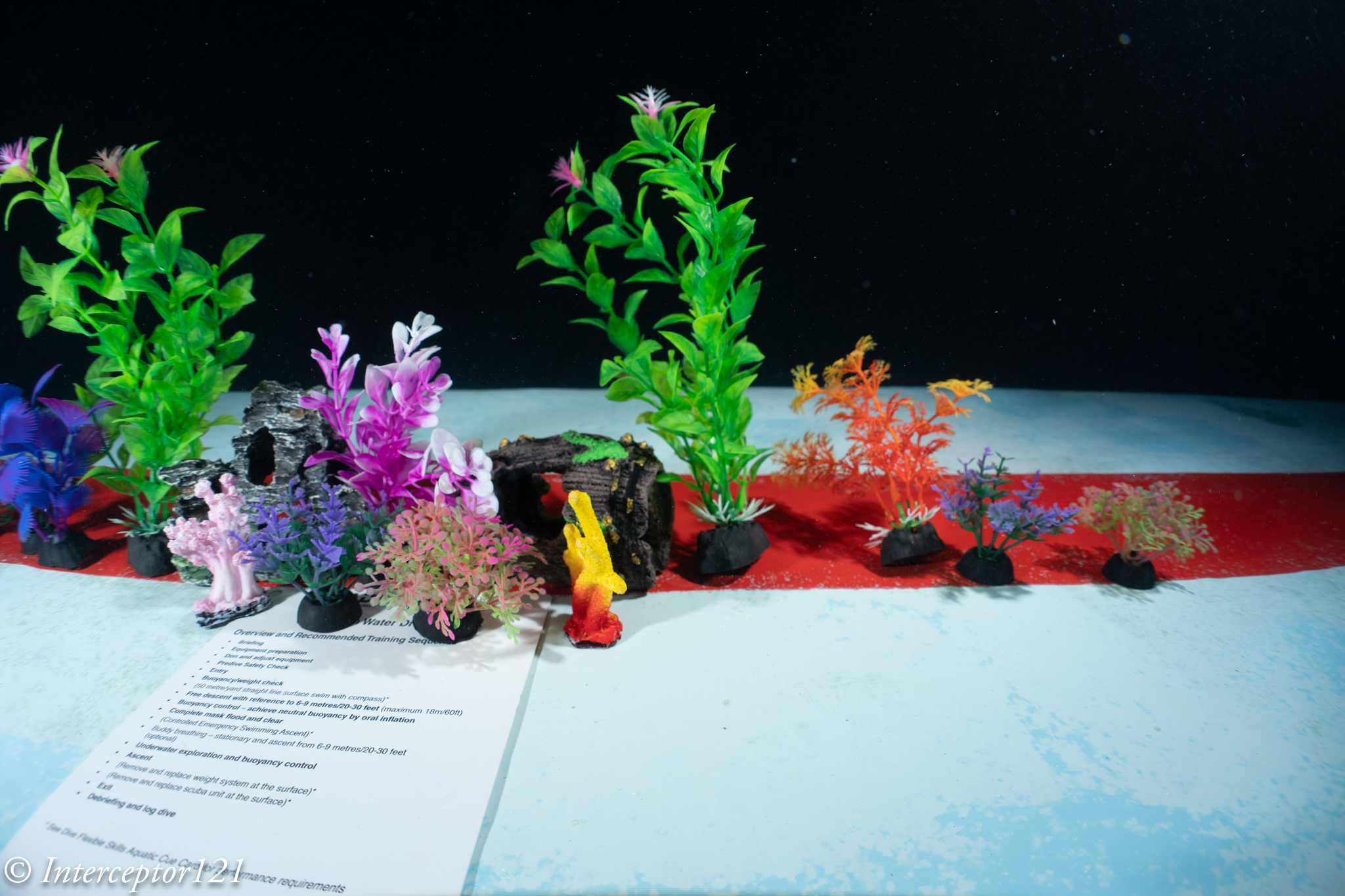
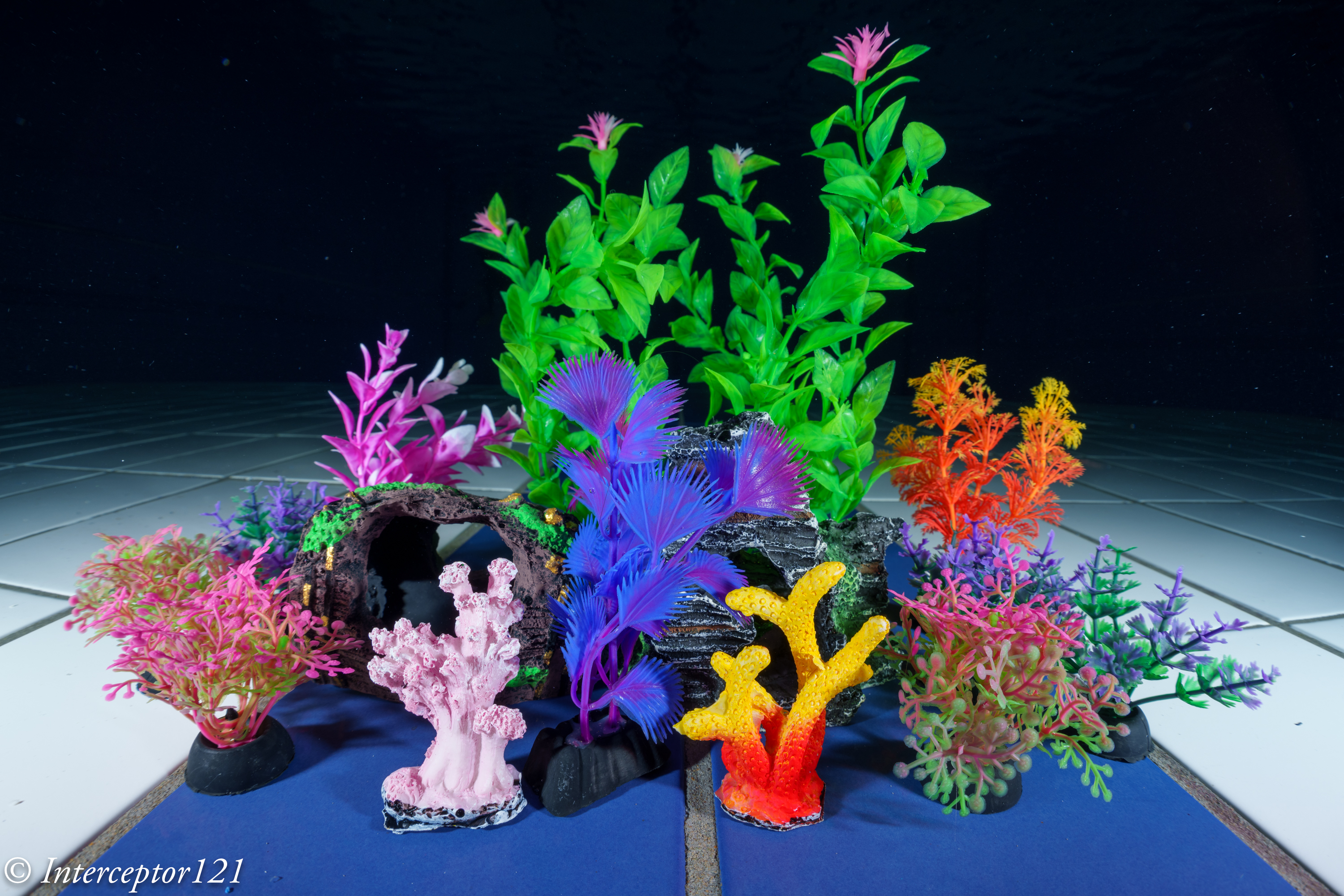
First I set up the small test reef and took images at various apertures.

I disabled distortion correction so there is a little black bar on the bottom when you are at extreme close range.

SEL28F20 F5.6 Front

The image at f/5.6 shows that on the focus line (the pink coral is the target) everything is good quality as you move to the edges but you can see the depth of field running out as you get closer. Do not confuse this with the lens edge performance as many testers do.

SEL28F20 F5.6 Edge

The focus point is on the line Achieve Neutral Buoyancy. You can see that the WWL-1 deteriorates the image quality especially on the meridional lines compared to topside. However this is overall useable in my opinion compared to the 28-60mm.

SEL28F20 F8 Front

Closing to f/8 achieves overall the best centre performance.

SEL28F20 F8 Edge

Edges are more than adequate I would say f/8 is the sweet spot of this lens for shots that are not too close.

At f/11 the WWL-1 in its best performance at the edges but the lens has lost a bit of punch.

SEL28F20 F11 Front
SEL28F20 F11 Edge

Here is a shot at f/16 just to demonstrate the issue of depth of field is unrelated to the lens aberrations.

SEL28F20 F16 Front

Personally I would not use this lens for close up work but if you have to f/16 is the way to go.

For reference this is the 28-60mm at f/11 which is totally usable, the shots are not as close so less demand on the lens.

SEL2860 F11 Front
SEL2860 F11 Edge

Shooting a target further away demonstrates the ability of the 28mm at wider apertures.

Tile Wall SEL20F20 F5.6

Edges are fine at f/5.6 but this is a flat target.

Tile Wall SEL20F20 F8.0

In conclusion my recommendation for the 28mm is to shoot the lens at f/8 and go to f/5.6 when there is nothing in the edges as necessary to improve centre sharpness. This is an improvement of 1 stop over the 28-60mm. It is not possible to use the lens at f/4 with the WWL-1 the performance is just not there.

Divers Example

The lens has a good contrast and pop.

Fly SEL28F20 F8
Gauge SEL20F20 f8
Octo2 SEL28F20 F8
Sharing SEL28F20 F8

Shots at f/5.6 are softer at the extreme edges and depth of field also plays a role.

Knee down SEL28F20 F5.6

Midwater shots do not display significant issues as expected.

SEL28F20 f5.6 Diver Side

Open Water Shots

I used this lens in Sorrento during my last trip shooting it always at f/8 which was a mistake for close up shots where I should have closed down the aperture.

The shots that follow would have been better suited to a fisheye.

Gattuccio Egg
Vedetta
In salita

At close range I did not close down to f/16 so the lack of depth of field is evident. Do not confuse this with edge performance.
Spugne
Cucu

You can see that as the focus is on the grouper the reef coming outwards is blurred due to lack of depth of field.

This is very apparent on this shot.
Cernia in crociera

I have the impression that those water contact optics work better when focussed closer in the frame not on the target as if the depth of field is mostly behind the focus point.

Wrap Up

The Sony 28/2 costs £339 currently and the flat port another £369 for a total of £708 for the set up.

I have not tested the lens with the WACP-C but I think performance will be worse as the mount has a lot of gap until the back of the lens is reached and this creates other side effect.

I believe that the 28mm prime is not something that you require for a 24 and even 32 megapixel camera. Users of the A1 or A7R series that want the absolute best quality and the ability to shoot one stop more open will look into this lens but the majority of shooters will stay with the 28-60mm as their only lens. For video users I think the 28/2 lens is a non starter and I am not planning to use it at all as in 16:9 the extreme edges are cropped and even the 28-60mm is fine.

Nauticam WACP-C vs WWL-1

I am conscious that a post like this is destined to create some stir, however it reflects over one month of testing of the two Nauticam water contact optics with my A1 and summarizes my conclusion for my own use.

Of course if you are reading this you may agree with what you will read and this will be your conclusion too. Or otherwise you would have bought the WACP-C thinking it was an upgrade for your Sony Alpha and well if it turns out it is not you will think it is anyway.

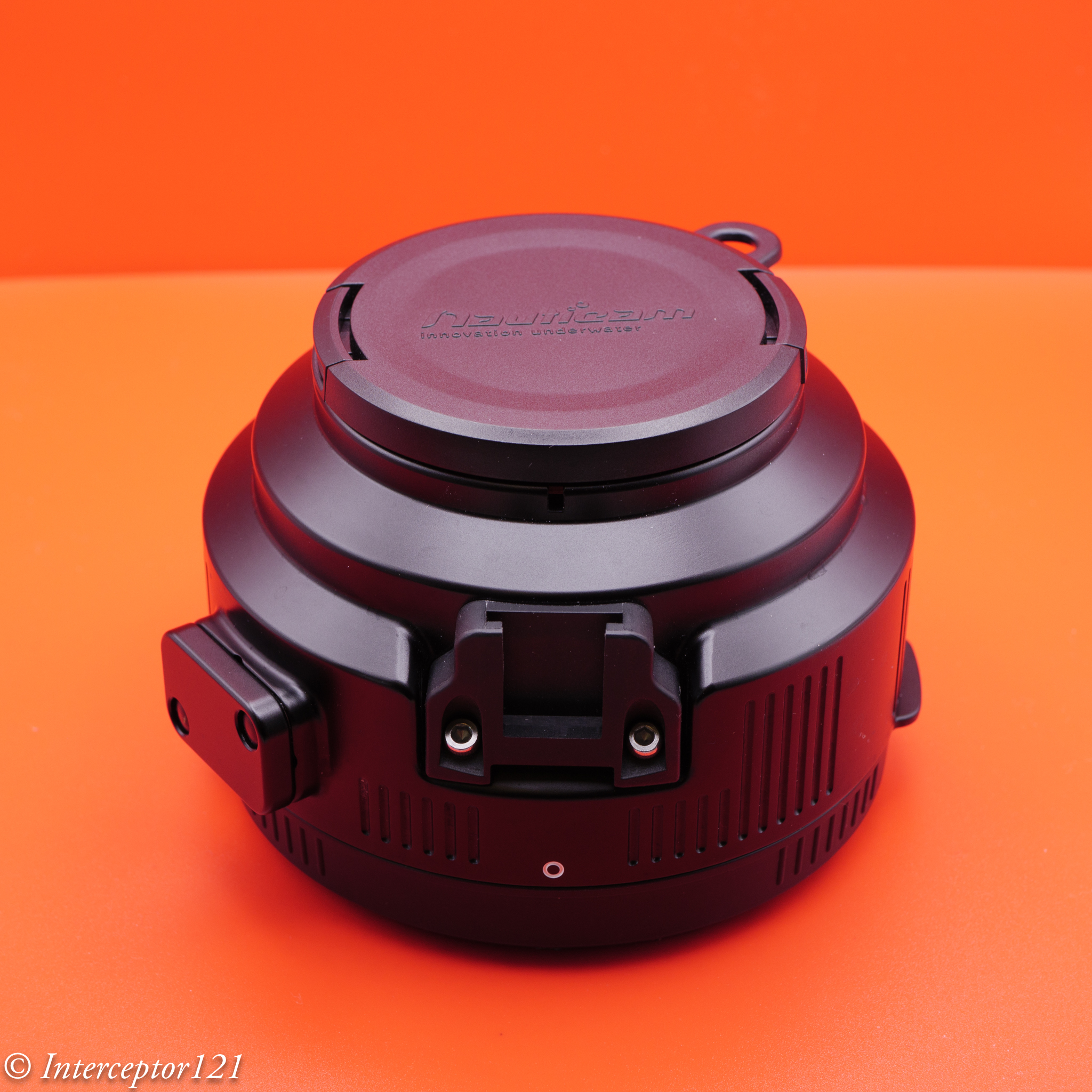
I was fortunate to be able to borrow the WWL-1 DRY from Alex Mustard. This lens is the prototype of the current Nauticam WACP-C. The lens has remained pretty much the same but it now has an integrated fixed float collar and built in extension. Other than a thickening of the rear lens mount ring it looks identical and therefore I assume optical performance is the same.

Someone will say well but it is not the same, but as we know the construction of the WWL-1, WACP-C and WACP-1 is identical and each model is 1.15 bigger than the previous with the optical design made of 6 lenses in 5 groups for all of them.

I have not had the chance to test the WACP-1, Alex said he would lend me that too however I am not interested in such large lens.

I have also had the opportunity to test the WACP-C with a variety of lenses including some not on the port chart like the Tamron 20-40 F2.8 and 17-28 F2.8 both did very well but nothing amazingly better than that little Sony 28-60 or the Sony 28mm prime and therefore I concluded that path is not worth pursuing.

Sony SEL2860 Lens Options

For the purpose of this article I will focus on the comparison with the Sony SEL2860 F4-5.6 28-60mm which is no doubt not an amazing lens but it happens to be pretty sharp from 35mm onwards. It is rather weak at 28mm at the edges so one of the things I wanted to check was if the larger WACP-C was giving an improvement over the smaller WWL-1.

Sony FE 4-5.6/28-60 Side

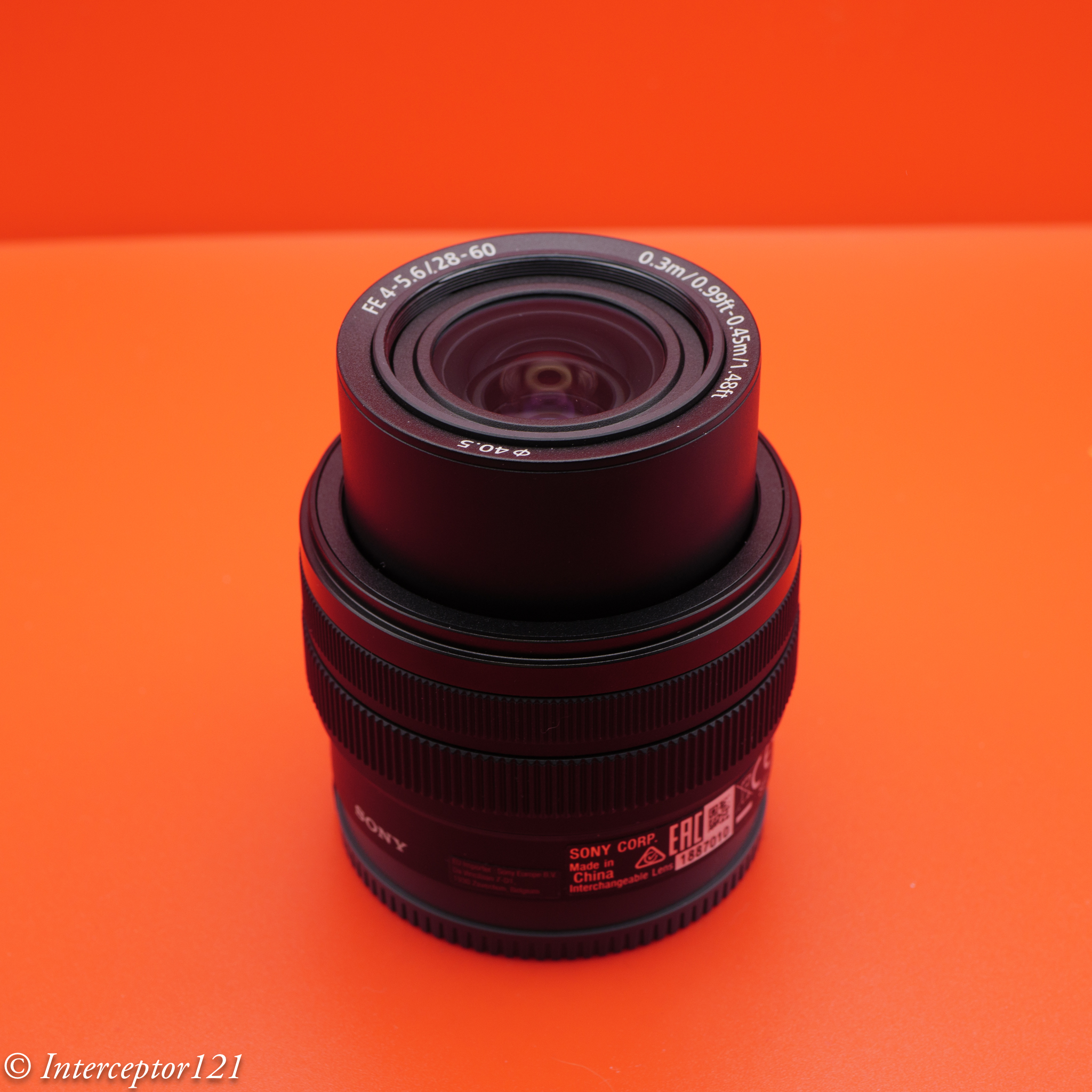
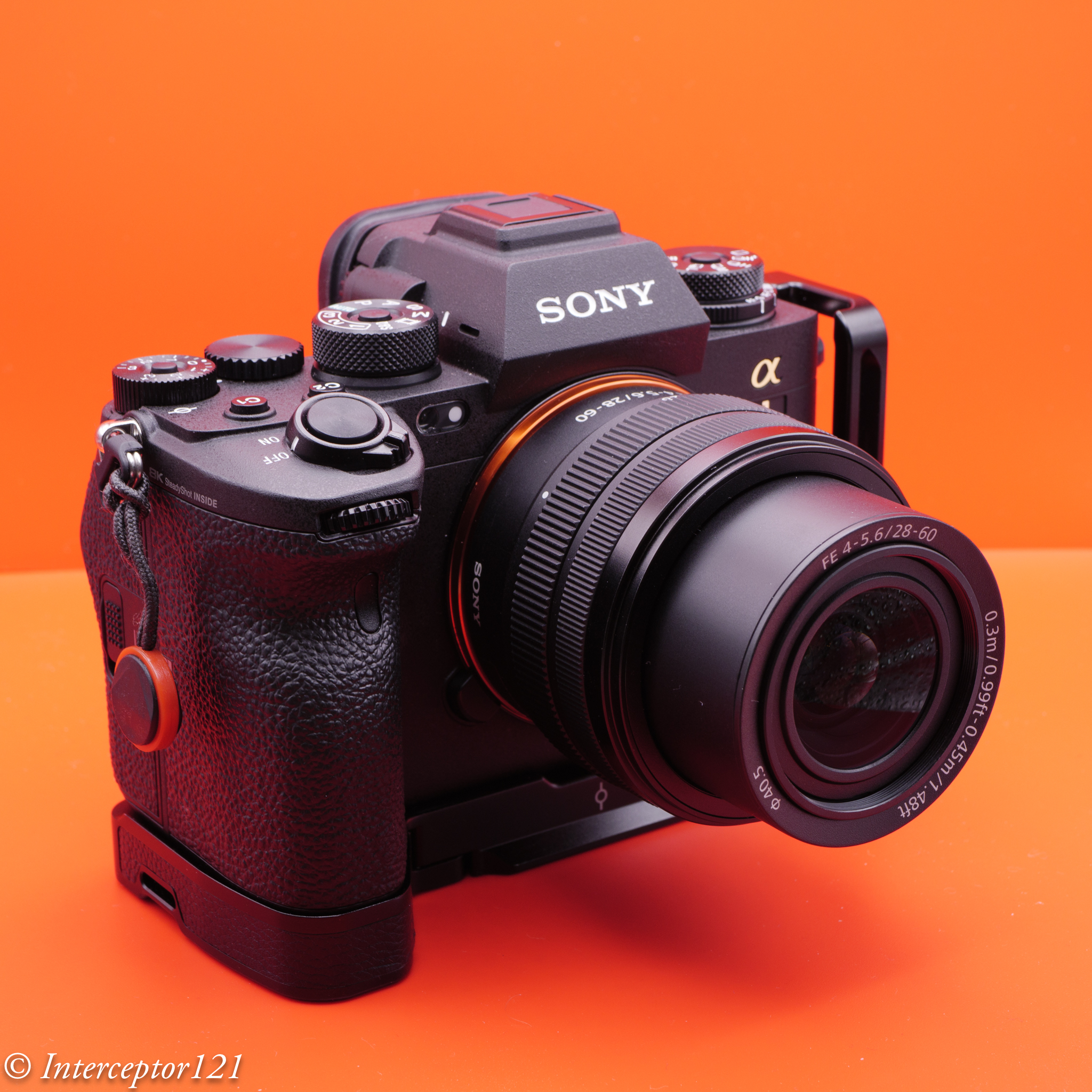
The Sony SEL28060 is a small lens that needs to be extended for use. When mounted on the A1 is pretty compact, no surprise as this is the kit lens for the A7C.

Sony SEL2860 Mounted Front

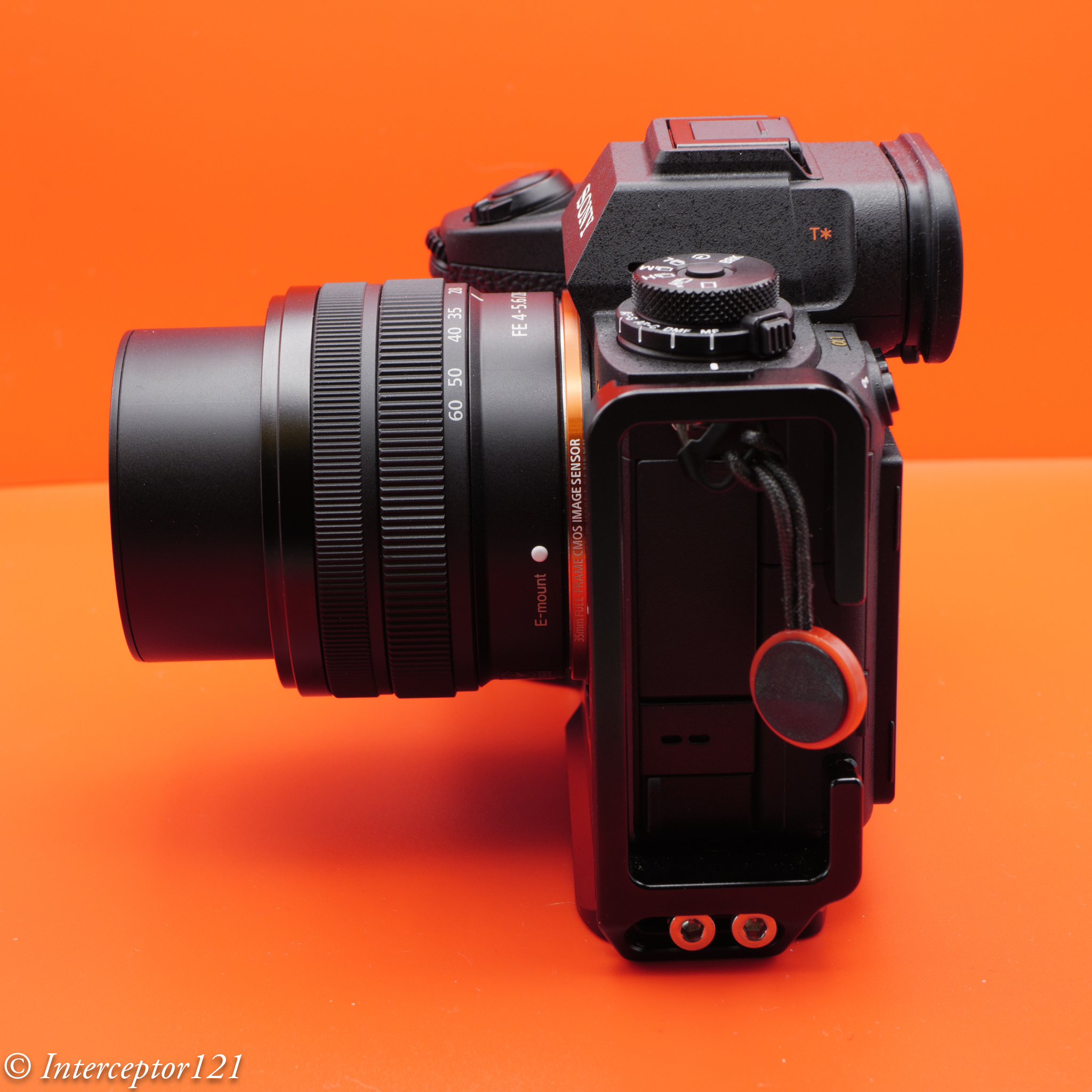
The lens is longest at 60mm but only 1mm shorter at 28mm which makes it ideal for use behind a wet lens.

Sony SEL2860 Mounted Side

To use it on the Sony E-Mount Full frame of new generation with the N100 port system you need the flat port 45 that comes with a rather unuseful knob that I have removed from mine.

Nauticam N100 Flat Port 45
Nauticam WWL-1 on Sony A1

The set up with the A1 is very compact and portable the whole housing, wet lens camera, strobes and arms together with camera and lens fit a carry on luggage on every airline of the world.

To use the WWL-DRY aka WACP-C I needed to use my 35.5 N120 to N100 adapter and a 25mm adapter ring. The production version only needs a 30mm N100 extension ring but will be as long as you see here.

WWL-1 DRY with float belt

There is a considerable difference in weight between the two set ups and the production WACP-C is heavier.

I own the original WWL-1 version with non integrated float collar which is lighter than the current WWL-1B.

Nauticam WWL-1

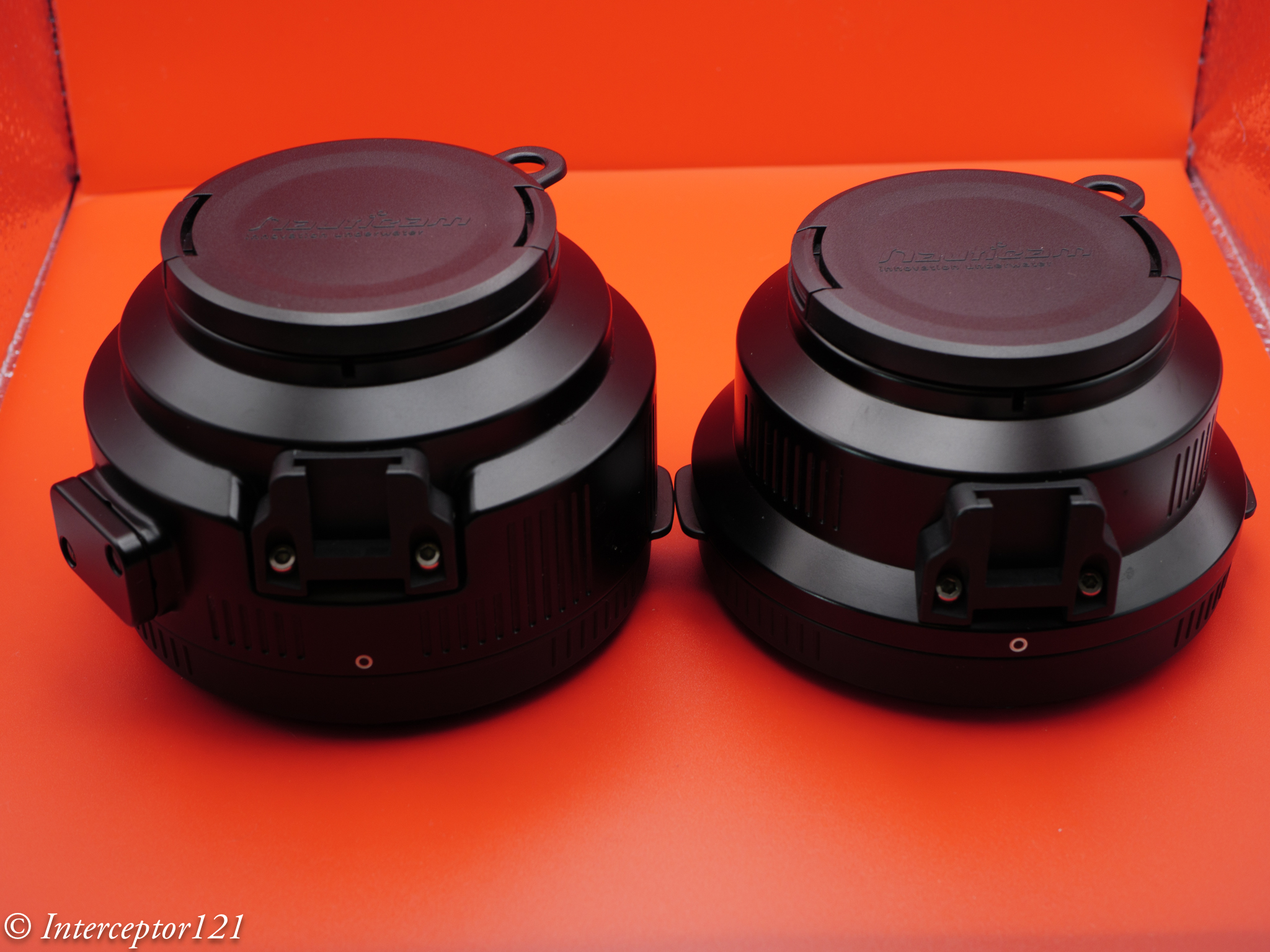
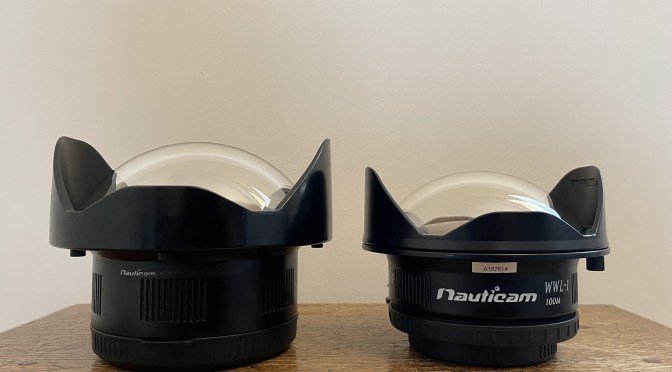
In the post title image you see both lenses without floatation.

Pool Tests

In order to perform a comparison I decided to use a semi scientific method consisting of a fixed scene and shots at very close range. The closest the subject is to the lens more stress is induced on the optics that are designed to focus far away. This means that if a lens is better than another at close range when you point them far way the gap will still be there but will reduce.

WACP-C

The first set of tests was performed with the WWL-1 DRY.

CFWA f/5.6 WACP-C 2860

I started at f/5.6 not f/4 that looked visually a waste of time. First I tried with the target on a line to see the potential effect of field of curvature and other issues.

At f/5.6 the sides are already blurry. The edges are even more fuzzy.

EDGE f/5.6 WACP-C 2860

The images are 6 megapixels feel free to open them in another tab and look for yourself.

Edge WACP-C f/5.6 2860

Moving to f/8 improves the situation but not as much as you would think.

CFWA f/8 WACP-C 2860

The edge remain soft at f/8.

Edge WACP-C f/8 2860
EDGE f/8 WACP-C 2860

From f/11 we have good performance across the frame using the SEL2860.

CFWA f/11 WACP-C 2860
Edge WACP-C f/11 2860
EDGE f/11 WACP-C 2860

Note that the focus point is on the edge and this means the issue if solely due to the water contact optic is not a problem of depth of field or field of curvature.

I proceeded to shoot at f/11 and f/8 avoiding f/5.6.

Look here
Maddy tells them off

Shooting at f/8 is possible if there is nothing at the edges and the depth of field is sufficient.

Maddy side

WWL-1

The test with the WWL-1 brought practically identical results.

Sides are soft at f5/6 and the slate shows obvious issues of depth of field.

SEL2860 F/5.6 Front
SEL2860 F5.6 Edge

Edges are very similar to the WWL-1 DRY perhaps a bit better.

At f/8 the situation improves as it had happened with the WACP-C.

SEL2860 F/8 Front
SEL2860 F8 Edge

From F/11 image quality is consistent across the frame.

SEL2860 F11 Front
SEL2860 F11 Edge

There is an obvious issue of depth of field so if you are shooting at close range with the 28-60mm you really need to look at f/16 but this was not the point of the tests.

f/11 side shot
David f/8
Diver f/10

Wrap Up

As you can see by yourself there is really nothing between the two optics and clearly the difference between the wet and dry version is simply in the ergonomics and of course the price. For me there is no reason to consider the WACP-C unless you have serious issues with a wet mount.

After all those tests I decided not to take the WACP-C to Italy and used the WWL-1 for both photos and video with good results.

Puolo -40

This shot is taken at 40 meters with the 28-60mm at f/11.

I pretty much used f/11 fixed changing other parameters for the exposure and at time using the zoom.

Andrea

This is not the red sea it is much darker and as you can see dry suit were in use.

Bavosa Ravvicinata

The zoom of the 28-60 has some clear benefits.

Conclusion

The WWL-1 needs the bayonet mount and the flat port 45 to operate with the WWL-1. This comes at cost of $2,119.

The WACP-C needs the N100 extension ring 30 to operate. This comes at $3,426.

If you a Sony full frame E-mount user and have issue dealing with the bubble removal of a wet lens when you jump in the water you can spend $1,306 to avoid yourself the inconvenience. However you will not have any benefit in terms of optical quality and you will be carrying more weight.

For video the wet lens is clearly preferred as you can operate the 28060 with a flat port and wet lenses for close up work.

The WWL-1 remains the true Nauticam master piece and a lens that keeps delivering years after the introduction.

WACP Prototype Experiments

Few days ago Alex Mustard popped in to drop his WWL-DRY aka WACP-C prototype so that I could conduct some experiments for the enjoyment of the entire underwater community on Sony E-mount.

This lens is not the same of the current WACP-C but it is very similar. It does not have a float collar, a bit like the original WWL-1 dimensionally appears a few mm different from the WACP-C specs.

The lens seems a bit shorter.

140 mm length instead of 145 mm of current production version

The dome diameter is identical somewhere in the region of 130mm.

Dome port perspective masks the real diameter of 130mm

The lens is very heavy in water so I needed some floatation.

Stix float belt carved to fit a dome

I rented a Tamron 28-75mm G2 from lenspimp only to discover it would not fit any of my extensions. Alex Tattersal has sent me an adapter on loan but it did not make it for my pool session.

I therefore decided to use my Tamron 17-28mm although the extension was 5mm too long I got no vignetting at 26mm.

Ready to dive

I exchanged notes with Alex who told me he tried all sorts of optics with his Nikon only to use a 1990 lens now discotinued as all modern fast lenses would refuse to work properly. I was determined to try anyway confident I would get good results.

Pool Tests

Arrived in Luton for a short one hour session last night I took my usual props. The first set of tests show already some interesting results.

I always start as close I can get to the props to fill the frame.

CFWA f/5.6 T28

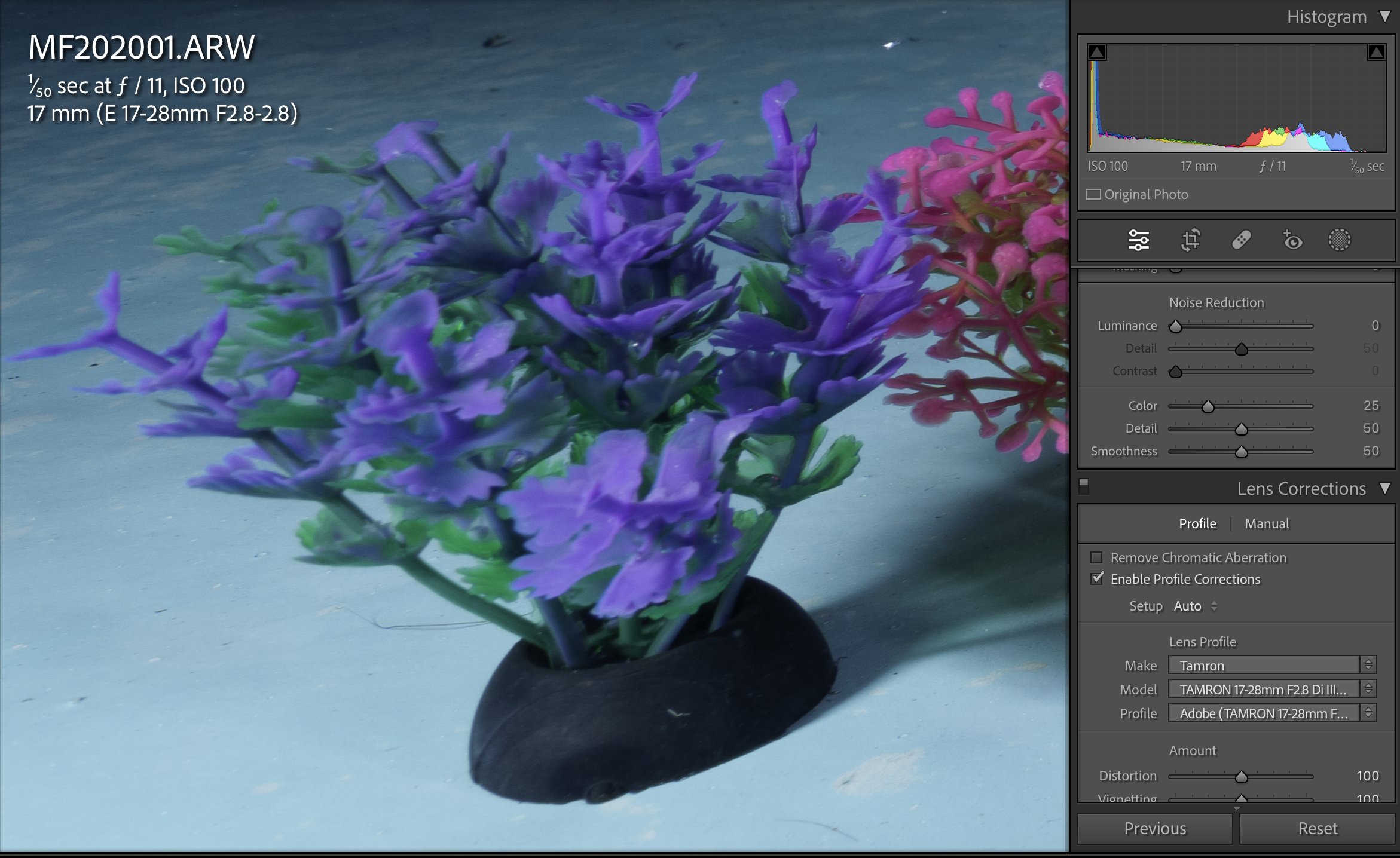
At f/5.6 the centre is very sharp however I noted the background and were not particularly crisp while the centre was but not in the background. There is an issue of depth of field so I started stopping down the lens.

CFWA f/8 T28

By f/8 results were already very good considering the shooting distance. Consider that a shot like tha requires f/16 on a fisheye or rectilinear to have sufficient depth of field.

By f/11 we are in a really good place.

CFWA f/11 T28

The depth of field is not quite enough for the plant in the back but the edges are sharp.

To show that this is a genuine depth of field issue look at this shot at 17mm in APSC.

17mm APSC f/5.6

It looks very much identical although this is even wider at 25.5mm equivament.

The second step is to look at edge sharpness the pool provides a nice tiled wall for this purpose. Here am shooting at around 1.5 meters.

You can see immediately that the frame is sharp throughout at f/5.6

wall f/5.6

Moving to f/8 improves edges

wall f/8

f/11 brings better edges but in my opinion not the best centre.

wall f/11

This reflects very much the nature of the master lens which is outstanding in the centre at f/5.6 with so so edges but very good on both accounts at f/8. F/11 starts showing an overall resolution loss.

I then moved to test field of curvature.

grid f/5.6

The lens has virtually no field of curvature and the edges are good already at f/5.6.

grid f/8

By f/8 the result is excellent.

grid f/11

At f/11 better edges but slightly worse centre.

Having completed the lab tests it was time to shoot some divers however I was coming to the end of the hour and they had started surfacing!

group f/5.6

Shots at distance with f/5.6 look great.

surface 3 f/5.6

Consider the shutter speed is low as I was trying to get some ambient light and the subject far so there is some motion blur.

surface f/5.6

f/8 is probably the sweet spot for underwater use.

Wide f/8 T28
group f/8

F/11 is really not needed unless you have a close up shot.

Self Potrait f/11 T28

Conclusion

There are some obvious strengths to the Tamron 17-28mm which in my view performs at 28mm way better than the Sony 28-60mm even with a too long extension.

Upon reflection I have decided not to invest on the Tamron 28-75mm as I already have thr Sony 24-70mm GM2 and there is an overlap topside.

Edit 8 April: I received today the adapter ring I needed for the 28-75mm G2 and unfortunately there is vignette at 28mm ruling this lens out entirely for the WACP-C.

If you want to use the Tamron 17-28mm with the WACP-C you need an N120 to N100 25mm adaptor ring, in addition to the zoom gear (not necessarily unless you want to shoot also APSC) and the 35.5mm N100 to N120 port adapter.

The Tamron 17-28mm costs $799 on Amazon.com and it is the best rectilinear wide angle for underwater for the e-mount and we now discovered also compatible with WACP-C.

I will try other lenses in due course but the lesson learnt is that if you do your homework you will find something.

Thanks to Alex for the loan and bear with me a little longer!

Wide Angle Rectilinear Lenses for Underwater Imaging myths vs reality

The subject of rectilinear wide angle lenses and underwater optical performance has been beaten to death.

Most recently some photographers and videographers have done without rectilinear lenses altogether citing the horrible performance at the edge of the frame as the primary reason to shoot lenses with barrel distortion being those fisheye or standard lenses with an added water contact optic.

Is it all justified? Should you stay away from rectilinear lenses altogether?

Of course not. Rectilinear lenses have a place in underwater imaging that is there to stay but…

There are many many buts so let’s dive into some demistification and general considerations.

Topside Performance of Wide angle lenses 17mm use case

The vast majority of underwater shooters do not perform any type of topside imaging being that photo or video and use their set up only underwater with the exception of the odd event or those that like to shoot macro above and below this is where we stand in most cases.

In order to ascertain if the performance of the wide angle lens in water deteriorates it is appropriate to determine the performance of said lens topside. This is something that not many people are in fact able to ascertain. You can read equipment review but it is never the same thing.

I have recently invested in a Sony A1 and underwater housing and I decided to purchase a rectilinear wide angle lens. I always try to buy lenses that are good topside and underwater and my choice has fallen on the Tamron 17-28mm F/2.8 Di III RXD.

Several reasons for buying this lens I will list the most important are:

  1. Close minimum focus distance (19 cm wide – 26 cm tele)
  2. Lens does not extend when zooming
  3. Reasonably compact (99 mm and 420 grams)
  4. Not too wide

Items 1,2 above are important underwater and 3,4 are also important topside when you use the lens on a gimbal or when you shoot interiors or close up and you do not want apparent perspective distortion.

I have been shooting the Tamron topside on trips and I have been very pleased with it. Before taking it underwater I wanted to understand what to expect.

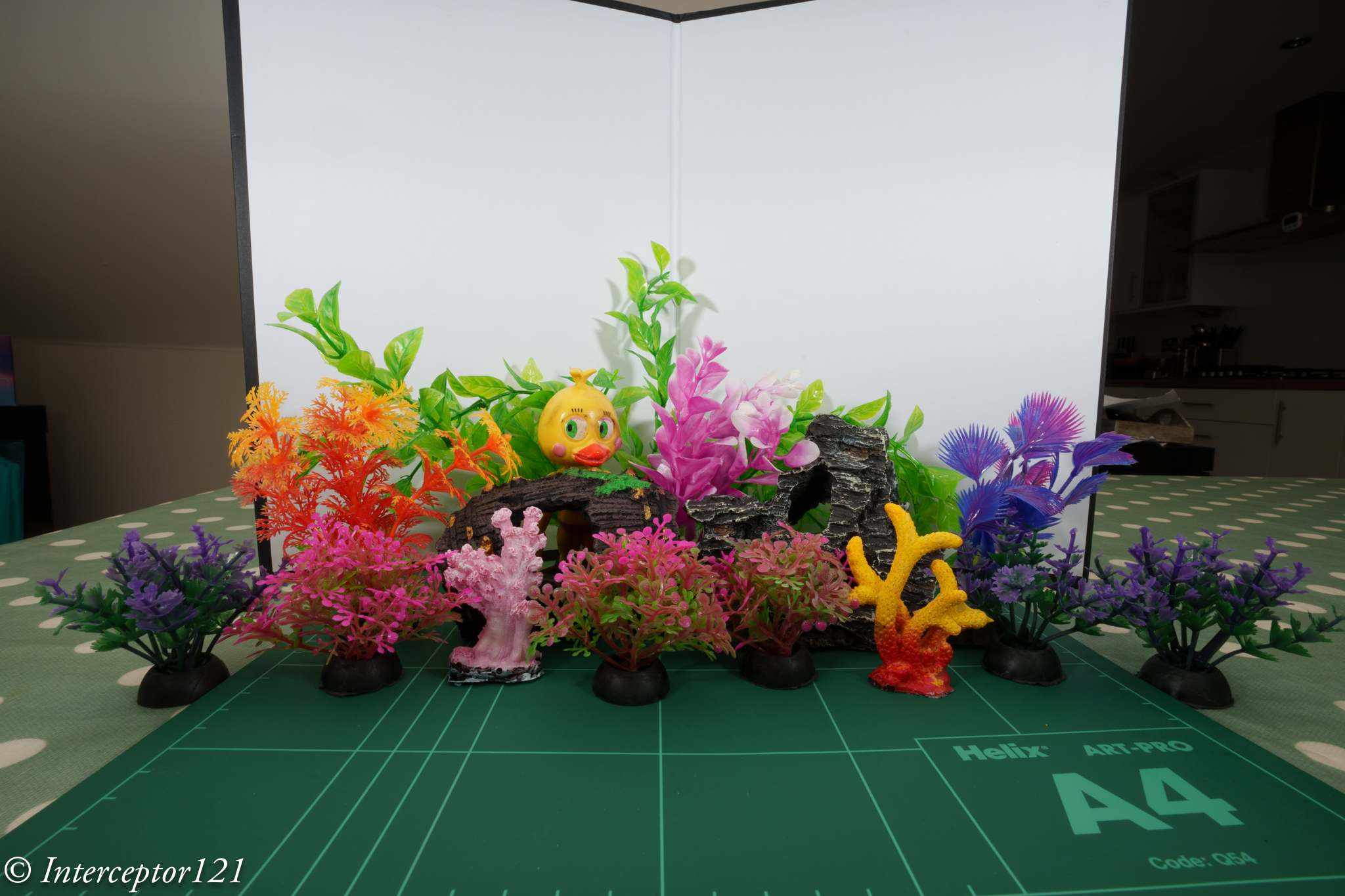
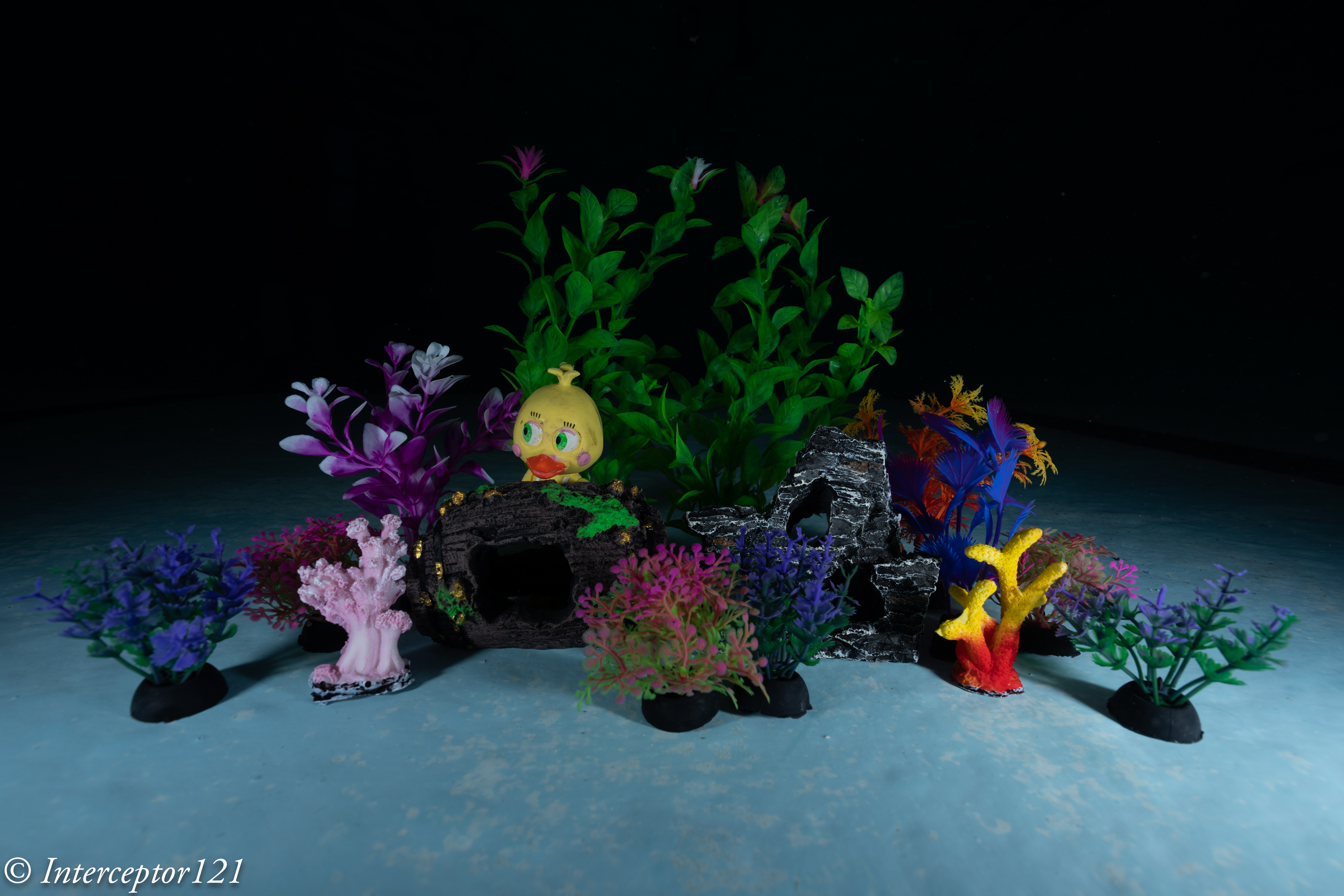
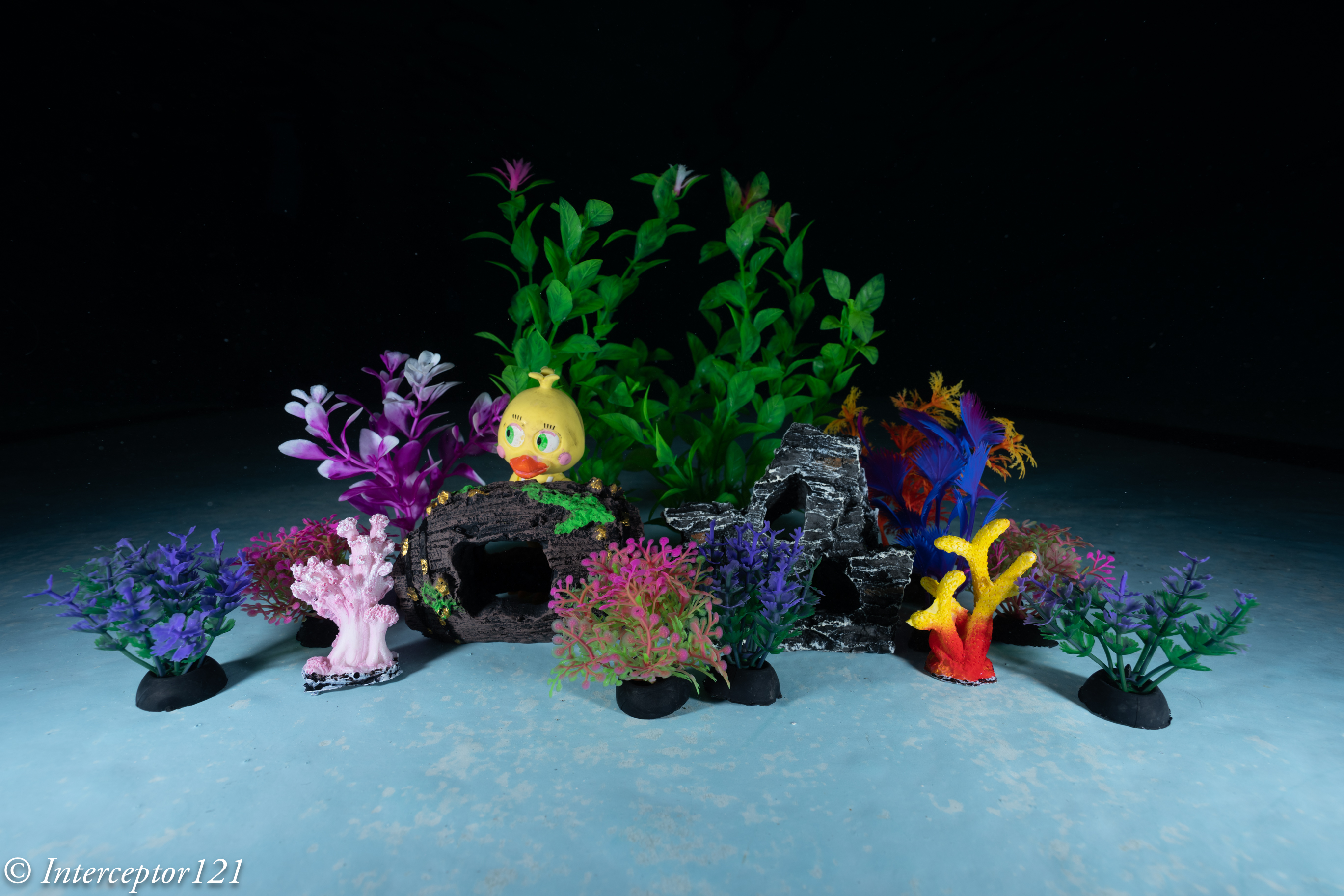
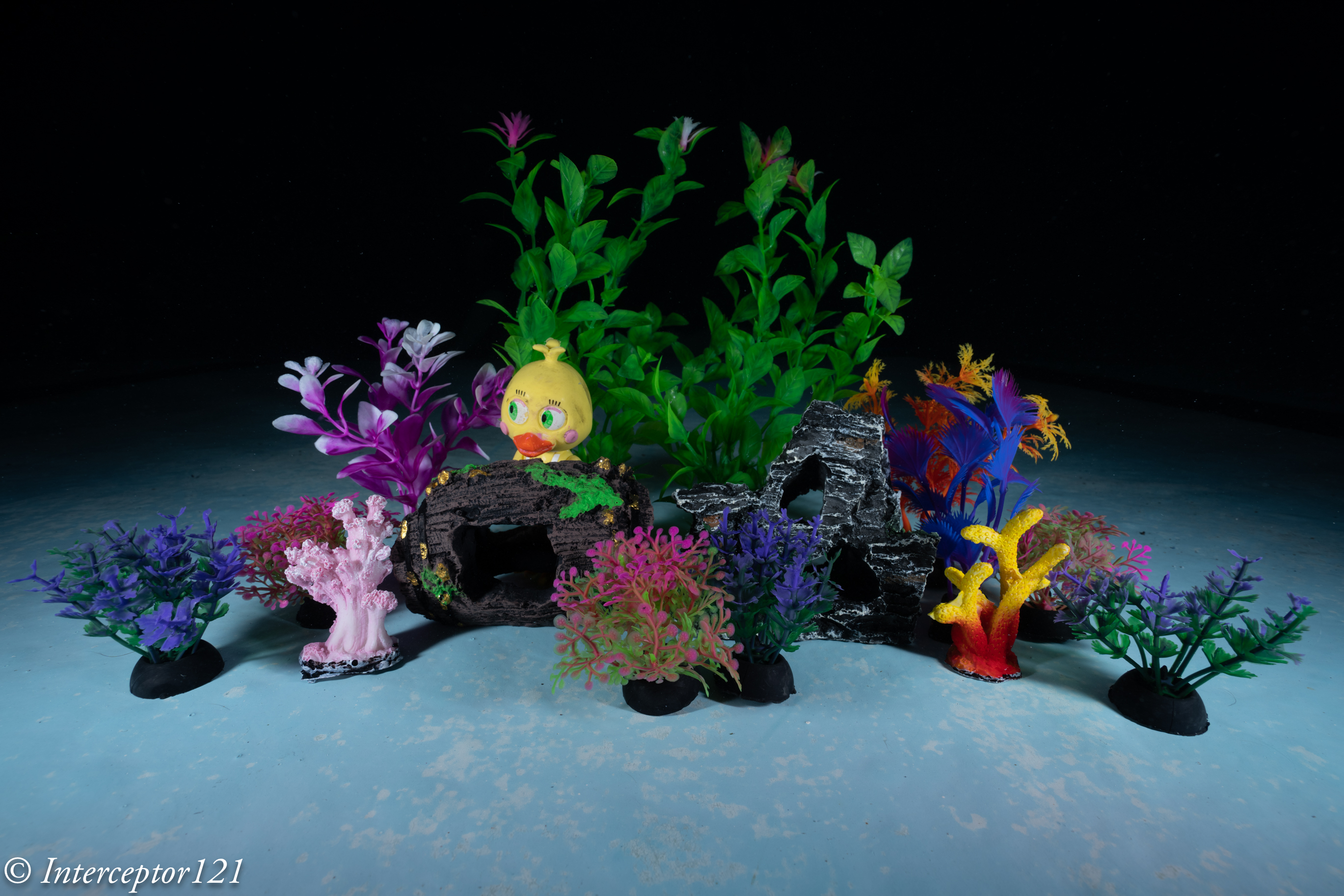
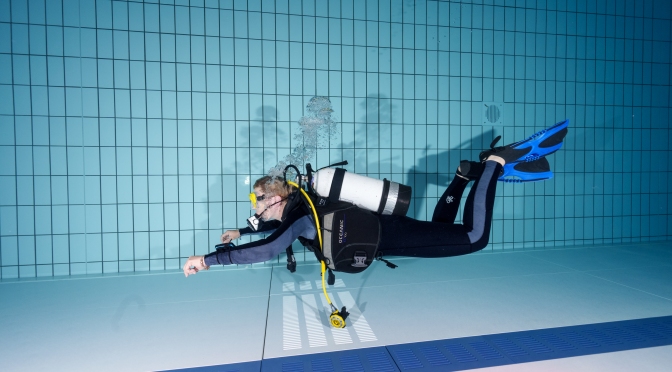
I built my scene using my underwater props on a table top and started taking a series of shots from f/8 to f/22 to see the results. What follows are a set of images taken on land with the focus on the eye of the chick.

Topside f/8 subject

At f/8 the first row of props is blurry and also the leaves behind are not sharp. The edges are soft.

This is due to lack of depth of field not to the bad performance of the lens.

Topside f/11 subject

At f/11 we have more depth of field however the props at the edges and the nearest part is still soft.

Topside f/16 subject

By f/16 all the props are in focus, the edges of the math are a tad soft but overall this is the right place to be.

Topside f/22 subject

By f/22 pretty much everything is in focus but the image quality has dropped considerably.

In conclusion topside we need to close down to f/16 to have all the props in focus on this scene.

Just so we are clear there is not an issue of edges or else there is simply lack of depth of field as we are shooting a close up.

Underwater Performance of Wide angle lenses 17mm use case

After rigging my camera and lens with the Nauticam 180mm dome it was time to hit the pool and try underwater.

What follows are a series of shots from f/8 to f/16 with focus on the chick as the topside shot.

Tamron 17mm f/8 Focus Mid

The image at f/8 looks very much like topside and lacks depth of field, however interestingly the bush behind the chick is relatively sharper to the topside scene. The dome port is increasing the depth of field behind the subject.

Tamron 17mm f/11 Focus Mid

By f/11 there is a considerable improvement all across the frame the items at the edges are still soft pretty much like the topside image.

Tamron 17mm f/16 FocusMid

By f/16 we are where we should be. Note how the entire set of props is in focus exactly like the topside image and only a slight deterioration on the very left of the frame prop.

Move your focus…

Dome ports increase the depth of field of the lens as infinity becomes nearer however they also shift the depth of field of the lens because the virtual image is closer and most of the depth of field shifts behind.

With that in mind I focussed on the first prop to see what happens.

Tamron 17mm f/8 Focus Near

At f/8 the first line is sharper even the props at the edges are substantially better and I would say acceptable however the leaves behind are out of focus.

Tamron 17mm f/11 Focus Near

At f/11 the edges are good and so are the props behind the chick with the exception of those really further back where we are running out of depth of field.

Tamron 17mm f/16 FocusNear

By f/16 focussing on the near prop we have pretty much everything in focus.

As final example this is a shot at f/11 with focus just behind the fake coral red and yellow on the right.

Tamron 17mm f/8 FocusSide

With the exception of the very very edge of the right frame which is bordering the dome edge the image is sharp throughout.

Why are the images not blurry?!?

You are now starting to ask why some images you see on the web look horrible and mine don’t? This is a legitimate question to which there are at least five answers.

Lens working distance

The Tamron 17-18mm has a working distance of 19 cm and is 9.9 cm long. From my calculation the entrance pupil is around 26mm from the front of the lens. This means that a dome radius of 10cm is sufficient to be able to focus right on the port. All other lenses for the Sony E-mount have working distance of 25 to 28 cm and would need extremely large radius to be able to focus on the glass.

Wrong Extension Ring

The Nauticam 18809 wide angle dome port is not a classic dome but has design without a flat base. The port has 11cm radius of curvature and is 83mm deep 180mm wide this means the entrance pupil needs to be 27mm behind the extension.

Nauticam 18809 180mm Wide angle dome port

Nauticam recommended extension is 40mm when combined with the 35.5mm N120 to N120 port adapter. Due to the shape of the lens this cannot be used with the N100 port as the zoom is close to the front of the lens.

Tamron 17-28mm with Nauticam zoom gear

Underwater housing manufactures unfortunately do not apply any science to the selection of domes and extension for a lens but out of pure coincidence the 40mm extension ring is what this lens requires.

Tamron 17-28mm 35.5 adapter and 40mm extension

Nauticam criteria for the 180mm port seems to be the lens needs to be more or less flush with the extension ring. In our case the entrance pupil is 26mm behind and the extension ring is a few mm over so we are more or less spot on. THIS IS ENTIRELY A COINCIDENCE!

With the 40mm extension the glass port will be exactly 11 cm from the entrance pupil and focus right on the surface.

Unfortunately the principles applied by manufacturers which are either to be flush with the ring or the dome mount or to extend until it vignettes generate loss of angle of view and distortion.

One of the worst offender is the Nauticam 230mm glass dome, where the rule of extend until you can generates pincushion distortion (edge pulling) effect.

Software Correction of Distortion

The lens correction has a warping effect on the edges even when the dome is correctly placed.

Exteme edge at f/11 with distortion correction off
Extreme edge at f/11 with distortion correction on

If you have a full frame camera or a camera where you can disable the correction make sure this is set that way.

For systems where lens correction is baked in the lens profile (micro four thirds) ensure to use a program that can disable the correction such as DxO Photolab for best results.

Constant Autofocus with subject tracking

As we have seen in most cases it is better not to focus bang on the subject but to focus closer or even at the side of the frame and work out the depth of field.

Many users use subject tracking that may seem a wonderful idea and works very well with a flat port however underwater results in blurred edges due to the depth of field distribution of the dome port unless you close the aperture until you can care less.

If you want to ensure the edges of your rectilinear wide angle shots are sharper use single autofocus and position the focus strategically in the frame the dome compression will do the rest.

Superwide lenses (<16mm)

When your lens is superwide you may have all effects on top of each other: pincushion distortion because your extension is calculated with the ‘go until vignette’ method, distortion correction in software, subject tracking, lens with long working distance and to make it worse perspective distortion and spherical aberration which occur when the lens is very very wide.

Choosing your rectilinear wide angle lens

I have computed all lenses avaialble for my A1 and calculated the ideal radius of a dome in this table. Unfortunately while the 230 port has a wider angle of view it has a radius of 12 cm which is only 1 cm more than the 180mm port. The choice of port is therefore driven by angle of view and not radius as 1 cm does not change much. Most lenses would need 15 or 16 cm radius to be able to focus close to the glass.

BrandModelWorking DistanceField of ViewRadius RequiredPort
SonySEL1224GM280122152230
SonySEL1224G 280122152230
SonyFE14 1.8 GM250114157230
SonySEL1635GM280107169180
SonySEL1635Z280107169180
SonyPZ1635G280107169180
Sigma1424DGDN280114164230
Tamron1728RXDIII19010499180
Zeiss18mm250100177250
Sony e-mount rectilinear lenses and ports

You can easily see that the Tamron 17-28mm has much better design characteristics to go into a dome port and this is the lens to buy.

From my tests there is no need of any field flatteners and correction lenses it works fine out of the box as the lens has minimal field of curvature and zero spherical aberrations.

Pool Session

If you are not happy with the CFWA studio scene here are some images from a recent pool session. Many f/8 and f/11 images no need to close the aperture more if you don’t have anything close and shot in single autofocus.

Skill training 17/8
Dave Side 17/8
Female Diver Side 17/8
Drysuit Diver Front 17/11
Maddy Portrait 17/11
Rush Diver Side 17/11
Manu Side 17/11
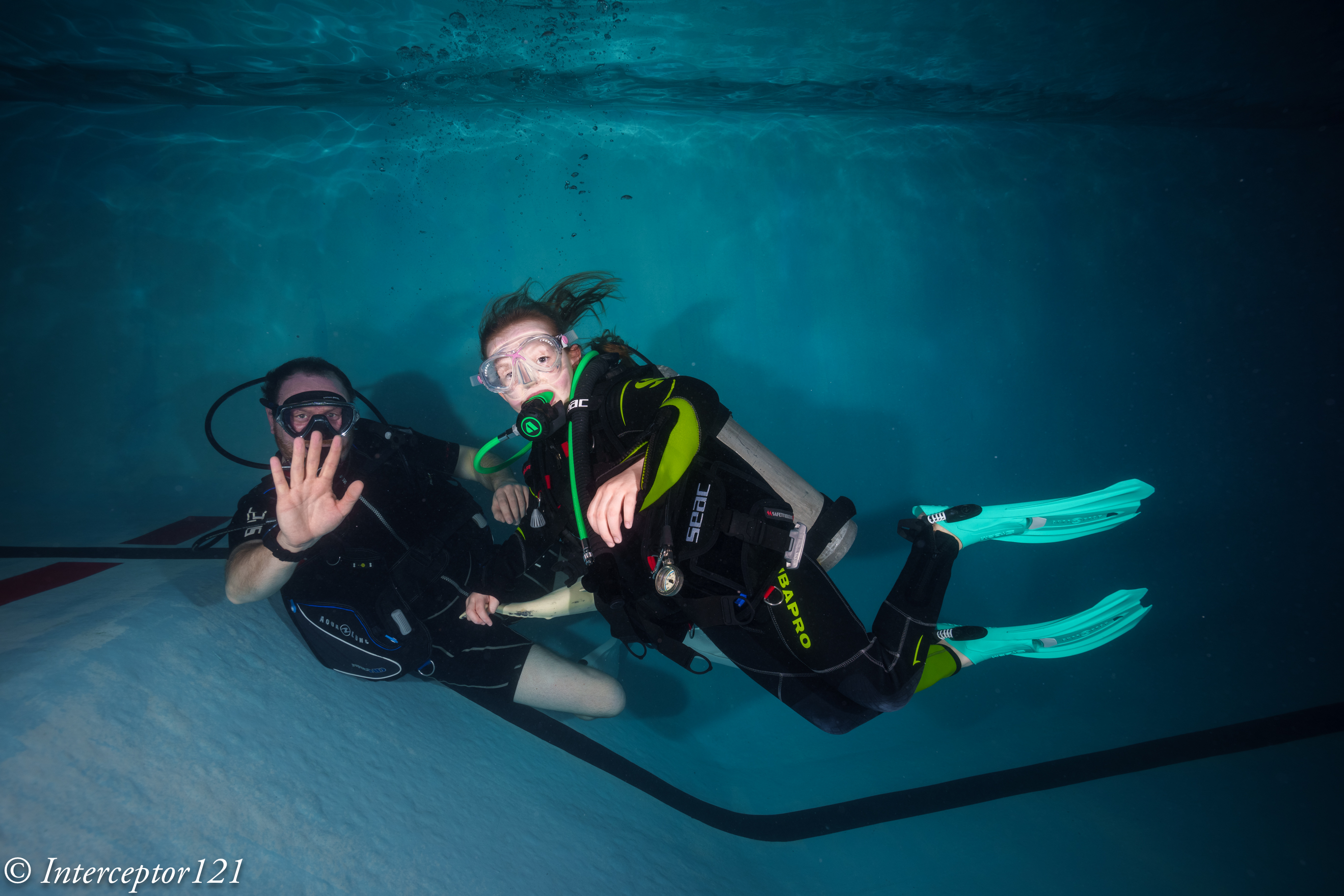
Dad Daughter 17/8

Quite interesting to see the fins at the edges of the f/8 shots.

If there is one challenge of rectilinear lenses is that you need strobe power. The narrower field of view compared to a fisheye means that you are standing further back that in turn means more strobe power and more particles between you and the subject.

Should I buy a rectilinear wide angle lens for underwater use?

My answer is definitely yes but each system will have the special lens, the one that focuses close, does not require a large radius and is not too wide and not too narrow (16-18 is ideal) however examine carefully images of others and check the lens construction as your suggested extension may be wrong.

But when your lens is fit for purpose using the correct size dome and the proper extension you will get high quality images that match or beat fisheye like lenses and water contact optics.

As example here an image shot with a canon 8-15mm at close range f/11. Does it have much better edges?

VideoDiver

And here a WWL-1 image at f/8

WWL-1 f/8

I cannot see any advantages of the fisheye like lenses at the edges at the same aperture in fact in both cases but judge for yourself.

Phil Rudin reviewed the Tamron 17-28mm on uwpmag you can find here some open water images https://www.uwpmag.com/?p=uwp-back-issues&issue=119

Unfortunately Phil used the Sea and Sea correction lens an expensive accessory that this lens does not require but as soon as I am in open water I will post images myself.

Nauticam WWL-1 on Sony Full Frame what to expect

It has been almost 9 years since my first review of the Nauticam WWL-1 and five years ago I revisited this lens on micro four thirds.

Since the very first release I was told by Nauticam that the WWL-1 had been tested on Sony full frame with the 28mm f/2 lens and since then more lenses have been added to the compatibility list and the WWL-1 itself has had a redesign called WWL-1B, this lens has an integrated float collar and I do not know if there is any difference in the optics but I assume there is none.

Nauticam WWL-1B

Nauticam has since released a number of other water contact optics with dry mount and today you have a choice of at least 3 flavours for your Sony full frame camera that provide the 130 degrees diagonal field of view.

ModelPrice (€)Weight (kg)Diameter (mm)Depth (mm)Max Filter size (mm)
WWL-114241.351569752
WACP-C29302.24170145.572
WACP-146043.9019417682
Summary Table Nauticam 0.36x Water Contact Optics

The three lenses provide the same field of view but they are different in size and mount. A useful way to see is that as the lens physical size grows you require a larger underwater optic.

The Sony E-Mount is still the only full frame format compatible with the WWL-1 in virtue of some really small and compact lenses. As you can see from the table above the WWL-1 rear element is large enough for 28mm lenses that have a maximum filter size of 52mm.

Two E-mount full frame lenses the 28/2mm prime and the 28-60mm zoom are compatible with the WWL-1.

As you move towards the WACP-C you can also use the 28-70mm lens which is one of the worst kit lenses on the market but will give you a longer tele end and finally the WACP-1 gives access to the Tamron 28-75mm and Sigma 24-70mm two lenses that have much higher quality than the smaller Sony lenses but have some restriction in terms of zoom range.

Underwater Performance Context

There are quite long discussions about which water contact optic to get for your Sony full frame once you have the 28-60mm zoom and some comparison in terms of sharpness.

In simple terms you can think of the following equation:

Underwater Performance = Land performance X Port Factor

Port Factor is always less than 1 which means a lens will never do in water as well than it does on land. Looking at my analysis of the 28-60mm corroborated by other test you know before buying any water contact lens that the lens has its own limitations and no matter how good is the port performance will only go down. However this may still be a better option compared to a standard dome port.

I do not have access (yet) to the other two water contact optics however I have a good idea of how the WWL-1 perform and how the Sony 28-60mm performs topside. If you want a refresh look at this article.

To understand how a water contact optic works you can go back all the way to the Inon UWL-100.

The idea of this lens designed for compact cameras is to demagnify the camera master lens to enlarge the field of view. You could then get an optional dome that will enable the lens to expand the underwater field of view from 100 to 131 degrees.

Back in 2015 I compared the Inon UWL-H100 with dome with the WWL-1 and concluded that the WWL-1 was giving better results when used on the same camera. It is now time to see if the WWL-1 can be used also on a full frame system.

Sony A1 WWL-1 Rig

The WWL-1 requires the flat port 45 to be used on a Sony full frame underwater housing. The lens will be attached using the same bayonet adapter that has been available for several years now.

Nauticam Bayonet Mount for WWL-1

I have removed the focus knob from the port as I found it inconvenient. The focus knob may be useful with the flat port but for the WWL-1 that is afocal is definitely not required.

WWL-1 topside view

Once you add the flat port the overall length is very much the same of the WACP-C but this will require an extension ring resulting in overall 30mm additional length.

Overall the rig is very similar in weight to the Canon 8-15mm with the Acrylic Dome Port 5.5″.

WWL-1 front side view

Pool Tests

With the rig assembled I went for a pool session with the objective of finding out what was the overall performance of the system.

What follows are a series of test shots of divers.

David f/8
Kid f/8
f/11 side shot
WWL-1 selfie 28mm
Diver f/10

In general I found the lens to be sharper in the centre at f/8 but closing down to f/11 was required if there was something in the corners.

Edge Sharpness

I was intrigued by a number of discussions on edge sharpness and after several exchanges with Shane Smith he was clear that the lens needs to be stopped down to f/11 for best results.

After the session in the pool I would agree with Shane however I was curious if this was an issue of the WWL-1 or the 28-60mm lens itself.

This image quite simple has something at the edges and has focus in the centre at f/8.

Closeup f/8

You will notice that the part of the frame closer to the camera is fairly blurry.

So I did another experiment placing the slate on the edge.

Fuzzy f/8

The edges were quite fuzzy. I wanted to exclude this was an issue of depth of field so I focussed right on the corner.

f/8 focus on corner

This is the resulting image and is still soft on the edge.

fuzzy f8 focus

I then took the same shot at f/11 with focus on centre.

Closeup f/11

The image at the edges is better. Then moved the slate to the edge.

edge f/11

The image improved overall regardless of the focus point indicating this is not a depth of field issue but some other defect of the lens, most likely as the lens meridional and sagittal resolution are different we have an example of astigmatism.

Edge 100% crop f/11
Blurry f/8 edge focussed on edge

The sharpness improves closing down the lens regardless of where the lens is focussing consistent to the MTF charts.

Looking back at land test shots we can see something very similar.

Edge at f/11 topside
Edge at f/8 top side

In conclusion it is not about the WWL-1 but about the lens itself.

Comparison to Rectilinear lenses

While the WWL-1 can offer a diagonal feld of view of 130 degrees the image is distorted and the lens can only offer 107 degrees horizontally and 70 vertically. Is like saying that the horizontal field of view is similar to a 13mm rectilinear lens while the vertical is is more like 17mm. A fair comparison is probably a 14mm rectilinear lens but as the WWL-1 is a fisheye like optic a direct comparison is not entirely possible. In my opinion as the image is distorted is more appropriate to compare the WWL-1 with a fisheye with teleconverter and when I look at what the canon 8-15mm with kenko 1.4 tc can produce for me the results are very similar, I would say the Canon has in fact an edge however the field of view are not comparable except when the WWL-1 is at the widest and the canon with the tc at the maximum zoom. I would go as far as to say that the canon + TC at f/8 is as good as the WWL-1 at f/11.

Canon 8-15mm with TC at 21mm f/8

Conclusion

If you have the WWL-1 from your previous rig it makes absolutely sense to get the Sony 28-60mm and flat port. This combination will give you decent (but not sensational) shots and work very well for 4K video at reduced resolution. I do not believe that this lens can resolve the full 50 or 60 megapixels of the A1 or A7R4 or A7R5 even topside.

If you are starting from scratch I would recommend to think careful at your intended use case. If you want angles wider than 130 degrees and already have the Canon 8-15mm you may want to check the kenko telecovenverter before you buy a new port as all you need is a 20mm extension ring and a zoom gear.

If you really like the field of view range of 69-130 degrees you need to consider which water contact optic you need.

I am still looking for a test WACP-C but until then my general guidance would be to consider simply if you prefer a dry or wet mount.

A dry mount has the benefit of being ready to go as you hit the water, without the need to remove bubbles between the wet lens and the port. As photographer a dry mount may be the best way forward.

If you intend to use your camera for video and insert filters between the lens and the flat port or you require the lens to be removed in water then go for the WWL-1.

Rigorous comparisons between WACP-C and WWL-1 are not yet available but the first indications are that the difference in image quality is very small therefore I would not loose my sleep there and look more at overall ergonomics.

The final consideration is should you get the WACP-1 instead? Based on my assessment of the Sony 28-60mm I would think this is not particularly wise even if this choice is very popular. Personally I always believe that the master lens needs to be good enough to justify the cost of the water optic so I would like to see how the Tamron 28-75mm performs however no test images are available so I am not in a position to conclude.

In my case having seen what the Sony 28-60mm lens can do I am not planning to invest in a WACP-C but I would be very interested in testing one.

The WWL-1 gets my approval also on full frame but it is not going to give me the same resolution than the Canon 8-15mm or the Sony 90mm macro will give. I look forward to testing some rectilinear lenses to see how those compare and this will happen in a week from now so stay tuned.

Costs to get one for your Sony full frame excluding lens:

  • WWL-1B €1,424
  • Bayonet adapter €102
  • N100 45 flat port €494

Total €2,020 vs WACP-C + N100 Extension Ring 30 €3,333

interceptor121’s cut – Nauticam n85 Panasonic Olympus and BMPCC port chart

I thought of adding a little stickie post of what I use for my Panasonic GH5 in terms of lenses ports so I made some edits on the official port chart v7.19 please find the google drive link here

There is an addition that I will cover in future posts and relates to using the Canon 8-15 mm Fisheye zoom lens on the GH5 body using a Smartbones Smart Adapter or Vitrox EF-M1.

I have already written about choice of Macro lenses fisheye and wet lenses for video and wide and for macro video.

My latest post is on rectilinear wide angle lenses that is a tricky subject for most.

which macro lens to pick for your gh5 or micro four third

I see many posts on line debating which macro lens is best for your micro four third system.

If I refer to the Nauticam system we have 4 macro lenses:

  • Olympus 30mm
  • Panasonic 30mm
  • Panasonic 45mm
  • Olympus 60mm

For the purpose of this article I will skip the Olympus 30mm as the Panasonic lens is known to be sharper and will focus on the other 3 lenses.

DxOMark is a popular tool for comparison as it gives you the results on one page. I have run it for the Oly 60 and the Pana 30 and 45 on the 20 Mpix OMD E-M1 MKII

DxOMark Comparison on Olympus OMD E-M1 MKII

Surprisingly the much more expensive Leica performs worse than the other cheaper models, this is confirmed on all internet sites running other type of tests.

What we can see is that there is little difference between the Panasonic 30mm and Olympus 60mm when it comes to image quality so whichever lens you choose your subject at the same level of magnification and aperture will have more or less the same detail.

Common Misconception: Shorter focal length give more depth of field

Many people think that using a longer lens is harder because there is less depth of field this is actually incorrect conceptually.

Let see why

Using an online calculatore like Dofmaster https://www.dofmaster.com/dofjs.html

Enter for the Panasonic GH5 the following parameters

Circle of confusion: 0.015 mm

Focal length 30mm

Distance 10.5 cm (minimum distance of the 30mm Macro)

Aperture f/11

Result Total depth of field 0.3cm

Now enter

Focal Length 60mm

Distance 21 cm (as it achieves the same magnification)

Aperture f/11

Result Total depth of field 0.3cm

So depth of field is not a consideration when choosing a macro lens…

Shooting a subject close to the background

In the following 3 shots am taking an image of a widget at f/11 at 29-44-60 mm on a Leica 12-60 (it is just easier it makes no difference to the outcomes)

Shot at 60mm
Shot at 44mm
Shot at 29mm

At the same aperture you can clearly see that there are no difference whatsoever in the detail and actually overall in the picture you don’t notice anything.

Shooting a subject far from the background

For the second shot I have moved the widget away from the wall.

Shot at 60mm
Shot at 44mm
Shot at 29mm

Again there is no difference in the level of detail of the widget however looking at the background we can see that

  • The 60mm shot reveals one brick and less than one quarter
  • The 44mm shot reveals one brick and a half
  • The 29mm shot reveals two bricks

So while the subject is exactly the same as the 60mm lens has a narrower field of view we see much less of the background.

This means that if you are shooting a nudibranch on the sand or something flat on a rock you won’t notice anything however if there is space behind the subject you will capture much more of that resulting in less subject isolation.

Underwater Comparison 30 vs 60 mm

In the first shot the Rhinopia is taken with a 60mm lens

Rhinopia Olympus 60mm

In the second shot the same Rhinopia with the 30mm (in a different place to be fair)

I have marked up with red the areas that with a longer focal length would have been minimised.

Which Lens to choose?

Now that we have clarified that depth of field is not a consideration and as each macro lens will have the same magnification there are only two factors that matter:

  1. Working distance
  2. Isolation from background

The 60 mm will have a longer working distance and at the same magnification will isolate the subject better from busy backgrounds, the 60 mm is also better for skittish subject because of the longer working distance. I have this lens and I have borrowed the 30mm in couple of occasions but do not have the 30mm yet.

There are however situations where longer working distance is not a benefit, specifically when the visibility is poor and there are suspended particles or the subject is really large.

In the example below I was at one meter from the two frogfish, a 30mm would have been better however the shot came OK.

Hairy frogfish Olympus 60mm

Conclusion

I believe the Olympus 60mm is a must lens to have. To date I have not felt the need for the Panasonic 30mm that is indeed a very sharp lens because I have always managed to pull out the shots. However for someone diving in murky water and focussing on nudibranches or subject laying flat on the seabed the Panasonic 30mm could be a better choice. I also want to say that using the 14-42mm at 42mm for me is actually a better choice for portraits and with a close up lens works very well with small subject not super macro and therefore as I already own the 14-42mm and various diopter for me the 30mm is not on the shopping list.

Getting the best colors in your underwater video with the panasonic gh5

There is no doubt that the Panasonic GH5 is a very capable camera and in given conditions the video performance you can get is truly impressive.

Broadly speaking a video clip needs to be:

  1. Sharp
  2. Colorful
  3. Contrasty
  4. Clean

Those 4 characteristics are tightly related to:

  1. Resolution
  2. Color depth
  3. Dynamic range
  4. Low Noise

Resolution

Today everyone shoots 4K and after all resolution is well supported by almost any camera, broadly is unaffected by other factors and unless the noise is really high sharpness of your frame is not going to be a real issue shooting at 4K.

Color depth

In normal conditions and not underwater a camera can resolve many colors. However underwater due to the diffraction of light and selective absorption of colours the starting point is very different from land. So generally is not the camera that cannot resolve the colors but the colors that are missing to start with. This post will focus specifically on this aspect. The Panasonic GH5 can resolve 23.8 bits in RAW and therefore technically has less than 8 bits color depth – do not confuse this with the 8 or 10 bit recording setting.

Dynamic Range

Underwater scenes tend to have limited dynamic range, with the exception of sunbursts or shooting against the light this is going to be an issue only in specific circumstances of very bright scenes with shadows. In all scenes taken with video lights dynamic range is not an issue at all. The GH5 has 13 stops of dynamic range but rarely this is an important consideration.

Noise

Noise is an important consideration as when the noise goes up the camera looses the other characteristics, color, dynamic range and resolution will be affected when the camera is outside the sweet spot. Broadly speaking the Panasonic GH5 does not do well once you pass the ISO 1600 setting and I tend to cap the ISO in video at 800 in most cases.

Diving Conditions

To understand how those variables play we can see how the same set up reacts very differently in scene where there is less light and therefore the camera uses high ISO like this one.

The same camera with exactly the same equipment in brighter water produces this

So the reason for the above is that with less light there are less colours and the clip looks what it is really.

OK moving on to the main subject of this post how do I get the colors right? It is a combination of techniques and the trick is to use the right one in the right conditions.

Generally every site has specific conditions that change depending on weather, time of the day, visibility and other factors. So in broad terms a site will have more or less light and therefore more or less colours. It is therefore impossible to categorically define what to do at a given depth but is more about typical values. With this in mind we have typically 3 scenarios:

  1. Ambient light shots
  2. Artificial light shots
  3. Balanced light shots

Close up Shots

In general close up shots especially of small subject fall within the scenario 2 for which a video light with high color rendering is important as this will define the colours you see. With a lot of power it is possible to extend artificial lighting to larger subjects but eventually you run out of power due to distance or size of the subject.

Wide angle shots and seascapes

True wide angle shots are generally ambient light shots which also means when it gets too dark the colors will be missing and it will look blue not matter the equipment.

In order to make the most of ambient light shots for wide angle it is essential to balance the colours in water even when you use a RAW format on a still image because RAW files are not as RAW as you think and are actually compressed.

Custom White Balance

Using Custom White balance with a grey card it is possible to obtain decent results until the camera hits the maximum color temperature in the case of the Panasonic GH5 this is 9900K. Depending on conditions you may get to 10-12 meters and this still works, in darker water this stops working much sooner.

Chrisoula K Bow
Chrisoula K Ambient Light 5 meters

Color Filters

Color filters push the limit of custom white balance further down. Some add more or less 4 meters others up to 6-8 meters at the expense of an overall loss of light. Filters are useful when there is a lot of light because also help to keep the Panasonic Gh5 in the best aperture range (not smaller than f/11)

Filter in action at 10 meters

Right now there are predominantly 3 filters on the market:

  1. UR PRO
  2. Magic filter
  3. Keldan Spectrum

All those filters will improve the performance and color rendering of your footage, under the conditions that the loss of light is not pushing the camera above reasonable ISO values.

In terms of depth range the magic filter and the Keldan Spectrum -2 version can be pushed to 15 meters depth on a bright day in clear water. The URPRO is capable of getting a few meters more down to around 17-18 meters although it does generate an orange cast (as there is no red left) it is still workable.

FilterLight LossTypical Max Depth
Magic Filter1 2/3 Ev15 meters
Keldan Spectrum -22 stop (WWL)15 meters
URPRO 1 2/3 Ev18 meters

This image gives an idea of the 3 filters as you can see they are very different one from the other.

Keldan top URPRO bottom Magic filter

Balanced Wide Angle Shots

This is an entirely new technique that has started with the Keldan Ambient light filters. I wrote a whole piece on wetpixel

The principle is to use custom white balance with or without filter to obtain color rendering and then put filters on the video light so that the color of the light emulates the ambient light and therefore it only gives texture not color.

Keldan has developed a whole range of filters for various situation that match their light and therefore are not applicable to any other light.

As I do not own a set of Keldan I have done some tests and found that a gel of Cyan filter 2 or 3 stops makes my divepro G18+ practically ambient light in the conditions I dive into.

FilterCyan Strength
Magic Filter2 stops
Keldan Spectrum2 stops
URPRO3 stops

The above value are based on my experience use at your own risk especially with different lights.

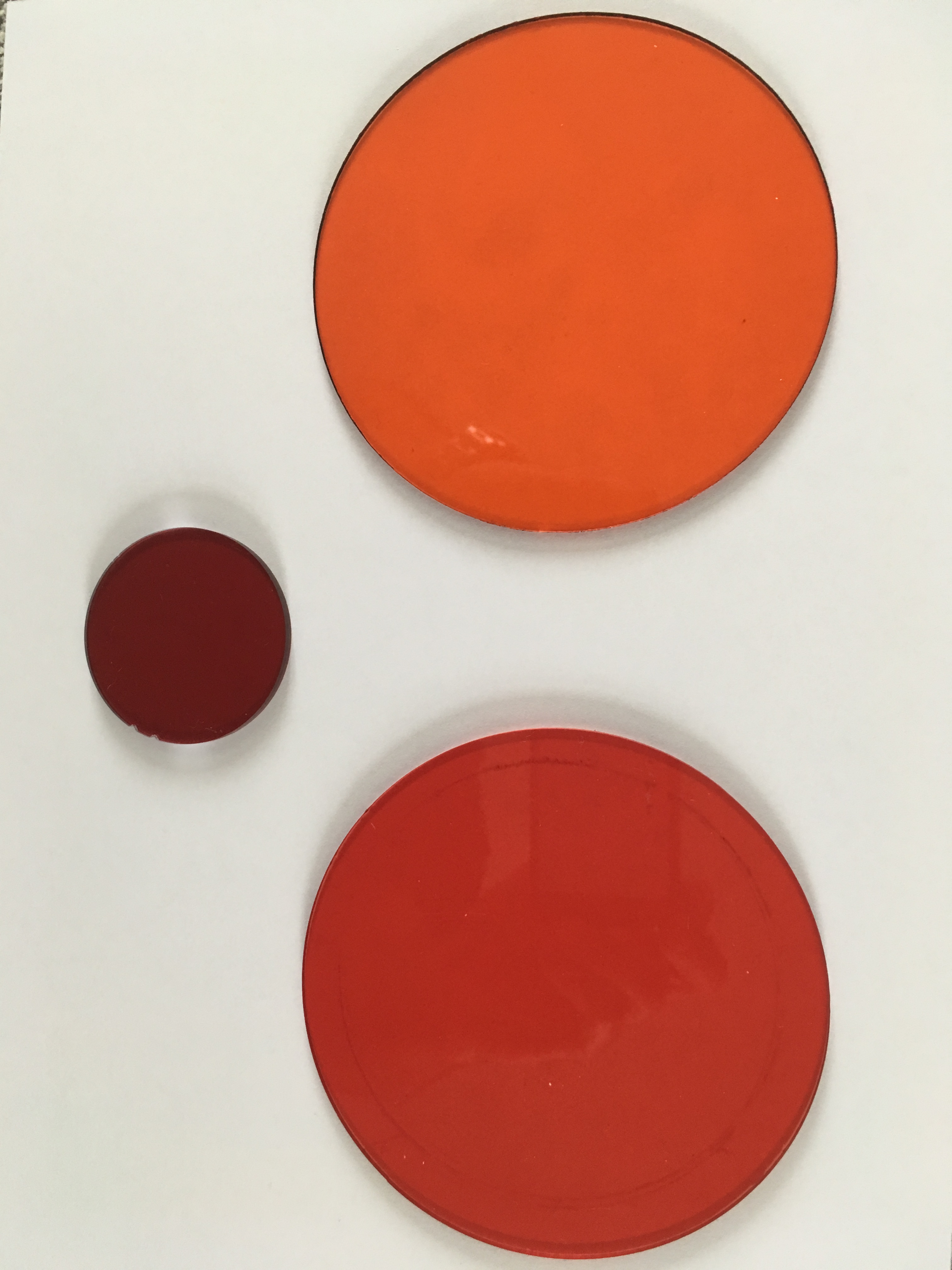
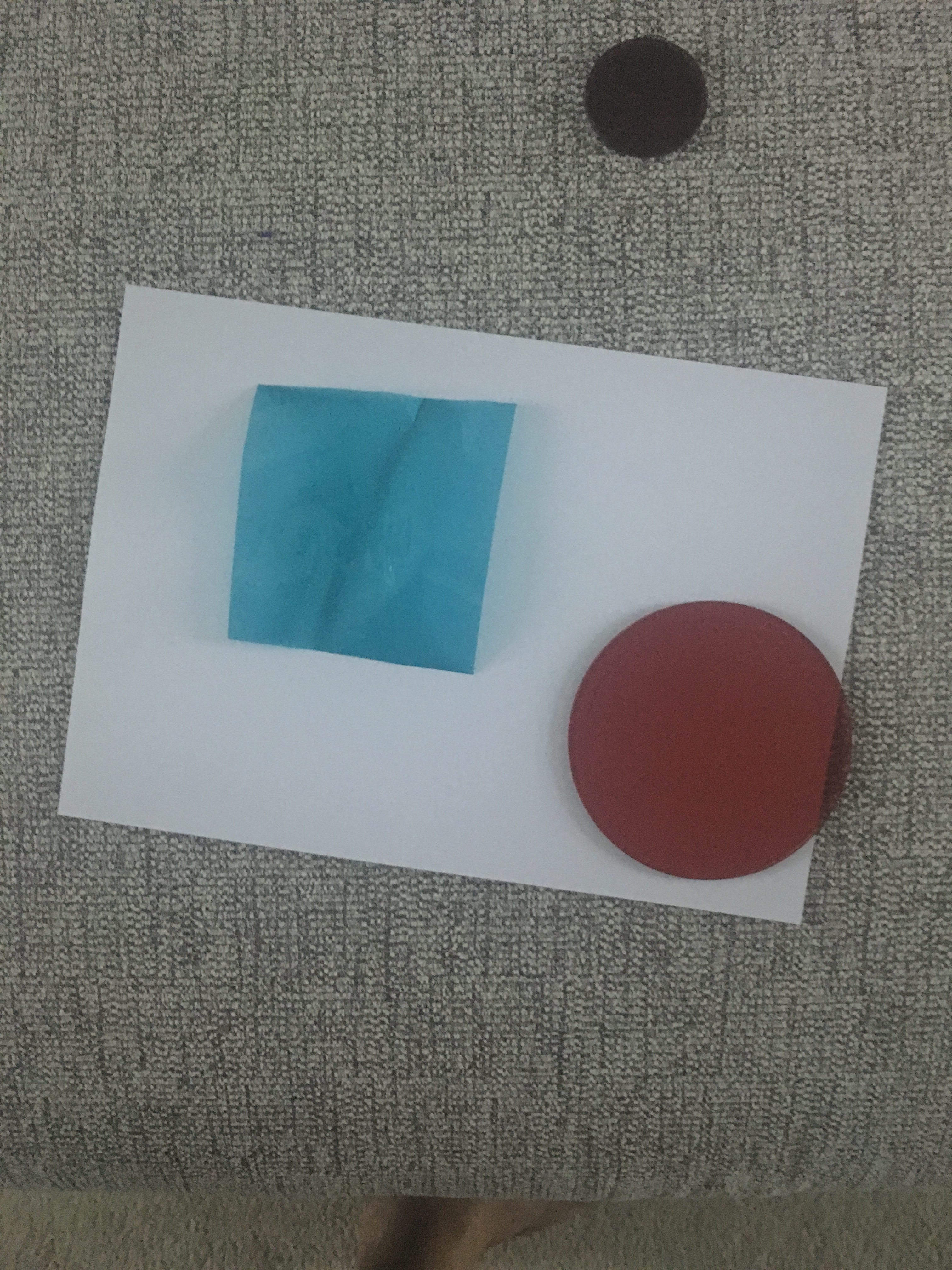
Square Cyan 2 stops Round Cyan 3 stops

To give an idea I overlapped the filter to my iPhone lens

This is the shot without any filters

Original Shot

URPRO and Cyan 3 stops (darker)
Magic filter and cyan 2 stops accurate
Keldan and cyan 2 stops accurate

This example shows that the two filters cancel themselves the result is almost daylight with no cast which means in water if you use a video light or a strobe you will not see a red or orange spots on the image.

For those taking pictures the same combination remains true with Inon Z240 and Sea and Sea YS-D2

Example picture here

five in a row
My own filter and Cyan 3 stop note that the light is coming from the other side

One thing to take into account is that you need to find a way to hold the gel on the video light or the strobes. The flat surface strobe diffusers make this process easy, finding something you can use with your video lights is not easy and also the gels may melt after continuous use.

Artificial lights

It comes a point and a depth where filters stop working, this could be as shallow as 8 meters in green water. As the scene is dark using lights is what is required. There is nothing specific about this technique except making sure you don’t get burned highlights or backscatter. As it happens in photography using long arms (maybe not as long as for stills) is key to get good lighting on your subject.

My Camera Settings

I use CineLike D with saturation, sharpness and noise reduction to -5. I shoot at 24/25p AVCI 400 mbps and follow the 180 rules, it is entirely possible to shoot at 1/100 if you like more crisp look.

Clearly there are people out there that do not like filters and think white balance is best etc but I think a good read on magic filters explains it all.

http://www.magic-filters.com/need.html