I receive so many queries about equipment that I thought I would put some of my items on sale.
My cupboard is near enough to explode and I need to streamline the equipment I have. Currently I have 3 strobes, a huge selection of ball and clamp arms, 3/4 and 1/2 locline arms, float arms, floats, video lights, tray bases, around 15 clamps and some 6 macro wet lenses and 3 wide angle wet lenses with 3 different mounts.
I guess it is time for a clear up so I will add a section with items on sale where I will list some of the combination items.
The idea is to provide a full set of lenses or a tray + float solution as those seem to be the most asked for items in my set up.
So if you look on the menu you will see the link Sales items with details of the various sets. I can also sell the items individually but I think this makes little sense as I’d rather do that on ebay.
Many people read my posts and then go to gear shops but there there is always a little mistake or problem getting the whole set up from here you avoid that. I priced the items based on 50% of retail UK price and I would ship to UK and Europe, other overseas will attract import duty so it is not worth it in my opinion.
If there is anything you like use the contact form on the relative page to inquiry
Once again Sony has updated their RX100 camera with a stunning new release that will surely be a market leader at least until the release of the new promised Panasonic large compact sensor with 4K video recording.
So the question is again is it worth throwing our hard-earned money to this new model and housing or should we stay with what we have got? The Mark I and II are still available at reduced price though it is becoming harder to find Mark I housing as new.
The answer to the question is: it depends on what you are planning to do with your RX100, for some users an upgrade may not be required or even not advised let’s see why. no don’t waste any time with the Mark III.
Every time a new camera is released and reviewed I get a bunch of emails with subject: New Camera XYZ what do you think?
The best reviews you find online are made by sites that specialize in land photography and no consideration is given to underwater use. So not necessarily a camera that is a top performer on land will remain such underwater as this depends on specific characteristics that may be different or even opposite to land requirements.
So those reviews cannot be taken as they are they need interpretation. Personally I use two sites for camera reviews imaging resource and dxo mark I use the first to understand ergonomics, performance and to compare images with other cameras side to side, and the second to check sensor quality and lenses. Imaging resource has made a good article to compare the various RX100 on land read it here
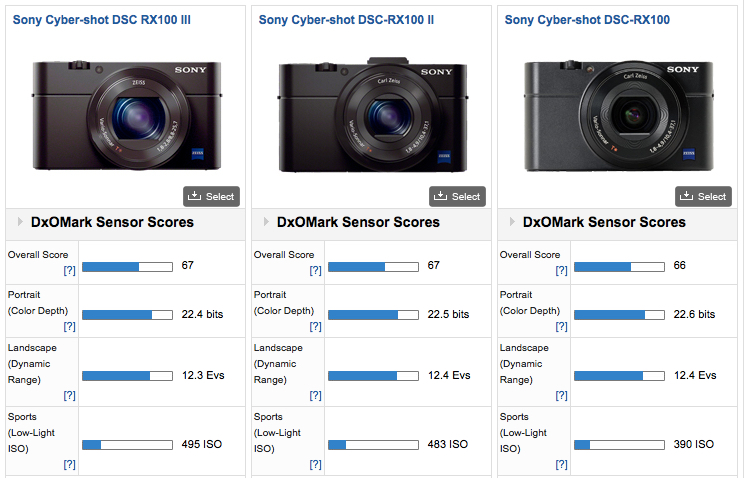
If you look at a sensor comparison on DXOMark you would conclude that there is no need to upgrade at all if you use your camera primarily for still pictures as the sensor are practically identical in performance as this table demonstrates:
RX100 Sensor Ratings
As you can see the differences in dynamic range, color depth or ISO are pretty much intangible.
However there are other metrics that are also important let’s see which ones and why.
Flash Recycling
We want our camera on board flash to recycle quickly after a full dump as the RX100 has only TTL flash and the flash can’t set to a minimum manual setting without consequences. Those are the flash recycling times at full output (a full dump will always occur when you don’t aim strobes directly at the subject for example wide angle)
Mark I: 7.2 seconds
Mark II” 4.4 seconds
Mark III: 3.3 seconds
The Mark III is pretty quick and the Mark II is acceptable the first release is definitely too slow.
Minimum Capture Area & Zoom
What is the smallest area that can be captured at wide end at the closest focus distance? This gives you an idea of out of the box close up performance
I do not have precise metrics yet but looking at comparable images on imaging-resource seems like the Mark III is worse than the Mark I and II of at least 20% with a capture width around 90mm versus the already not very good 76mm of the Mark I and II.
To fix this issue we use close up lenses in water that fix to a great extent the focal length and then zoom in to achieve magnification which means longer camera lens more magnification I roughly estimate that the Mark III will be worse of a factor of 0.7x so things will look 1.4x bigger with the Mark III this is terrible news for macro shooters as it means you need to be on top of the subject to fill the frame, this is in some cases not possible.
I have estimated that you need 11 diopters to achieve 1:1 macro so the Subsee 10 and Inon UCL100 that gave real macro on the Mark I and II won’t be sufficient. With two UCL-165 or Dyron 7 you are looking at 2.58″ or 6.5 cm from the back of the first close up lens that means you will be right on top of the subject which is not really an option.
Update July 18th: Nauticam has confirmed that even with their SMC lens the most powerful diopter on the market the capture area is 38mm wide so does NOT achieve 1:1 macro as I suggested…
Lens Focal Range
The new mark III has a 24-70mm lens compared to the 28-100mm of the Mark I and II what does this mean?
Less magnification with close up lenses and no real 1:1 macro
Vignetting or even not possible to use fisheye lenses designed for 28mm lenses
This means that with the Mark III your scene selection will be restricted compared to the 150 to 24 of the mark I and II.
Update 23 July I have done some tests that confirm my suspicions please look at the following frames. The Mark III once zoom to 28mm actually works fine with the Mark II housing except the power button.
RX100 Mark III with Inon UCL-165 Close up lens
With a single Inon UCL-165 (+6.06 in water) the minimum capture area width is 5.4 cm which is bigger than the Mark II 4.8 cm. Not only that the distance from the top of the lens is only 9cm.
With stacked UCL-165+UCL330 total power 9.09 diopter we get this
Stacked UCL-165+UCL330
4.4 cm width however we start running into problems as the minimum distance from the lens is only 4cm.
We finally achieve 1:1 with two stacked UCL-165 however the distance from the top of the lens is 3cm definitely too little
two UCL-165 stacked
I have also tried the Mark III at 28mm and it still vignettes with the Inon UWL-H100 in air until around 30mm. Instead the old UWL-100 28AD is fine at 28mm either way image looks narrower than with the Mark II but this may be an issue with the old housing.
So basically no macro with the Mark III and no decent fisheye as expected.
Underwater Photography Conclusion
Due to the reasons above the best camera for the job is the RX100 Mark II, with the Mark I coming close but being penalized by the strobe recycle time, the Mark III really is not an option for the serious shooter due to limitations of the lens.
Let’s have a look at some other features of the Mark III that are not relevant for stills as much as they are for video.
ND filter
Shooting at the surface with plenty of ambient light or on land can create problems if you want to follow the 180 shutter rule, the ND filter of the Mark III ensures your footage will be smooth on land and in water. Take into account that on land you can apply optical ND filters (I have it for the Mark II) so this is really for underwater use when you are shooting at 1/50 or 1/60 shutter speed and the scene is too bright when you hit f/11 and the lowest possible ISO. Having now tested this feature I confirm it is really valid on land on a bright day to keep the aperture wide.
Clear Image Zoom
This is a special digital zoom with edge enhancement that only worked on JPEG stills on Mark I and II but is now available on video on the mark III. This means an additional 2x zoom is available bringing the focal length to 140mm that is more than adequate for macro. This is not an option on RAW images so irrelevant for still users.
23 July update Having done some tests for macro video (as stacking two diopters is not an option) the image quality suffers but anyway this is all you are left with lacking any other options.
Clear image zoom 1.5x on single UCL-165
Image stabilizer
The Mark III adds a further stabilizer mode with additional crop that takes the lens to 96mm equivalent in video mode. This is well worth for super macro hand-held footage and effectively provides an option where you can either use the super steady shot and no clear image zoom when hand-held or leave on only the optical stabilizer and use clear image zoom. If you shoot macro on walls and not on flat sand this is a well worth feature.
Update 23 July 2014
Following a side by side comparison you can find on this link
It follows that there is really no 5 axis stabilisation and only an additional mode with more crop with correction for rolling shutter that anyway does not really work!
Full Sensor Readout Video
The mark III reads the whole sensor not just alternate lines when capturing video this increases should increase the resolution to a great degree and increases the perceived resolution and clarity of your videos. However this does not seem to correspond to real life tests. See this sample with a side by side comparison the Mark III looks visibly worse than its predecessor even on the higher bitrate XAVC!!!
Video Formats
The Mark II introduced a well welcomes 24 Mbps 24/25 fps mode now the Mark III introduces a 50 Mbps mode in XAVC (that can be rewrapped into normal MP4) that produces even better footage although it will be quite demanding on your workstation and most likely some of your home devices will struggle playing the files (my Apple Tv 3rd generation only plays up to 25 Mbps) when uploading files online this will downgrade to 8 Mbps so won’t matter unless you have a good player at home. improves nothing and requires manipulation as the files are actually not MP4 compliant as they have WAV audio (!) they are also inside the AVCHD folder which is painful. As seen above seems like the encoding has got worse on the AVCHD files and only the higher bitrate compares but still does not match the mark II at the lower 24 Mbps!!!
HDMI connection
You can now connect the Mark III to an external HDMI recorder if you are into that kind of semi pro usage. For the normal user this is not relevant: if you are into spending that money probably you have already a DSLR or a Panasonic GH4.
Video Auto Focus
The auto focus in video has got worse you can see an example in the stabiliser test, and actually plenty of frames are blurred on the mark III. Awful!
Underwater Video Conclusion
The Mark I with only a 28 Mbps 50/60p mode is definitely a poor choice, the Mark II is acceptable to most users. and the mark III promises even better performance if you are a serious video user and have another camera to take pictures the Mark III may be well worth it.
The Mark III despite some useful feature is actually a let down and perform worse in practical terms than the mark II that remains my camera of choice.
Summary
If you have a Mark I camera and are frustrated with flash recycling you should be looking at a cheaper upgrade to the Mark II.
If you have a Mark II and your priority is photography upgrading is NOT recommended.
If you don’t have any RX100 get yourself a Mark II or wait for the new Panasonic as the Mark III is pretty much a pile of crap.
Is it the first time I am actually sending back a camera and invoking consumer rights but when I spoke to the camera shop they told me they had other returns and this is not really an upgrade!!!
The above image was shot at 100mm equivalent with one diopter with the RX100 Mark II. You won’t be able to fill the frame with the same close up lens and the Mark III camera
I have recently received a number of messages asking me why I am not upgrading to a micro 4:3 set up.
There are several reasons why I am not doing that even if my photo rig is nearly as heavy as a micro 4:3 or even a DSLR and have to do mostly with video not with stills.
I will try and touch on the key points in this post, please remember those are subjective and by no mean a criticism to other people that use 4:3 set up for video.
Note: my perspective is one of a typical non professional user that has limited time to get the best shots. This is not an absolute point of view it is clear that if you are a ‘pro’ and have much more time to spend to get few seconds of footage many considerations do not apply.
Composition
The way I have learned to love underwater video is the composition opportunities that it gives. My main source of inspiration is John Boyle and his book that remains the only valid handbook for what I am concerned even if it is a little old.
One of the classics of underwater video is the sequence: wide-medium-close-super close. On a micro four third in order to have good quality you would choose a macro lens or a wide angle lens, both those choices will prevent a number of shots you either do close and super close or wide and medium and maybe close but not super close.
With a camera with a fixed lens with a range of 28-100mm and wet lenses you can cover the whole spectrum of shots although you may need to swap lenses during the shot the possibility is there.
Optical Quality
Some users try to use one lens to catch all, usually the choice is a Panasonic 14-42mm or an Olympus 12-50mm. However this is not as exciting as it seems in the first place. I have run some comparisons on the optics on DXOMark assuming the 4:3 are on a Panasonic GH3 that really is a mini SLR you can see the results by yourself
Comparison Panasonic 14-42 vs RX100II vs Olympus 12-50
The RX100II gives better quality than both those lenses and especially it does it at f/1.8 versus the f/3.5 of f/4 of the other lenses.
The RX100 does have issues of distortion and chromatic aberration at the edges because of the extensive correction but is overall sharper at wider aperture. This is very important for video that is shot at ambient light.
Wet Lenses
You can add M67 lenses to the Panasonic 14-42 and the 35 macro port (am talking about Nauticam ports here) the results will be worse than the RX100 as the starting point is worst. There is no M67 mount to use the Olympus 12-50mm lens, I will try to see if the flip diopter can do that without vignette but still this gives only 24mm against the 18mm of the RX100 with an Inon wet lens.
Video Quality
The only cameras that are decent are Panasonic as Olympus video is pathetic. However only the GH3/4 have anything better than a compact in terms of recording formats. The new Sony RX100 Mark III with 50 mbps 24/25p seems almost equally interesting.
Stabilisation
Micro 4:3 cameras do not have in camera stabilization in video mode and most of the lenses (the 14-42 is an exception) do not have optical stabilizers to contain costs. It follows that close ups are shaky and even wide angle has jumps.
Conclusion
With all the considerations above it follows the only real set up would be a lens with a stabilizer, the only available that can also shoot close up with a wet lens is the 14-42mm Panasonic. However this lens seems to have worst optical quality than the on-board lens of the RX100II (I have checked some real life shots myself). The only benefit left is the higher bit rate recording format and this is only if you go on a GH3/GH4, with higher recording formats available for the RX100 Mark III and with an announced Panasonic LX8 with potential 4K I personally do not see a reason to jump on the 4:3 wagon for video. I do believe though that if you take mainly stills there is a compelling reason for 4:3 as you can have one camera fitting almost everything and smaller to pack than a DSLR (but not that much and forget about 200-400mm f/2.8 tele lenses).
In one of my first posts on this blog I covered the subject of setting white balance with the Sony RX100.
It may be useful to have a quick recap on the topic:
For pictures setting a custom white balance is not useful if you shoot in RAW as the amount of correction in post processing is far superior*
For video (that is shot in compressed format) setting the appropriate white balance for your shots is essential
There are exceptions to this rule, some people like to set custom white balance even in RAW when they shoot ambient light pictures. This is because changing the white balance shifts the histogram and therefore if you had taken a shot with an incorrect white balance you may retrieve wrong information from the histogram. Personally I do not do this most of the ambient light shots I judge by eye and not histogram or are silhouettes anyway but may be useful to know.
The other exception is when you shoot a raw video format with bit rates in excess of 100 Mbps, in that case the footage is captured in a bland format lacking any real depth and contrast and things are corrected in post processing. This does not apply to any consumer camera that works in AVCHD or Mp4 with bit rate lower than 50 Mbps in any case.
It follows that setting the appropriate white balance for our videos is something that is important otherwise our clips will look dull, green or have some sort of color cast we do not like.
As many of you RX100 I have experience with the infamous Custom White Balance 9900K error. In theory if you set your custom white balance with the camera in P mode over a neutral target this error should only occur if the color temperature is out of range (>9900K) unfortunately this is not the case and you get this error pretty much always with our beloved camera. At the beginning I thought that this was due to my cheap PADI slate, but after various attempts against my hand, sand, buddy’s tank, the sun I have to think there is some genuine issue here.
So I got myself whibal card, that on my test on land performs amazingly well with both the RX100 and the Nikon D7100.
The first thing we can realize is that the auto white balance setting is rather cool in outdoor scenes, whilst it tends to be warmer in indoor scenes with artificial light.
Auto White Balance
When you take a custom white balance the colors appear warmer and the bluish cast departs and the yellows come back.
This is particularly bad news if you shoot underwater without a filter and think of using auto white balance as those results will be pretty ugly.
The whibal card has a specific black mark that if illuminated tells you the white balance reading is incorrect because of reflections. I thought this was the key to the 9900 Error, unfortunately I was wrong.
It just fails 100% reliably really painful so I could not get rid of my trusted red filter for the Galapagos trip. I even tried setting the white balance with the filter and it would fail as well.
So I went back to auto white balance and red filter and I am pretty happy with the results, many people have asked me if I have manipulated the footage in post processing as the colors look very deep and some have even said unnatural. Even so shooting at 1/50 means a relatively low ISO and in the specific trip another f/stop of aperture was not really significant but I would have like to have the option of working without the filter, sadly this was not an option.
For what concerns white balance just a few things I want to say:
1. At depth there is no color anyway so what your eye can see it is not what it is, the proof is when you use lights or strobes things look much better than the naked eye. Using your visual as a reference can produce dull results.
2. You have to set an appropriate white balance for your scene, this means removing the cast. If a scene has no cast and the colors look saturated this is not a white balance issue on its own but may due to the camera settings. The RX100II is one of the less saturated camera on the market. The mark I instead is pretty saturated take this into account.
3. Footage that looks dull IS in fact ugly. The fact you set custom white balance with or without a filter does not mean that results is the perfect result, there is no such thing in fact and as colors disappear at depth white balance is not that effective anyway
Nick Hope sometime ago published some interesting tests on wetpixel
It turns out that there is more than meets the eye.
Just to clarify the only color correction in my Galapagos clip is:
1. In the scene of the dolphins I was pointing the camera upwards and did not have time to take the filter off so ended up with a red cast, I performed a white balance adjustment in iMovie on the opposite value of the tint I was getting until I liked it.
2. In the scene where there is a group of Galapagos sharks and the close up of the eagle ray I have reduced the blue gain as it was over saturated
In all other cases the only changes were increase of contrast or reduction of brightness. When the water was green like at the end in the Punta Vicente Roca scene I did not touch it to make it look artificially blue.
Again for those who ask I use a deeproof push on filter for the Inon UWL-H100 this filter is my preferred for the only reason that is actually the only one available on the market that fits on the lens. Personally I would much prefer a plastic filter like the ikelite/URPRO but this one is glass. It seems to correspond to a deep sunset 2700K with magenta tint of +5 on the RX100 but I have no tools to measure it I can only say it works.
So my recommendation for the RX100 is to get this solution as the Inon lens has the best optical quality and a hood that comes very handy to reduce flare. There are other lenses that fit the RX100 but have no hood. Obviously an not even considering the fisheye style lenses as distortion is ugly and placing a filter under the lens is a very bad idea.
The time finally came for our trip to Galapagos and I was ready with a set of think rubber suits to overcome the cold water. I just bought a 5mm Oneill Sector (wonderful suit) a 3mm hooded vest, kevlar gloves and a 5mm 4th Element short john. Well the short john was not used and for most I used just the wetsuit and a set of O’Neill Thermo X unders (very recommended) as El Nino is coming and the water was warmer at 25-27C or 77-80F.
This means lack of schooling hammerhead at shallow depth close to the reef, they were in the blue. We had however our good dose of schooling barracuda, tuna (in the 1000s) and even galapagos sharks
This is the video I produced
If you have problems with playing in your country use vimeo instead
The conditions were difficult with low visibility and in some sites very green water as you can see here
Questions will come about what I used etc etc so here is the list
Sony RX100II in Nauticam housing
FIx adapter for Inon LD mount
Inon UWL-H100
Deeproof blue water filter
Sola video lights 1200 (just few shots of the barracudas and some close ups)
Combination of arms and sometimes no arms
Ultralight tray TR-DM with extension and handles
The video has been produced with iMovie 9.0.4 no stabilization performed except the scene with the moray eels mating (very mild)
I shot the whole trip in shutter priority 1/50th of a second in the 25 fps 24 Mbps format. After some tests at home I have decided to use this mode as I can’t physically play the 50 fps files the camera produces on any of my devices differently. The 25 fps gives a film look and very smooth footage. This format is only available on the RX100II and not on the original RX100 so the consideration I made at the time for video settings of the RX100 remain valid.
The benefit of 1/50th shutter speed is a full f/stop of light the disbenefit is that at the surface and for backlit shots this is too slow, in those cases I go back to program mode or increase shutter speed to 1/100 or 1/200 or more.
For what concerns the editing I import the raw files in iMovie without using the conversion and then export with x264 using very slow preset and level 4.0 compatibility to use it with my appleTv.
I do minimal color correction in some cases I had to eliminate the red color cast of the filter when shooting upwards, to do that I change the white balance to top yellow until i remove the cast.
In some cases I had to put the green gain to the max for the same problem but in all other cases there is NO color correction in post.
When you work with AVCHD cameras the footage is compressed and the key is to get it right in camera.
As Galapagos conditions were challenging, although less than I expected, I used gloves in some dives to hang on to the barnacles and I also modified the set up to completely eliminate the lights.
I would dive with two 3″ segments and two 6″ Inon Mega float arms when I had the lights on and for other shots in ambient light I would have this set up here that looks odd but it is very effective and almost neutral at only 120 grams in water. The position of the floats means the camera stays upright at all times.
Compact tray for ambient light
I would put a single Sola light on top of the housing not for video purpose but to signal the dive master when I was a bit far in the murky or dark waters. I used this set up on almost all blue water dives (Darwin and Wolf) and the normal set up with lights for the South and West sites with murky or green water.
There will be a separate post on the photos, I did a total of 18 dives with the camera of which 4 where photo and 14 video. You can see an example in the featured image.
I have now ran some statistics on the final clip that I produced
I used a total of 41 video clips:
ISO average was 273 with the following breakdown
2 clips at 160
30 clips at 200
6 clips at 400
3 clips at 800
f/stop average was 3.1 hyperfocal distance on average 1.16 meters. So if I were able to shoot without filter I would have not gained anything in terms of sharpness as most subjects were further away
I would consider the Galapagos and the dive trip I did not the best in terms of brightness and visibility so I would conclude that the RX100II with the Inon UWL-H100 and a red filter is the best set up for wide angle video in terms of performance, ease of use and flexibility.
As you add up lenses and accessories to your underwater photography or compact video rig you start experiencing an increase in weight first on land and afterwards in water.
My current rig for photography weights in excess of 5 Kg (11 lbs) and in water this is very near to 2 Kg (4.4 lbs). The housing and the hardware are usually the main culprit but even strobes or lights can easily add weight. As you add more and more components the weight of your rig ramps up.
I use locline arms for video and this greatly helps reducing weight both in and outside water. My compact video rig is around 500 grams or 1.1 lbs in water but also very lights outside water. The Sola lights really help with their incredibly compact size. The heaviest items are the tray and handle and the lenses.
Sony RX100 Mark II Underwater Video Rig
For my video rigs I use STIX jumbo floats on the tray and on the locline segments. Each one of those floats gives around 160 grams 5.6 Oz lift in water.
Stix floats are available as large and jumbo format more information directly on the 4th generation designs web site here
For stills I use aluminum arms as I find them more precise but also need longer arms and be able to sustain a heavier weight for a strobe outside water. Strobes frequently weight over half a kg with batteries, this is too much for a 1/2″ locline arm and stiffer 3/4″ segments are required. I don’t particularly like the 3/4″ segments and I prefer ball and clamp solutions. 3/4″ segment can hold easily a strobe but can’t be really too long.
This is my basic still set up I had for the Panasonic LX7
LX7 Photo Rig Front
Even in this case I tried to use as many floats as possible to keep it light around the usual half Kg 1.1 lbs underwater weight.
For my RX100 I have two strobes and arms with 8″ and 5″ long segments.
The 5.5 Kg rig in hand
As you can read this is 5.5 Kg on land and even with 6 Jumbo stix floats the underwater weight is over 680 grams or 1.5 lbs this for me is a bit too much to carry around so I started looking into alternative solutions.
Left Inon Mega M – Center ULCS 8″ with 3 Jumbo Floats – Right ULCS 5″ with 2 Large Floats
The ultralight buoyancy arms provide too little lift in my opinion to be worth using so I looked at float arms in carbon or plastic material as an alternative. I came across Inon and Nauticam products and so I ran some comparison based on some metrics I have defined myself.
Update 16 March I also include Stix float arms now.
Those are:
Buoyancy per $: how much lift do you get per $ spent
Buoyancy per mm: how much lift do you get per mm effective length*
Buoyancy per gram: how much lift do you get in relation to the on land weight of the arm
*effective length is measured from the center of the arm balls
I refer to US $ prices just for convenience the same would apply even more in UK/Euro terms so here are some results
Standard Float Arms
You would use standard float arms if you have an acrylic dome on an SLR or mirror-less or a plastic housing that gives considerable lift as those solution give limited lift in water ranging from 75 to 333 grams.
Arm Type
Buoyancy
Cost Total
Weight
Depth Rating
ULCS S + 2 Stix L
154
$57.50
101
40m/130ft
Stix 6″ L
142
$43.00
101
40m/130ft
Inon S
75
$75.95
142
70m/230ft
ULCS M + 3 Stix L
237
$66.75
146
40m/130ft
Stix 9″ L
260
$48.00
146
40m/130ft
Nauticam M
240
$80.00
200
100m/330ft
Inon M
135
$89.95
181
70m/230ft
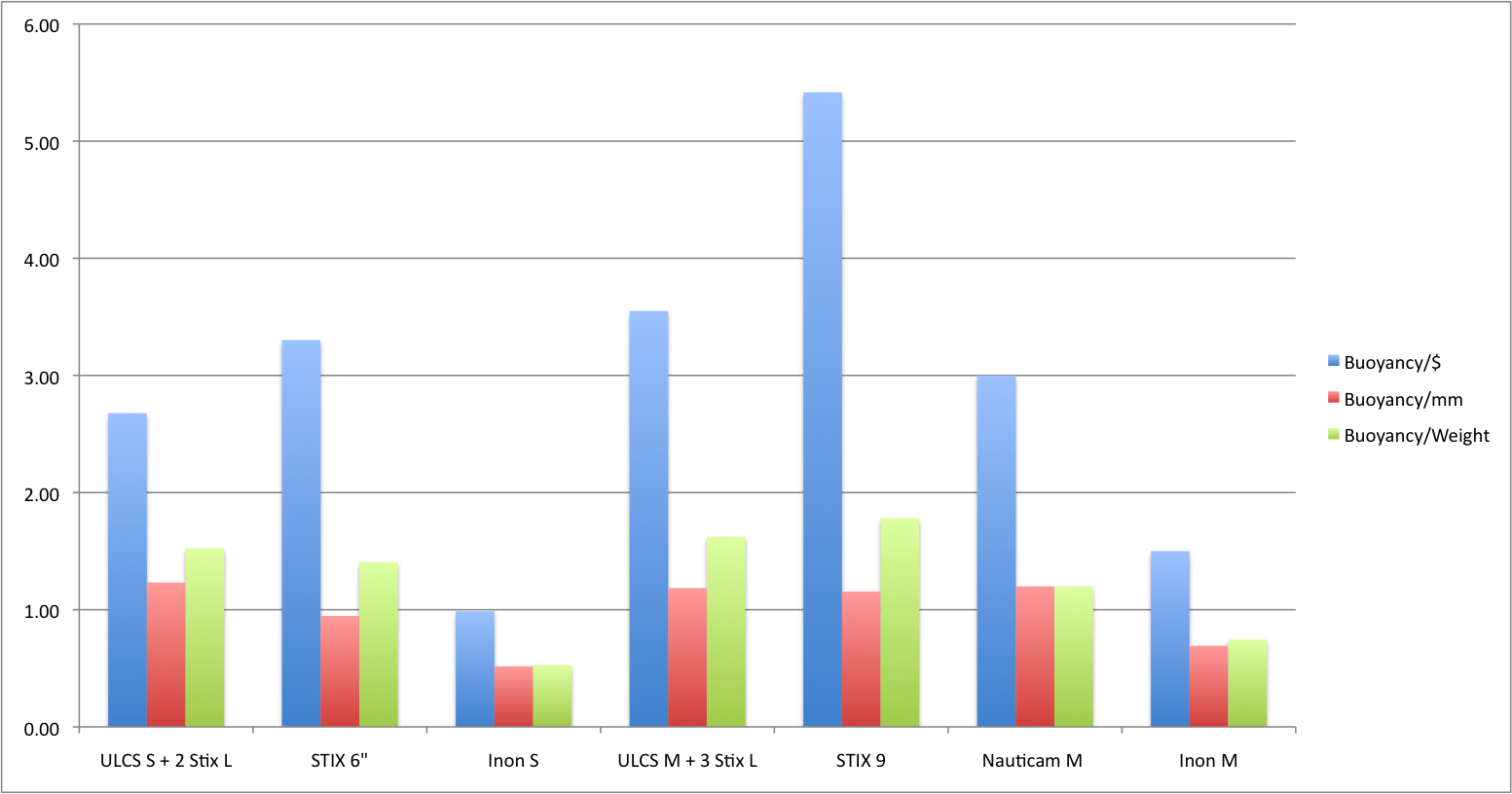
I have compared an ULCS 5″ and 8″ segment with Nauticam 60 mm diameter and Inon arms of the same diameter 52 mm or 2″. Those are the results. Update the new graph also includes Stix arms made of aluminum with plastic balls and their own floats.
Standard Float Arms Key figures
In this category you can see that a STIX arm with large floats beats a carbon or plastic float arms on all metrics in fact on the shorter segment nauticam does not even produce a float arm solution.
An ULCS 5″ segment with 2 large floats give a lift of 154 grams or 5.4 Oz and an 8″ segment a good 237 grams or 8.5 Oz, Stix arms offer 142 and 260 grams respectively in the 6″ and 9″ lengths.
This solution gives more lift in water and is lighter on land I see no benefits investing in a float arm in this range of buoyancy and for this reason I have not even considered ULCS buoyancy arms. A pack of large stix floats costs $25 for 4 units of 99 grams or 3.5 Oz lift each and those can be moved on your arm segments making it a very flexible option.
Mega Floats
I define as mega floats anything that offers at least 2 grams lift for each mm effective length. I put the Stix arms in this category even if they fall short in this metric as they are comparable and cost effective.
Each one of those solutions will provide in excess of 274 grams or 9 Oz lift in water. In this category we have the ULCS arms with Stix jumbo floats as the most agile solution at 2.5″ or 63.5 mm diameter, this has the benefit of not requiring extra long clamps to fold two segments with floats fully. Nauticam and Inon both have segments with 90 mm and 97 mm diameter. Inon segments have an extra benefit compared to Nauticam for compact camera users using wet lenses as they can support up to 2 single lens holder for each segment as in the picture earlier in this post. Stix arms made of plastic are the cheapest in this category though can’t offer the same amount of buoyancy of carbon or ABS arms.
Arm Type
Buoyancy
Cost Total
Weight
Depth Rating
ULCS S + STIX J
274
$62.50
122
40m/130ft
STIX 6″
284
$43.00
122
40m/130ft
Inon S Mega
390
$82.95
219
70m/230ft
Nauticam S Mega
375
$90.00
240
100m/330ft
Inon M Mega
650
$93.95
295
70m/230ft
ULCS M + STIX J
416
$74.25
175
40m/130ft
STIX 9″
425
$51.00
178
40m/130ft
Nauticam M Mega
655
$120.00
275
100m/330ft
Those are the results:
Mega Float Arms Key Figures
Stix float arms score higher on a Buoyancy/$ metric and also lead the way in terms of buoyancy/weight ratio however the amount of lift offered is limited and this solution does score low on the buoyancy/mm metric. Especially in the medium segment around 8/9 inches you can see that there is not much difference on a buoyancy/$ between a 9″ stix arm and an Inon M mega.
You do get a problem with this big arms if you want to fold the segments on themselves. Currently ULCS provides the AC-CSB clamp for 2″ arm segments but even with that you can’t fold two mega arms.
Inon Mega + ULCS Large
Here a few example of the issue I mentioned a mega arm with a 5″ segment with float reaches maybe 30º and without the float around 20º
Mega float + 5″ segment
Ultimately I do not think is a big issue as you can use the strobe adapter segment and still achieve all possible positions for your light anyway if you are concerned do get a couple of the longer clamps.
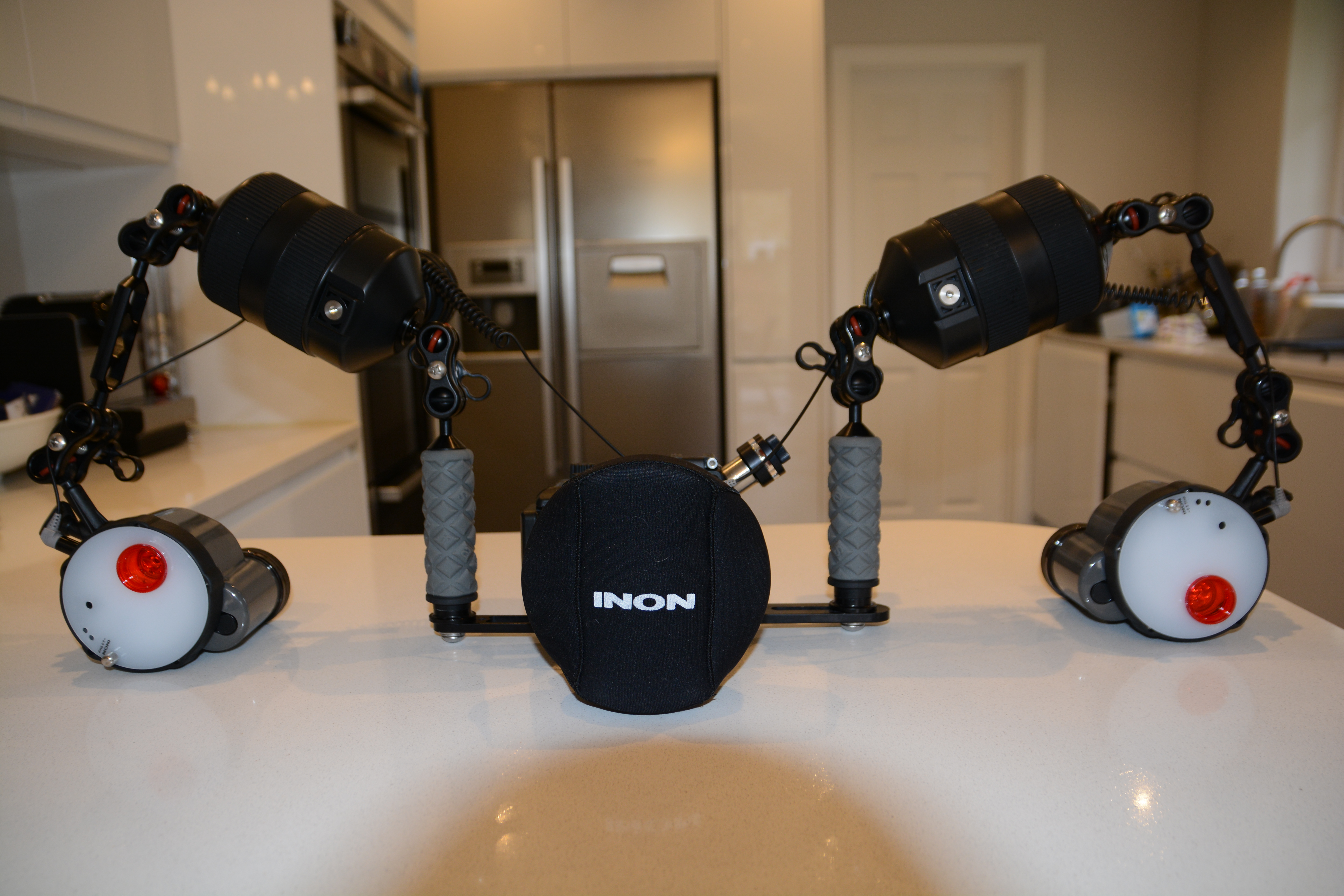
This is my rig with the float arms it does look neat compared to the version with STIX floats
Sony RX100 Mark II rig with Inon Mega float arms
Conclusion
Unless you have a plastic housing or a housing nearly neutral in water floats or float arms at 2″ diameter are not really effective, produce limited lift and are not a really cost effective way to add buoyancy to your rig. 2″ floats can be used to trim your rig in case larger floats are too buoyancy but are not a primary way to achieve the purpose. For example if I wanted to make my rig neutral I could add 2 large Stix floats on each arm.
Stix floats offer a lot of flexibility as you can take them off arm segments and put them elsewhere in a flexible way. Stix floats are also an option just within recreational limits 40m/130ft past this depth the floats loose buoyancy and eventually crush. Stix do offer custom materials float that resist greater depths on request.
Mega arms are a bit clumsy but do provide the lift needed and are cost effective even if a bit heavy on land. My preference if you use wet lenses is for the Inon arms, those are the most cost effective and provide the most lift and can also support lens holders. Inon arms are rated for 70 m/230 ft if you go deeper you need the Nauticam arms that ca go down to 100 m/330 ft. So for technical photographer float arms are really the only way forward in terms of off the shelf solutions. Obviously you can get bespoke solution using submarine grade divinycell but that is beyond the expertise and reach of a normal user.
How much lift do you need?
To calculate the buoyancy of your rig you can use manufacturers data sheets (Inon is brilliant, ULCS does provide some weights, housing manufacturers usually don’t). Failing that you can calculate this item by item using a graduated measuring container or last resort put your whole rig in water and use a luggage scale.
Caution
I balance my rig to have it neutral WITHOUT wet lenses this is for safety reasons. If you use a heavy wide angle wet lens and your rig is overall neutral the moment you take the lens off the port your rig will start to go up. Likewise if you had to loose your lens your rig would float and could escape to the surface. If you want to balance the overall rig you need to find a solution to balance the lenses themselves otherwise severe risks of runaway ascent chasing the rig could incur
Over a year ago I wrote a set of posts for the RX100 and some of the quirks of this wonderful little camera.
Steadyshot – aka Image Stabilizer
The RX100 has a specific Active mode for video not available when taking stills. I described the differences between those two modes in this post
Everyone is so obsessed of having the widest possible field of view that other more important considerations are completely missed out.
If you have ever shot a video with a GoPro underwater you know how bad is the quality of the image in the corners, this is because the flat port combined with the gopro lens create many optical aberrations.
Our RX100, especially the original Mark I, also has an issue in the corners, this is not just an underwater issue is also true on land. The lens on the camera has a lot of distortion and when corrections are applied to the image this effectively creates corner softness.
When we add a wide angle lens the image quality in the corners deteriorates further especially if the lens is flat creating a lot of chromatic aberrations that you can see in pictures with a blue or yellow halo around the edges.
Standard Steadyshot
Now the good news the Active steady shot mode crops the image of a factor of 1.15x getting rid of the majority of the corner softness.
There is of course a price to pay which is the loss of some of the angle of view. According to my calculation if you use an Inon UWL-H100 you start from more than the declared 100.8º more around 104º in fact. When the active mode is on this drops to around 95º. Remember all those values represent the largest incident angle that means the diagonal field of view.
Active Steadyshot
A lens with 100º diagonal field of view means 90º horizontal. So after the active mode is engaged our horizontal field of view looks more like 84º which is equivalent to a 20mm lens. This is sufficient for most close wide angle shots and plenty for ambient light videos of large fish or wrecks. I generally suggest to keep the Active mode on, of course if you can be in a fixed position and hold the camera really steady you can also use the standard mode and obtain more field of view. There is a chance though that you will need to crop the extra field of view if you need to stabilize in the editing phase.
For macro shots without a tripod the steadyshot is a must and helps greatly. I do not even see a reason to take it off if you have a tripod as the RX100 does not have a particularly small capture area.
Digital Zoom
This brings the second subject: digital zoom, if you shoot pictures you avoid it as what you are doing is to crop the image, something you can do yourself in processing. In video though there is very little quality loss as we use just 2 megapixels of the 20 of the RX100 camera. In my test you can use digital zoom until the 2x multiplier is reached, this corresponds to 7.2x magnification and see no noticeable degradation in the image quality. The other benefit is that the depth of field is the same despite the magnification so you can save yourself stacking two diopters with all the difficulties that follow in terms of focus.
Max Optical Zoom with UCL-165
Digital zoom is always on in video mode and I recommend to use it with a single close up lens before embarking on dual diopters or a strong single diopter. Also take into account that with a single +6 diopter your working distance is around 4″ which is ideal for most critters except pygmy seahorse and bobtail squid or some shrimps.
Digital Zoom 2x with UCL-165
Video Lights
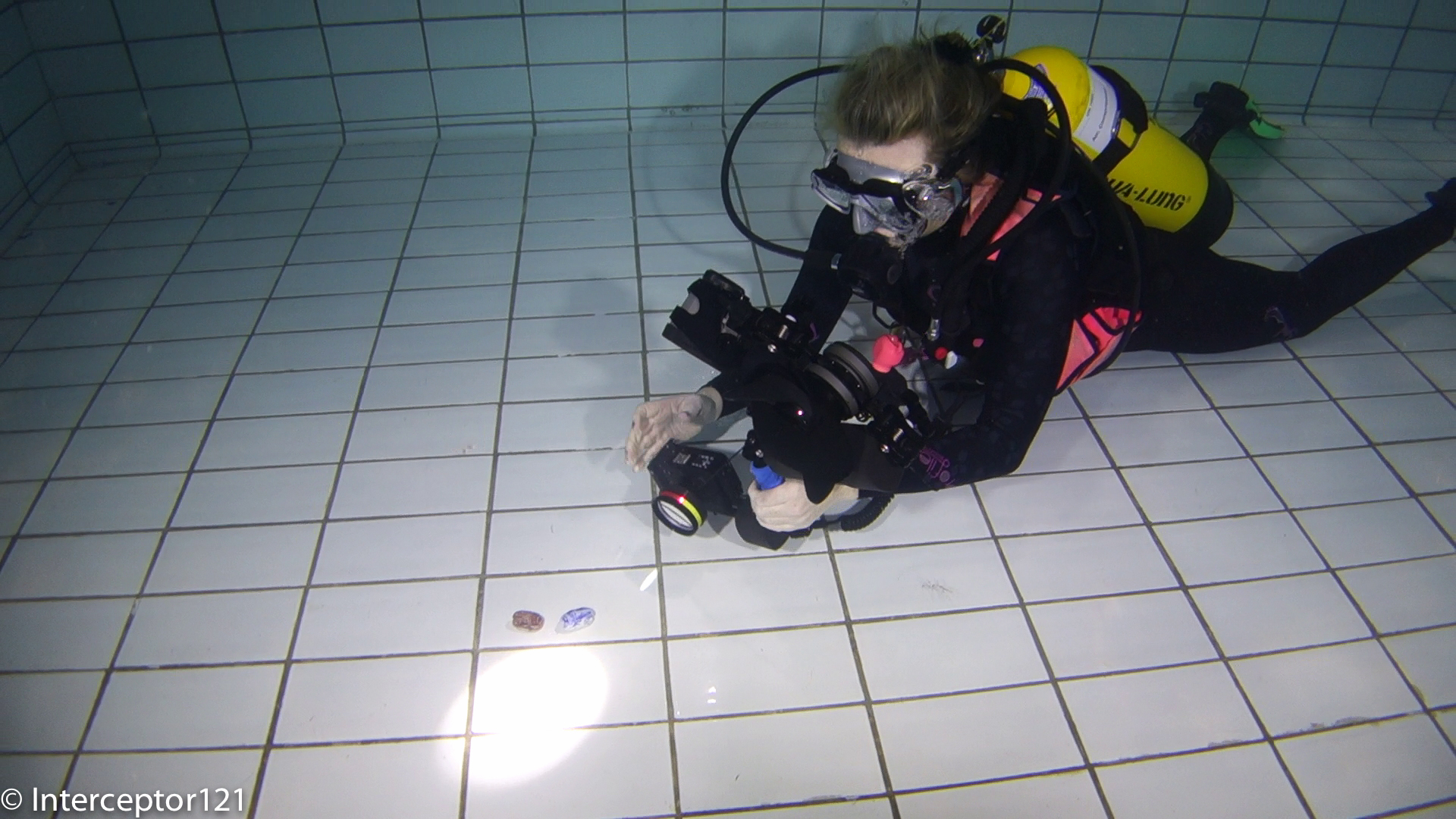
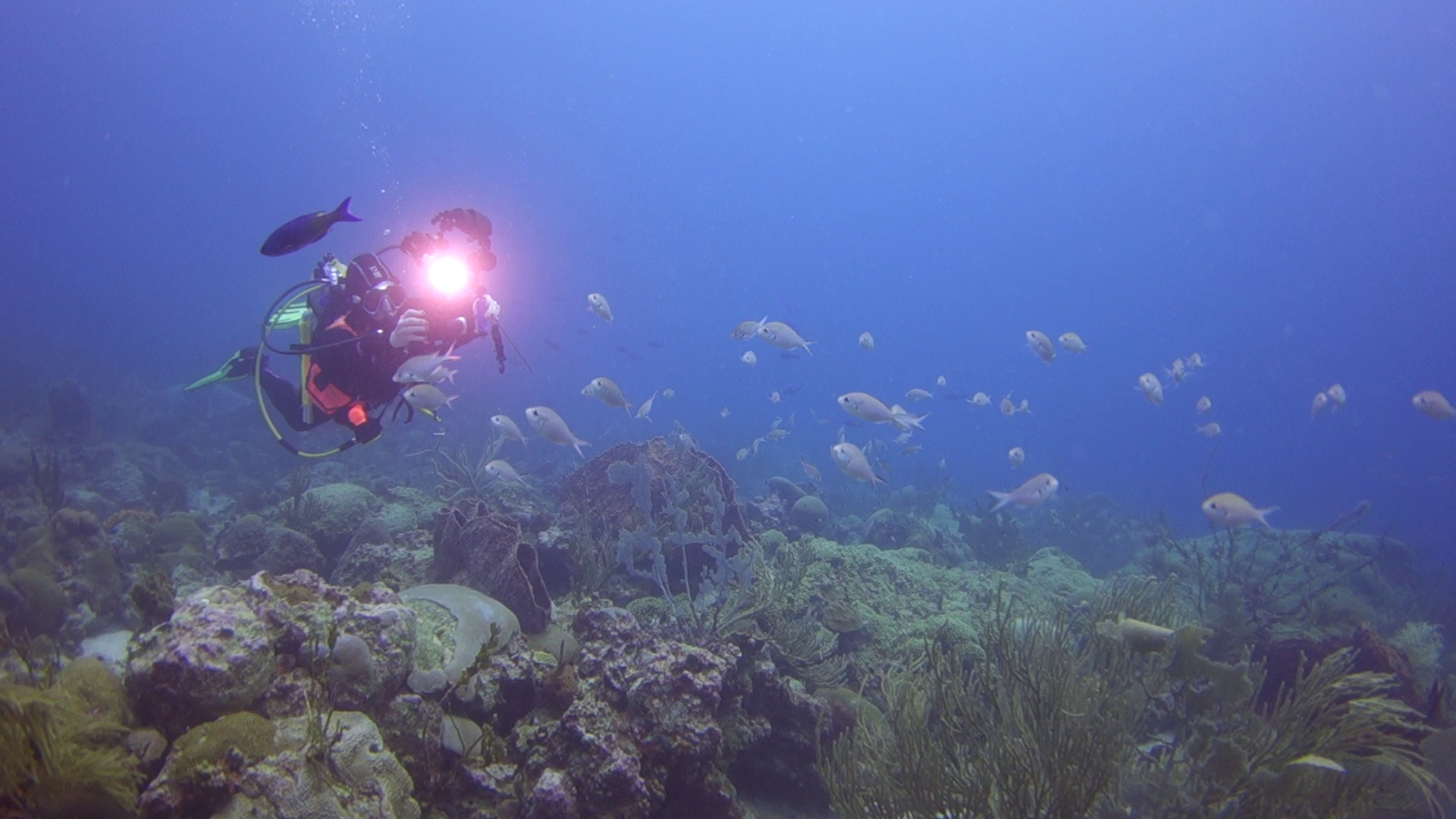
In another post I have explained that getting hung up about light angle coverage is not really the only thing to consider, there is also luminous flux and quality of light. With my Sola 1200 I can cover something between 2 and 4 feet away with decent results further away is just back scatter. Generally this is ok for some close portrait work and close wide angle and of course not sufficient to cover part of a wreck or much larger subjects. You may decide not to bother at all with lights for wide angle and just render your deep wreck dives in black and white in this case consider that a pair of Sola Dive 800 at $399 are a high quality macro set up, function as dive light and provide some decent close wide angle portrait illumination. For macro shots you need much less than that, I set my fill light at minimum (300 lumens) and the main light at 2/3 which is 600 lumens, I can shoot at f/11 with this light intensity. You can see me shooting in the feature image.
Following the failed test on the Nauticam Electrical Sync Cord bulkhead I was out in the market to check what else could be done with the M16 port on the RX100 Mark II housing.
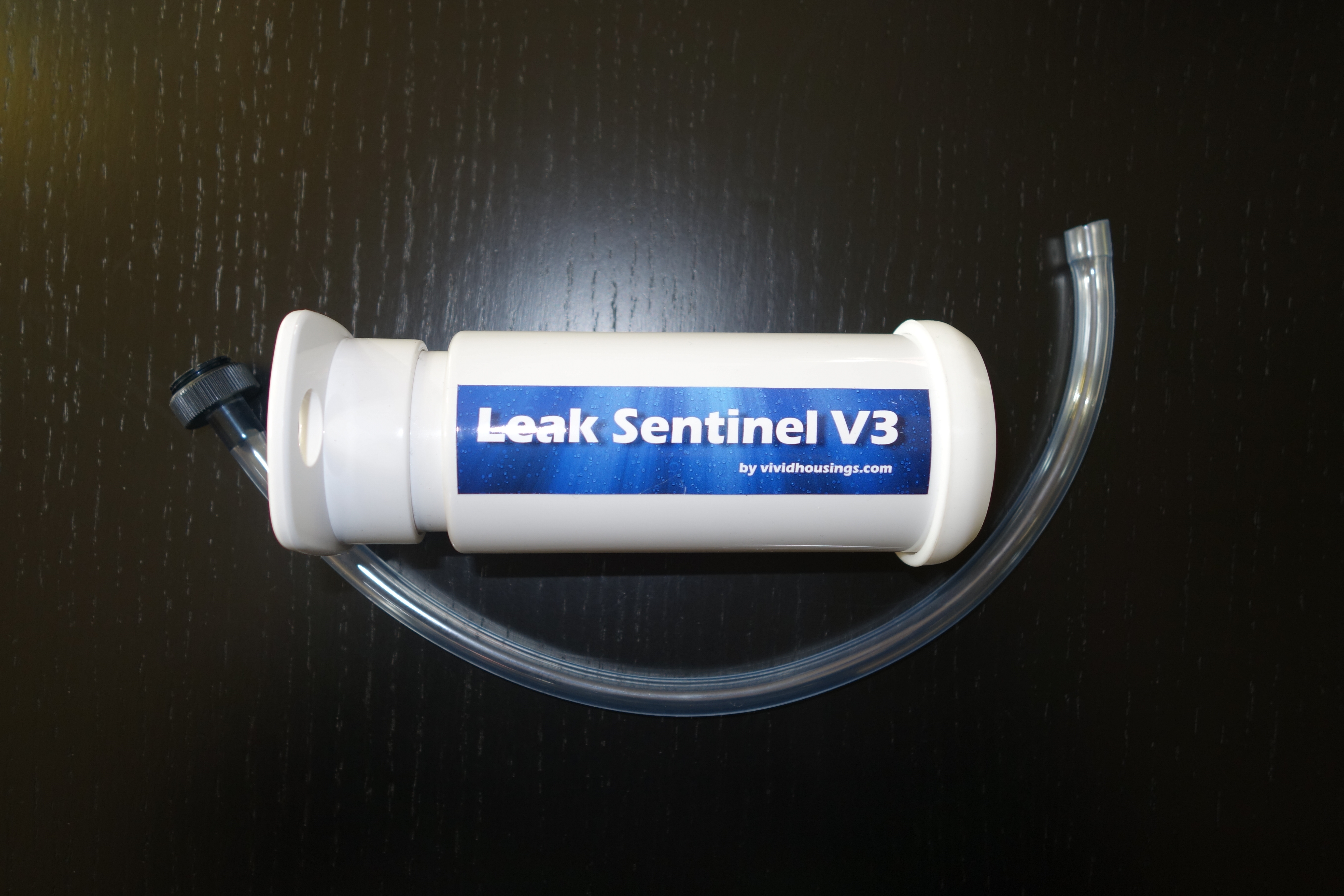
I bumped into the leak sentinel while at the London Dive Show. As you may know Nauticam provides now a vacuum system with temperature compensation on all new micro 4:3 and DSLR housings. Also older models can be retrofitted but not the RX100 because essentially the moisture sensor is much simpler.
So if the Nauticam housing has already a moisture sensor why bother adding a vacuum test. The advantages are numerous:
A moisture sensor still requires the housing to be put into water to be tested
A moisture sensor starts beeping when water has already made its way into the housing, if you are in a situation where you have a mandatory safety stop or a deco stop you don’t want really to have the additional stress of a camera flood.
With a leak sensor you can check the integrity of the housing before the dive and without putting it in water
You can rapidly change battery and the likes and not worry if you have compromised the seal of your housing
With all of this in mind I went off and contacted Vivid housings
After an email exchange about the design of the product I was convinced that it was worth getting it so I ordered one and after just 3 days it turned up in my post directly from Slovenia.
The system comes with an M16 adapter to screw on the housing bulkhead. The best way to remove the cap on the Mark II housing is using a CR2032 battery like the one of the moisture sensor.
I set up the system on the housing as in the featured image and started my preparation. It takes 3 pump strokes to get a green light and the instructions say to add between half and a full stroke to make sure it is not on the edge. I had 4 full strokes.
I prepared the housing and camera in a room at 21C and waited 20 minutes before putting it in water at 15C.
I then put the camera in video recording mode for one hour, the Rx100 has a limit at 30′ so I had to record two files. After one hour the system was still showing a green light I took it out of the water and follow the depressurization procedure and extracted the camera. Measuring the temperature inside the battery compartment the sensor indicated 28C.
Now this made me think to the fact that this solution, although equipped with a temperature sensor, does not actually manage temperature compensation. If you know anything about physics you know that the following is true for an gas also known as Gay Lussac law
the pressure of a gas of fixed mass and fixed volume is directly proportional to the gas’s absolute temperature
As our housing is rigid and not compressible this means that the ratio between temperature and pressure is constant.
This also means that if the temperature increases because the camera warms up with use the vacuum will drop (pressure increases), this could create a false positive.
I therefore performed the following steps
I immersed in water at 32C and started shooting a video clip.
After around 50 minutes the led started to alternate red and green. The camera has the temperature warning indicating a possible temperature close to 40 degrees
I kept the camera in water pretty sure there was no leak and then at 60 minutes took it out of the water
After few minutes outside water in a room at 21C the light went back to green
The camera temperature in the battery compartment was 36C
Water Temperature MeasureTemperature warning
The ambient pressure was 1016 mpa so I estimate I created around 750mpa inside the housing with 4 full strokes, however as the camera sustained an increase of 19 degrees from 21 to 40 the pressure sustained an increase of 6.5% bringing it in the warning area of the leak sentinel and generated a false positive.
Now there are a few considerations to be done:
1. If you shoot pictures even firing the flash is unlikely to get the camera as hot as when you shoot video
2. The water in the dive will seldom be 30C anyway
3. It is preferable to prepare the camera in a temperature as close as possible to the diving temperature and in the driest environment available
4. It is possible to estimate the amount of vacuum each pump strokes gives and compensate for the temperature changes
The worst possible scenario is a video camera housing prepared in an air conditioned environment this is the only scenario where temperature compensation is useful.
Generally the suggestion of the user manual to give one or half pump strokes should be changed. Say that I have a large housing and it takes 10 strokes to create the vacuum, I would suggest another 3 strokes is diving in warm water otherwise the possibility of false positives is increased.
Vacuum Pump
For what concerns the RX100 and only for very warm water shooting a lot of video there is a theoretical possibility that the camera overheats, and if the housing had been assembled in a much colder room, this gives a false positive.
To minimize this possibility prepare your housing at the normal ambient temperature of your dive site is generally the best practice for tropical diving. I also do not recommend practices like preparing your housing in a cold air conditioned cabin, some people think they avoid condensation not thinking that a 20+ degrees thermal shock does do any good to the camera.
Ultimately at €200 including worldwide shipping I can definitely recommend the leak sentinel to all RX100 users. Considering the cost of your investment even at the price of the RX100 Mark II of $750/£649/€699 this is a good tool and more than anything give you the extra reassurance of having a watertight housing, and also helps you in all your situations where you have a battery change or you have to open the housing before the end of your day.
So after a few months since I got the Nauticam housing I finally had the time to get in the water and try it on.
I was in Barbados for a week and although the diving was not exactly outstanding I did have enough to test the camera behavior.
The link to the videos are here for YouTube at 1080p
or if you prefer Vimeo at 720p
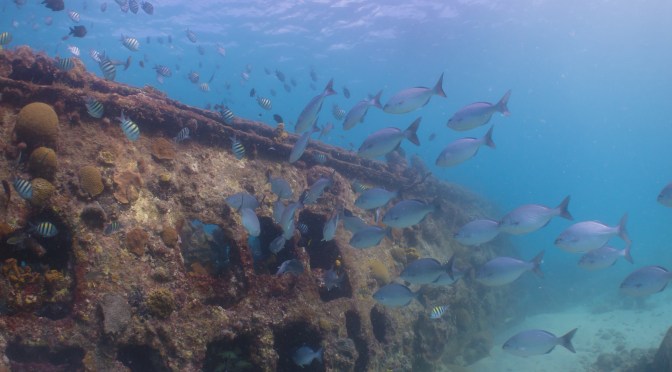
The footage was all taken at 1080p50 the highest mode of the RX100. The RX1oo can work in both PAL and NTSC standard but I chose the PAL mode just to avoid the annoying NTSC message at startup. The clip has been edited with iMovie 9.0.9 and then exported in 1080p25 using Xencoder codec for quicktime in high profile. Youtube then reconverts it to its own specifications, but at least I have the highest possible starting point.
As mentioned the RX100 shoots at shutter speed of 1/100 in 50p mode and this suited me fine in case I wanted to produce a 60p clip for viewing on the computer as currently no online system supports it.
As discussed in the previous post I shot all wide angle in camera Program mode. This allowed me to use the left control wheel button to call the white balance set menu that in video is not available. I set the picture format to 16:9 so that would show similar on the screen. I did notice that when I actually started the movie recording the crop of the active steadyshot kicked in with a reduction of field of view of around 9 degrees or a 1.14 zoom equivalent.
However the active steady shot was well worth it as I have not used any stabilization for any part of this clip and therefore not introduced any extra cropping.
The wide angle shots with the RX100 are an absolute breeze when you use a filter and there is no need for custom white balance until it gets too deep to actually use a filter. I struggled getting decent results with custom white balance, the 9900 K error came pretty much every time except when in shallow water and balancing on sand. Also the results were off with too much magenta tint to the point I had always to correct it.
Ultimately I kept the filter and the camera in Auto White balance and did not bother doing a custom reading at all. The results were excellent.
SS Stavronikita AWB
In deeper water the filter started making the image a bit dark so I took it off and used a temperature setting of 9900K with Magenta and Amber at the maximum.
For close up at distances over 20cm I still shot in program and had good results. When getting super close or macro I used Movie mode in Aperture priority mode with aperture set at f/11. Towards the end of the clip you can see a shot of a small pink frogfish that is done like that. The close up on the eye is shot with two stacked Inon UCL165 the depth of field is really small as you can see but still workable considering I hand held the camera at all time.
Pink Frogfish f/11
When I shot this arrow crab I had left the camera in program mode so it chose an aperture of f/5.6 you can see that whilst the mouth is in focus the arrow is not
Arrow Crab f/5.6
Similar situation with the pedersen shrimp where not everything is sharp in focus
Pedersen Shrimp f/5.6
Obviously I am being very exigent with my footage and in normal condition this is already good to very good.
So what I liked and what I did not like about the RX100 Mark II:
I liked:
The ergonomics and ease of use are outstanding
The camera performs incredibly well with a filter in auto white balance
The manual focus with peaking works extremely well
Dynamic range and colors are outstanding and not just for a compact
Image crisp even in the corners at f/1.8 compared to the Mark I this is extremely significant
The active stabilizer was great and meant to manipulation in post
Battery life is incredible
Performance in low light is excellent and better than the Mark I the camera never reached the ISO MAX of 800 I had set hitting a top of 640 at 30 meters
Autofocus at wide end in bright conditions is superb
The only think I hated was the custom white balance results an absolute disgrace, to the point that there is no benefit doing it. Not only that the few parts of the clip I had used it and correct it were still a bit off and required correction in post to a small extent.
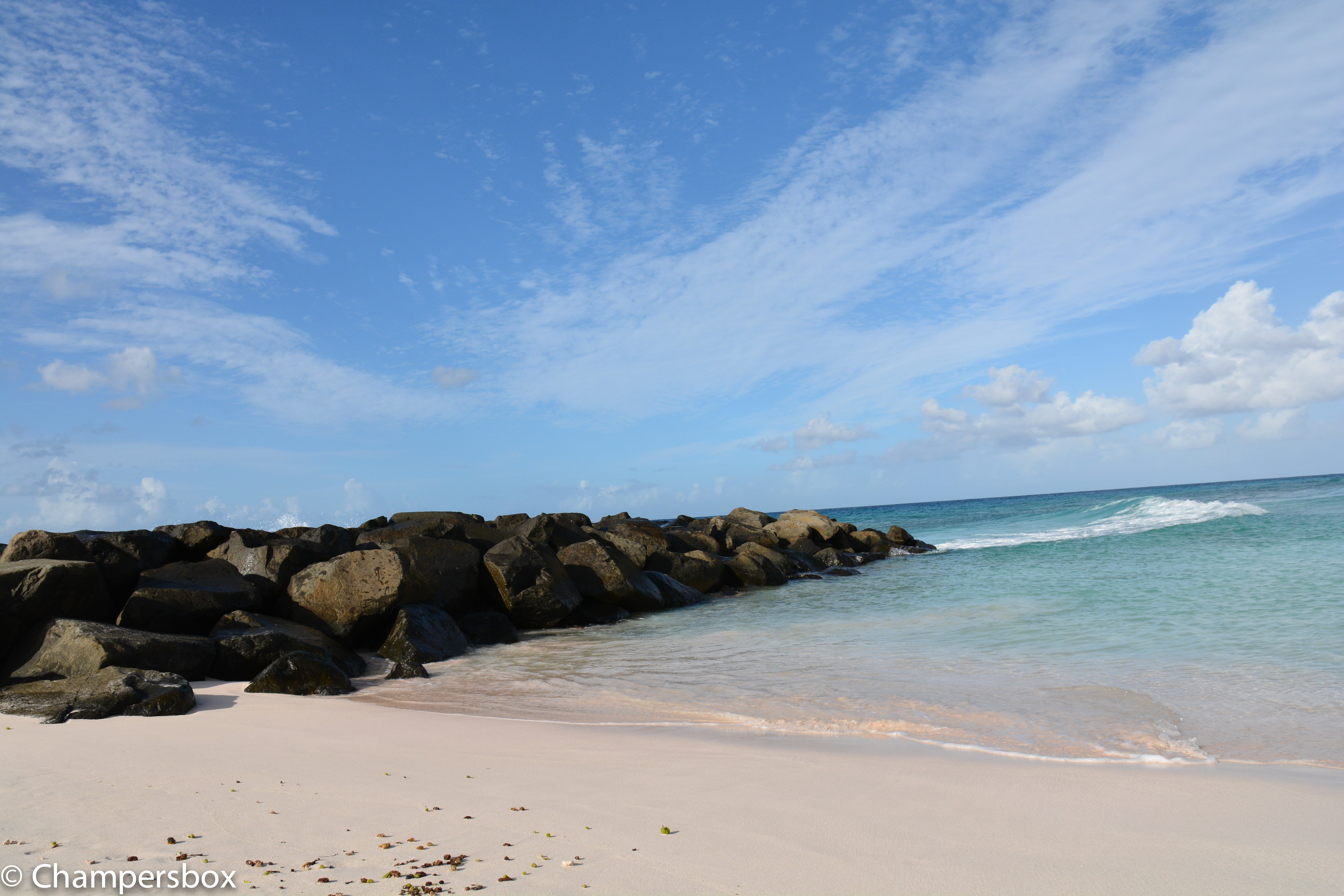
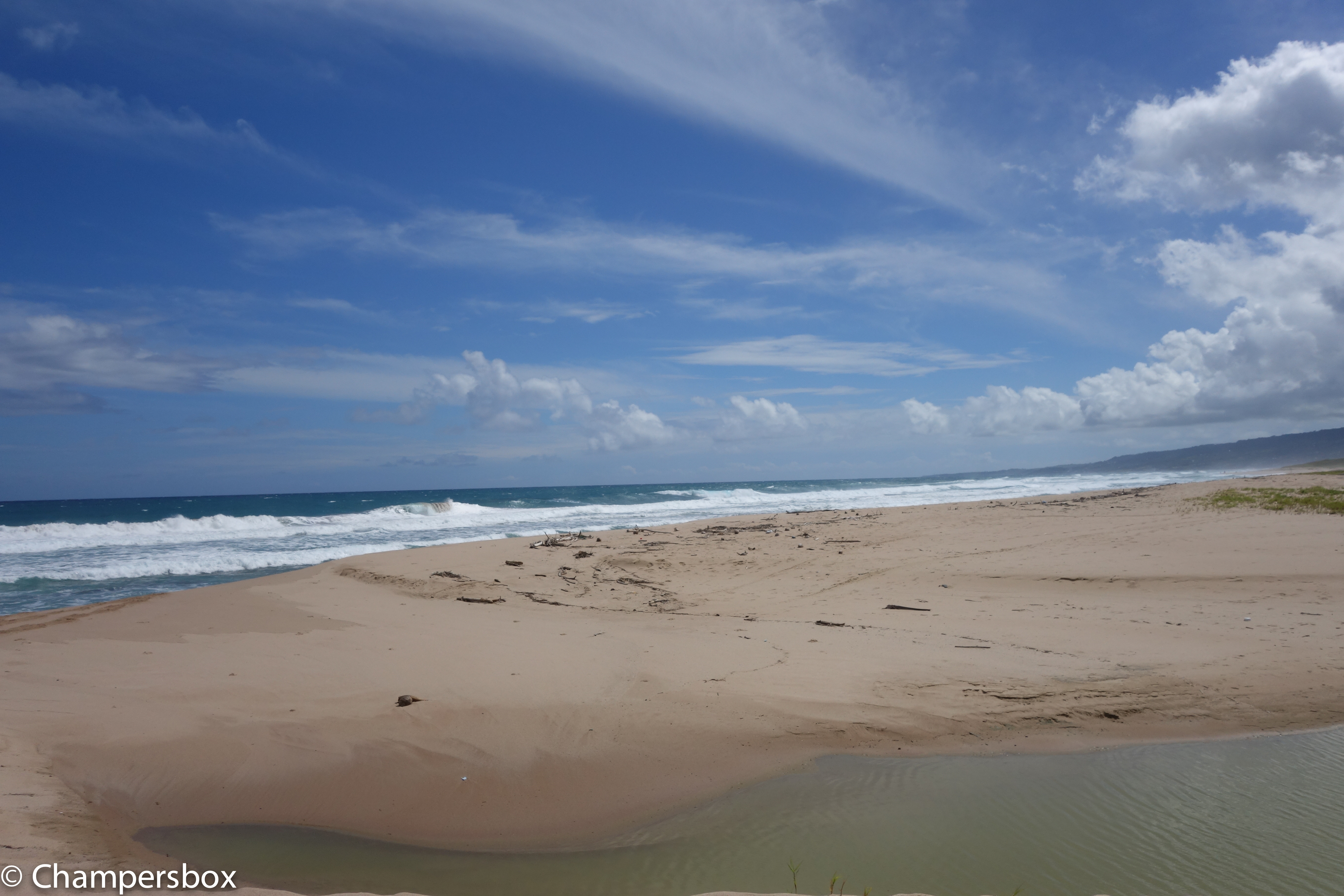
Also to consider some of the topside capabilities of the RX100 Mark II just to give an idea though this is not exactly the same location have a look as this shot with a Nikon D7100 with sigma 17-70 in comparison with the RX100 Mark II
Nikon D7100 Beach LandscapeRX100 Beach Landscape
There is a difference but considering the size of the RX100 and the fact it fits in a pocket I don’t think there can be that many complains. Obviously once you look at specific lenses for the DSLR things change but in the 28-100mm all purpose range I would say that the gap is not as much as double as the price of the two set ups.
So is the Sony RX100 the best compact underwater video set up? Definitely
Is the Mark II better than the original RX100? Yes and well worth an upgrade for video
How does it compare with the Panasonic LX7? The dynamic range and the colors are superior and produces footage that is simply better and sharper. Where the LX7 excels is at macro in clear waters, this is not because of magnification as the RX100 and LX7 perform exactly the same with diopters, and this is because of the LX7 amazing autofocus. However with a bit of silt or other objects in range there is need to switch to manual focus and there the RX100 is actually superior when using peaking even if the depth of field is actually less, the manual focus on the LX7 with the magnifier is not as good unfortunately.
So my ranking for video is:
1. Sony RX100 Mark II
2. Panasonic LX7
3. Sony RX100
I would also add that for stills the LX7 is even more rewarding at macro range due to the performance of autofocus.
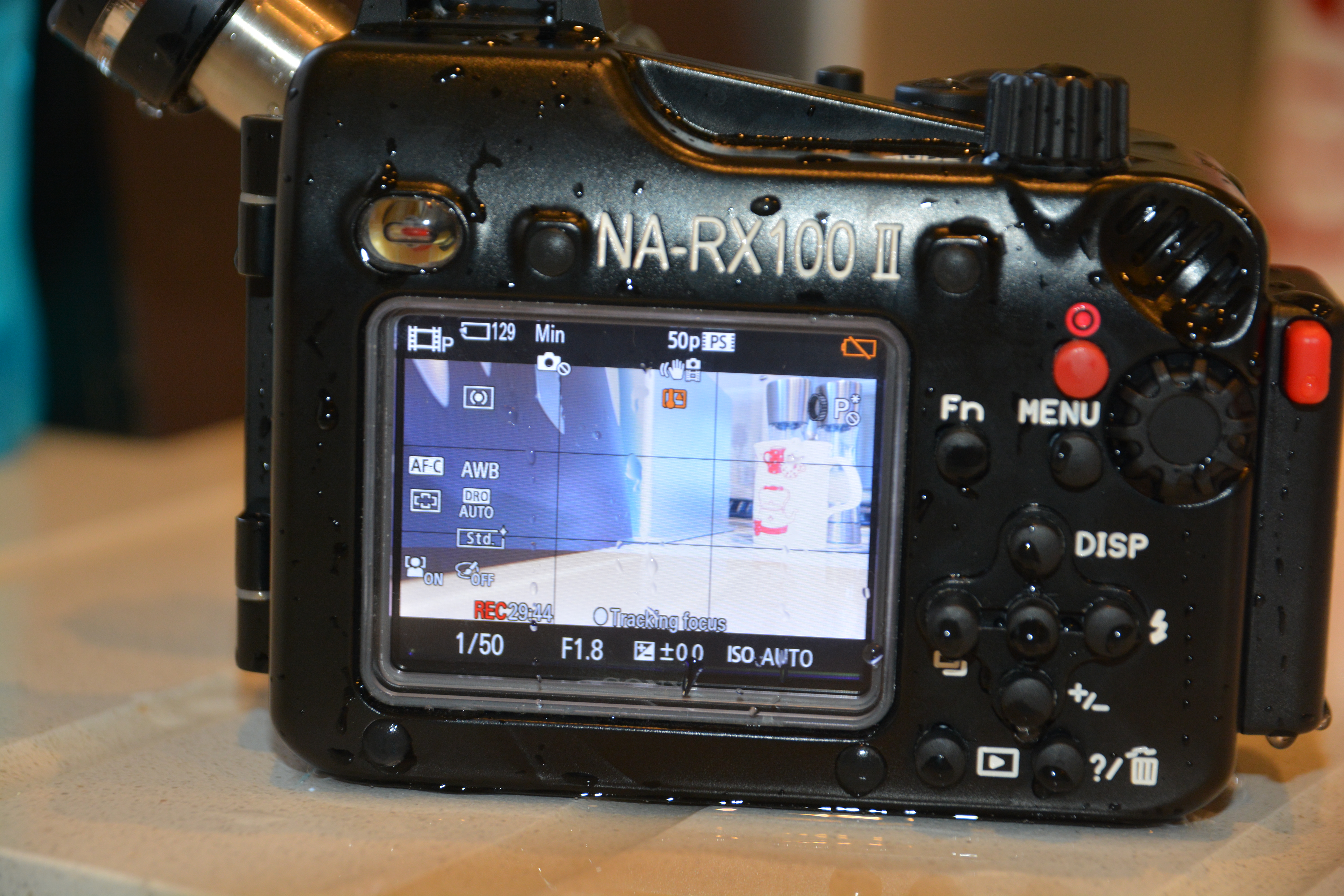
It is not a mystery that the RX100 is capable of shooting excellent video. In fact in some comparisons with SLRs cameras there is little to no difference in the footage quality. The RX100 has many settings and options so which ones are important for underwater video? I will go and explain those that I find useful.
RX100 Video Behavior
Although the RX100 offers full manual control in video this option is not as useful as it seems. Now that many video editors support AVCHD progressive the 50p or 60p options are the more relevant as the footage can be slowed down to half speed and still offer a standard frame rate (50/60p at half speed is 25/30p).
The RX100 shoots video in program mode with shutter speeds of double the frame rate so 1/100 for PAL and 1/125 for NTSC that is excellent news. The camera will then drop to 1/50 or 1/60 when the max ISO is reached which is still acceptable. In Movie Program mode the camera shoots at the lowest possible ISO for the set shutter speed at the widest required aperture. The RX100 has a minimum ISO in video of 125 and the RX100 has it at 160, which is quite high.
Shooting Wide angle
I shoot all my wide-angle footage with the camera in Program Mode. By that I actually mean Photo Program Mode. Pressing the movie button in P mode results in the same behavior that shooting video in P mode. In order to be able to frame correctly I set the image format to 16:9 also for stills. This is also useful to capture ambient light landscapes. I started shooting in P because this allowed me to white balance quickly however I found out that the custom white balance on the RX100 Mark II is a total disaster and in fact I never use it as it gives weird results. I shoot with a red filter with Auto white balance on until approximately 25/27 meters and then I move to White Balance set to K (colour temperature) 9900K Tint set to M7+Y7. When shooting with lights I also use auto white balance. Generally speaking I only use the movie button and the white balance settings for wide angle.
Deep Wreck in Program Mode
Shooting Macro
When shooting with diopter at tiny subjects focus with the RX100 is a challenge. I set my video mode to Aperture priority with an aperture of f/11 and Auto ISO, the camera will always keep a shutter speed of double the frame rate which is ideal. If you light the subject properly the RX100 will always shoot at the lowest ISO maybe at 200 but not more. I use auto white balance for all my macro. I find it convenient to leave the video mode like this so that I only have P for wide angle and Movie – Aperture priority for video. If you prefer you can set those as memory recall 1 and 2 but I find that not as useful except you don’t need to use the control dial.
Frogfish at f/11
Settings for the Function Buttons
Many features that can be assigned to the function button are not available in video or not useful. I only have 4 settings in the function wheel:
ISO
Metering Mode – Always on evaluative
DRO – I set it to auto
Focus Mode – in video only constant and manual are available
To be perfectly honest I rarely change any of those except for testing the camera exposure. Even the metering mode can be left to evaluative all the time as when you shoot macro the area is so small and evenly illuminated that I have never had an issue with exposure.
Settings for the Control Wheel
I use the following assignments and I find them very useful:
Left: White balance
Centre: Manual Focus Toggle
Right: Exposure Lock
The bottom arrow is always assigned to exposure compensation and can’t be changed I set it to -0.3 eV all the time.
White Balance
The performance of custom white balance with the RX100 Mark II is shocking worse than the original RX100, 9 out of 10 I get a white balance error and the results are usually off with too much magenta. The only occasions where I do not get an error is in 6 meters or water (20 feet) on a sandy bottom. In other conditions it does not matter if you try with sand, tanks, hand, slates the outcome is shocking. The results can be used changing the tint to an M2 or even zero but generally using a filter and auto is just much easier and better. I assign the K setting to 9900K M7 for shooting at depth, This is painful because it means that unless you have a flat lens like an Epoque or Inon you can basically forget shooting video with the RX100 as the custom white balance is erratic at least.
The Inon UWL-H100 has only one red filter that is compatible and is made by deeproof. I find this filter excellent though I prefer plastic to glass I have to say it works a treat.
Results with White Balance Error 9900 Note the Magenta tingeSimilar scene with auto white balance and red filter
Focus
The RX100 focus automatically on the center when shooting video and does it very well,. Tracking focus is not as useful and by assigning the center button to manual focus it can be eliminated. When shooting macro it is essential to use peaking. I set it to low with white color. Generally with diopters there is only one focus distance so I move the camera until the peaking shows nice white and then press record trying to be steady. That’s pretty much it.
DRO
I keep the dynamic range optimizer to Auto. This means the ISO is most of the times set automatically to 200 to preserve dynamic range. When the scene is perfectly lit the ISO is chosen to be 160. I don’t see much difference between ISO 160 and 200 but if this bothers you set the DRO to off which means the camera will mostly shoot at ISO 160 in good light conditions.
ISO and Max ISO
I set the ISO Max to 800, having analysed a lot of my footage I have not found one example where the camera shot at ISO800 yet unless I had a filter and was at 30 meters. However I prefer the camera to drop the shutter speed and keep the ISO to 800 instead of going all the way down to 3200.
Zoom
In video the RX100 activates digital zoom even when you set it to off. This deteriorates the image so you need to pay attention that the middle notch corresponding to 3.6x is not exceeded or you will see artifacts in your footage.
Stabilizer
I use active steady shot thought this reduces the field of view as it does help with shake quite a lot with macro footage.
Other Settings to disable
There are a number of settings that are harmful in video either because they use battery or because they are counter productive I disable them all list includes:
Smile / Face Detection
Picture effects
Audio recording ( I do not like bubble sound)
Wind Noise Reduction
The following are only relevant for still but I like them off regardless.


















 Interceptor121 Photography & Video Workshops