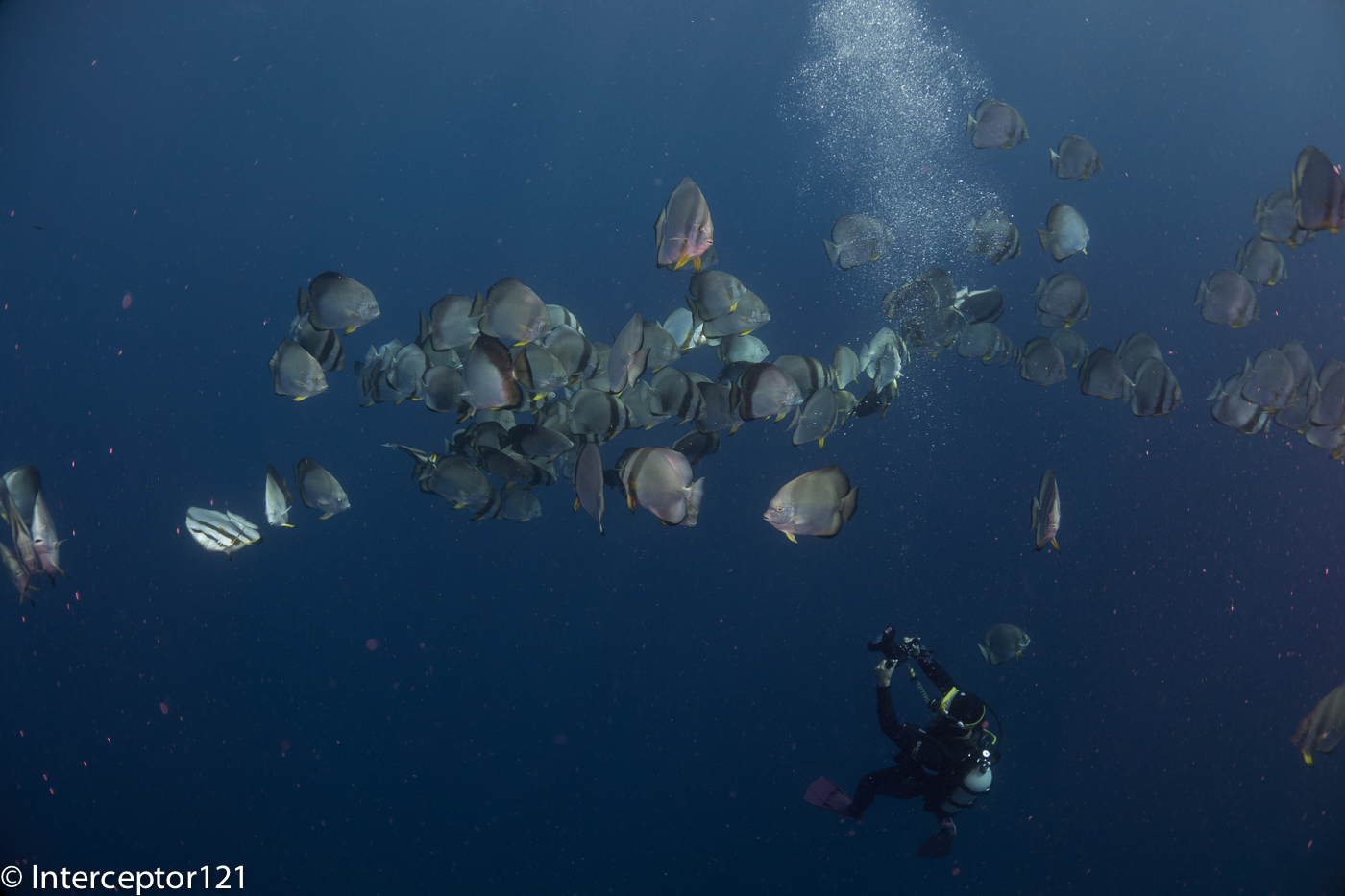
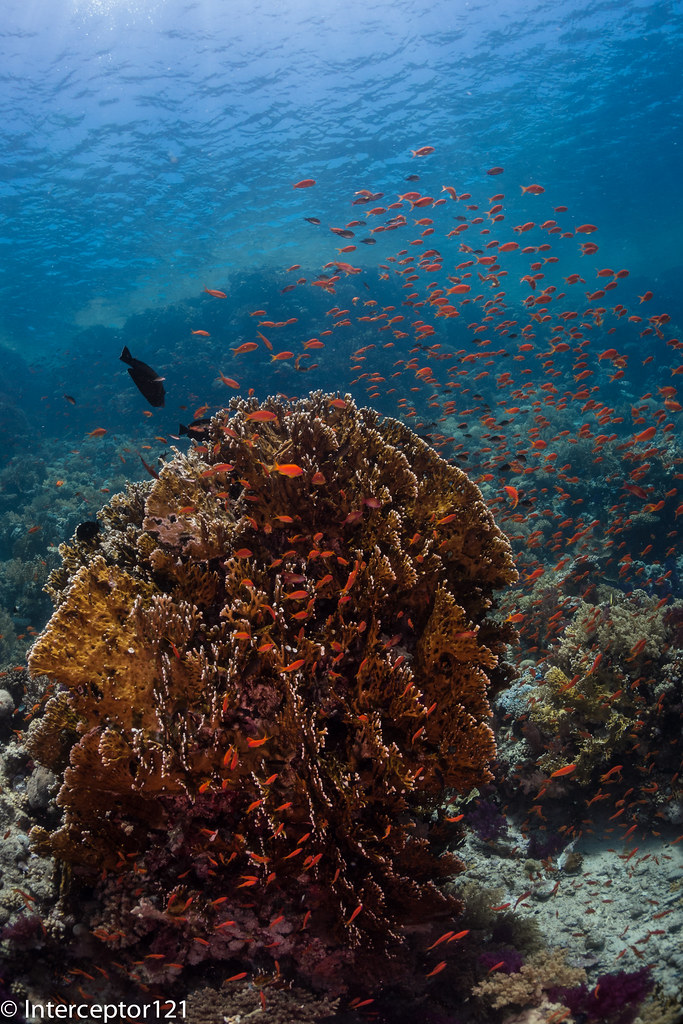
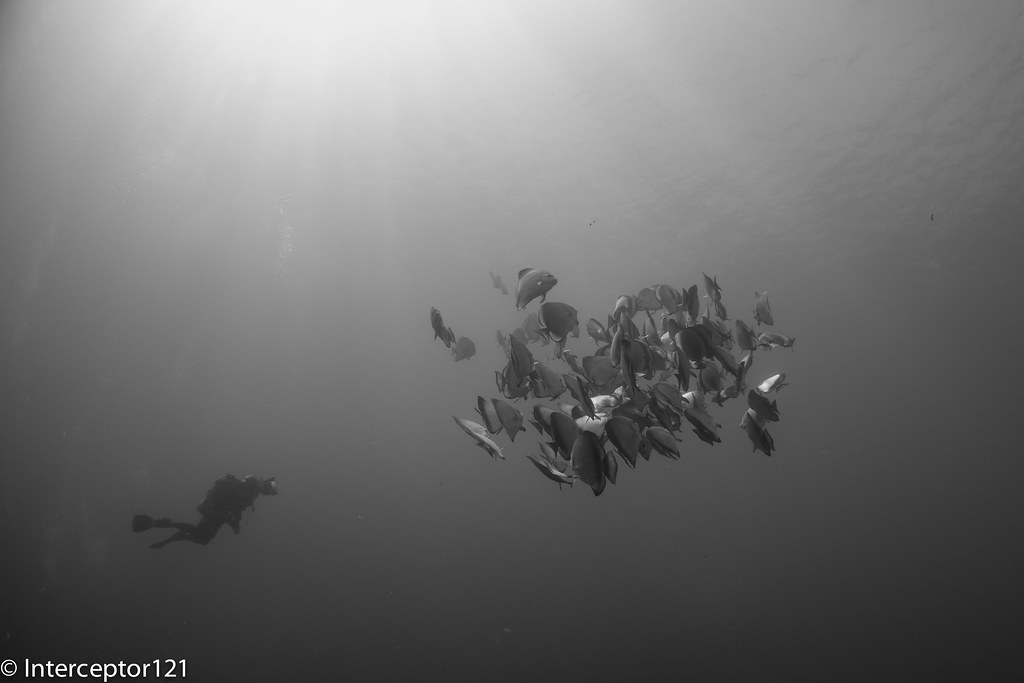
All posts by interceptor121

Panasonic DMC-LX100 Housing and More

So the LX100 gets the highest score for a compact camera on dpreview with a staggering 85%

Full details are here

http://www.dpreview.com/reviews/panasonic-lumix-dmc-lx100

Of particular interest are the video grab comparisons

http://www.dpreview.com/reviews/panasonic-lumix-dmc-lx100/8

In my opinion the 4K mode of the LX100 is as good as the GH4 there are however fewer options and control and rolling shutter seems to be an issue with the LX100.

Nevertheless the 4K video mode blows the Sony RX100 series away in any version so I guess for land use the Panasonic DMC-LX100 truly is the camera to beat.

I have been waiting patiently for housing and now is confirmed that Nauticam will come up with a housing in early 2015. Wetpixel has a special on Dema on their news section and this has images of the LX100 housing prototype.

http://wetpixel.com/articles/wetpixel-coverage-dema-2014/P1

The housing has a changeable port system similar to a micro 4/3 and 3 ports were shown at Dema

Panasonic LX100 Flat Port

The rectangular flat port is very similar to the Recsea housing for the Canon G series.

Many people get very excited to read that the LX100 has a minimum focussing distance of 3 cm at wide end but this is as such not so exciting as it seems. Due to the wide field of view of 84º diagonal this means that the area captured at the minimum distance is somewhere in the region of 1:1.25 reproduction ratio. So this is not real life macro. This compares to the much smaller area of the older LX7 that had a 1.25:1 and as such offered super macro out of the box (though nobody would shoot macro at wide end or be 1 cm away from the subject).

Which means that the LX100 will need diopters with this flat port to achieve macro and more specifically a close up lens with power in water of 10 to achieve macro. This corresponds to the Subsee 10 or the Inon UCL100 or the Nauticam SMC.

The flat port is nothing to get very excited as in water the camera will behave as a 32-100mm equivalent lens camera and a field of view of only 68º.

The other option displayed was a mini dome port.

Nauticam LX100 Mini Dome Port

This looks around a 4″ dome, if this is the case the camera will not only maintain the land focal length 24-75mm but also potentially be compatible with a flip diopter as the one used with the micro 4/3.

This is a hope more than a guess, Nauticam please ensure you can apply a flip diopter to the dome port as that would be the best all round option for this housing. As previously noted 24mm is wide enough for reef scenes and with a +10 diopter, and possibly an additional +5 or +6 this becomes a great solution for underwater video. At 4K the focal length changes to 26-81mm which is still acceptable.

24mm is not enough for wreck dives or whale sharks so here it comes the wide option.

Nauticam LX100 Wide wet lens

I am not sure if this port will work at all with the zoom but it is declared to offer 110º and therefore a 0.63x magnification.

Nauticam has declared that standard wet lenses do not work with the LX100 and hence they have come up with this specific port system.

Looking at the G7X housing this seems to be just a special adapter with a set of wet lenses more than real ports
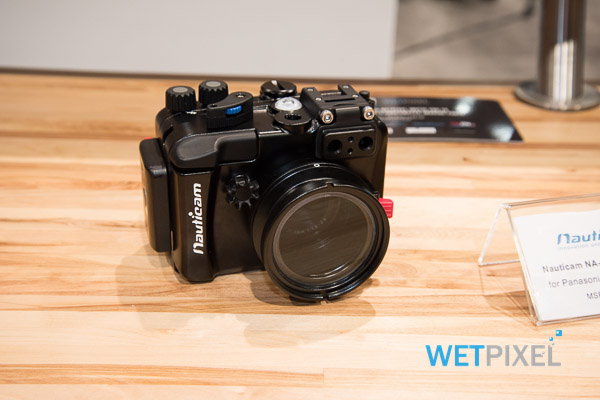
Nauticam G7X Housing

Anyway we will have to wait but my favorite option would be the mini dome especially if the flip diopter holder for 4″ dome can be used.

If this is not the case I would have a major problem with this housing as the lens out of the box is not good enough to be used as is. I am slightly confused also by that weird rectangular port considering that 32mm is not wide enough for anything I can’t comprehend the reason for its existence.

We will have to wait and see. I have contacted Nauticam asking if the dome can have a flip diopter holder. Will keep you posted

Final Note: the Panasonic LX100 is not an option for stills as the RX100 Mark III, a 24-75mm lens is not good enough and the lack of fisheye options combined with the short zoom is definitely a no go.

Right now for stills I would still consider the Sony RX100 Mark II as the winner until we get confirmation of that lenses can the Canon G7X use.

Panasonic DMC-LX100 Youtube 4K selection

Still no confirmation that there will be housing I am compiled some of my favourite 4K videos

This is a breathtaking clips from Benjamin Todd

Another test here

There have been some rumours that the 4K mode is not a full sensor read however considering that the resolution is 4480×2520 (11M) in 16:9 and 4K is 3840×2160 this gives a crop of 1.16x there are not enough pixels to do a half line scan but the resulting angle of view seems to indicate 28mm focal length not the 26mm advertised that would give a 1.08x crop. The multi aspect sensor of the LX100 could explain why the field of view relationship changes but a 1.08x scaling seems very strange and difficult to implement. Probably something in the internal logic between sensor and lenses makes this work to have more details we need to compare the 4K still shots captured by the camera with the grabs from the video clip. Nothing on the manual seems to suggest any difference between the two so my guess this is a full sensor read.

Finger crossed that Nauticam and Ikelite produce a housing for this camera soon


Panasonic DMC-LX100 First Impressions

I have been fairly busy with work and actually there have not been many things to look at on the digital compact market until Photokina.

Possibly the most interesting news is the release of the Panasonic DMC-LX100 which is coming in the UK stores on the 20th of October at £699 list price the same of the Sony RX100 Mark III.

Looks like the Panasonic will beat the RX100 Mark III quite easily on the video compartment due to the ability to shoot 4K the few samples I have seen compared to the GH4 show that with a normal lens the two cameras give pretty much the same result

Moreover the fact that the LX100 has a 12.8 Megapixels sensor with constant diagonal field of view means that at 16:9 for video the resolution for stills is 11 Megapixels and the crop to get to 8 Megapixels of 4K is minimum.

In fact the camera reports a 26-81mm focal length equivalent in movie mode at all resolutions in video. This is different from the Panasonic GH4 where the 4K crop includes considerable reduction of the field of view.

This has a positive and a negative implication, the positive is of course the field of view at wide, the negative is that the zoom of only 81mm means little magnification in macro.

The LX100 has a close focusing distance of 30 cm and this means to achieve 1:1 you need at least 9 diopters so an achromatic lens like the subsee 10 or the Inon UCL-100 is what is required, this means a working distance around 3″ from the back of the lens which really means 2″ from the front a bit close similar issue of the RX100 Mark III

However with 4K there is a lot of resolution to play with and looking at the manual it seems iZoom is available in all modes so maybe even a weaker diopter and a bit of iZoom produce good results. Most likely with a camera like this one a Subsee 5 with iZoom is more useable than a 10 diopter but this needs to be confirmed.

Some people will think why bother with all of this as maybe there will not even be a housing, well some sources tell me that my favorite housing manufacturer will in fact produce a unit for the DMC-LX100

I have not handled the camera so I do not know how the zoom works, the lens seems somewhat similar to the LX7 and therefore could work with the Inon UWL-H100 but this needs to be confirmed.

Reading the instruction manual the only disappointment is the lack of an ND filter, Panasonic has put a 43mm thread on this camera lens, surely more flexible than the electronic ND filter however this was quite a good feature underwater.

Also Auto ISO work in manual so you can leave your desired shutter speed and even aperture for your subject and rely on the camera large sensor to do the rest. The LX7 worked quite well even at f/1.4 so I am not sure this will really be needed however with a base ISO of 200 and a micro 4:3 sensor this camera could work just fine at f/4 pretty much at any depth we shall see

So it is only a matter of waiting to see what the housing will allow or not.

For all the still fans out there, this camera is going to be disappointing for macro worse than the RX100 Mark III my recommended set up remains the Sony RX100 Mark II for wide and close and decent macro, super macro is out of range with a 1″ sensor but this is another story.

If you want to understand why check this graph from dpreview

Video Feature Sony RX100 Mark II in Malta

Following from my previous post I managed to get together a clip out of the 5 dives I did

The first day was somewhat plagued by visibility a bit lower than the norm for the location but the second day was fabulous

For this trip I brought with me the Inon UWL-H100 and the red push on filter from deep roof H20 and the Inon UCL-330 as I was expecting medium size fish and nothing really small

Here is the outcome

I am quite happy how things turned out so let me share the settings with you

First I shot most of the footage in 25p AVCHD mode only some small sections are shot at 50p and actually I did not need to slow down any of the material.

For the wide shots I used steady shot in normal mode and shutter priority at 1/50th. With the filter on I had auto white balance with tint correction G2 A1. I noticed that the camera was giving red tint in some situation and so added a bit of green back. The Amber correction instead is for the RX100 itself the camera does not have vibrant yellow and is a bit blue.

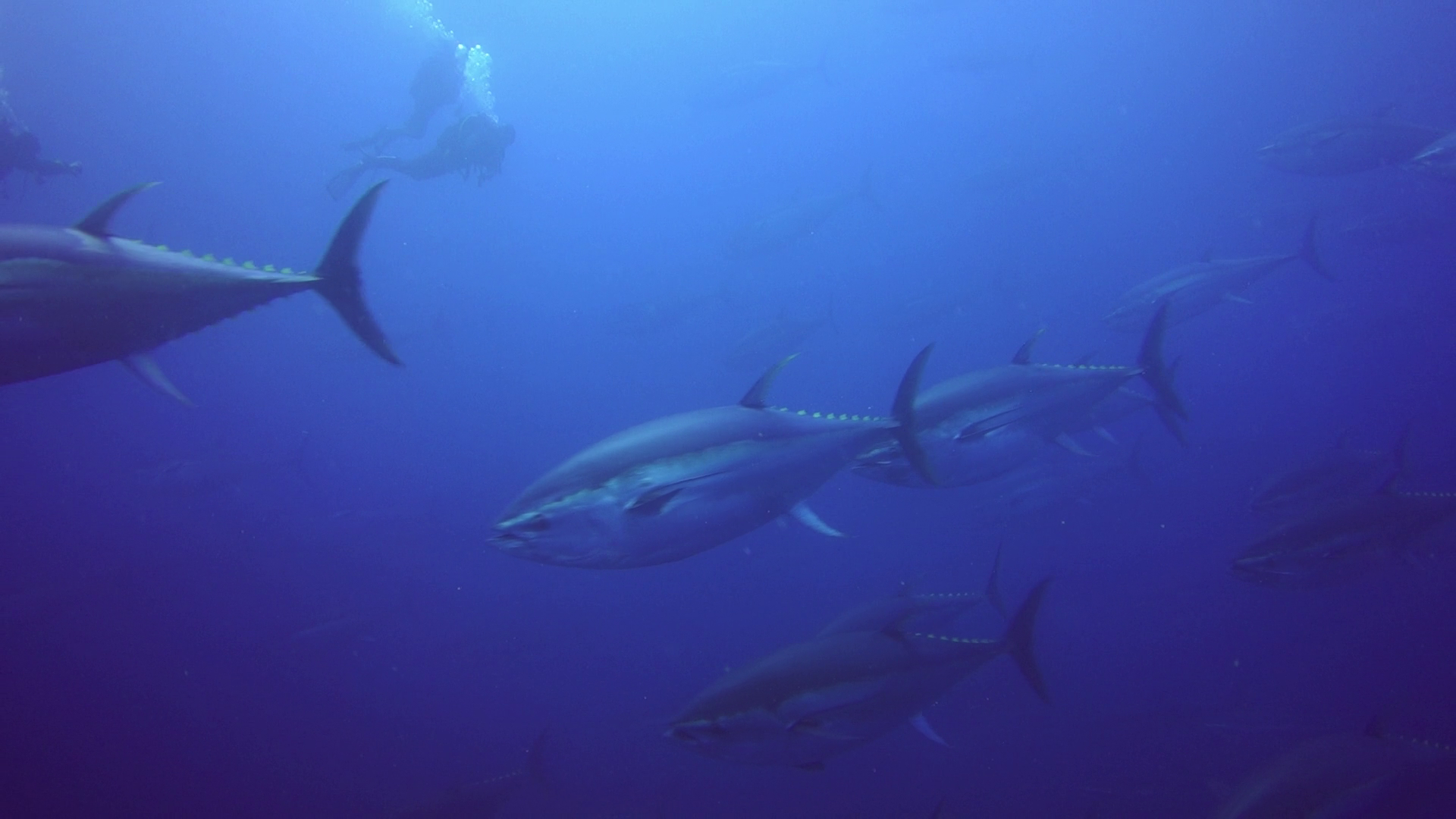
Tunas
Tunas – AWB with filter

For the first time I use creative mode changing the standard contrast to -3 in order to prevent crushing of blacks.

Exposure was set all along to -1/3 and metering to multi area with AUTO ISO limited 160-800.

I think the results are so good that in fact I have performed no colour correction to any shots in ambient light.

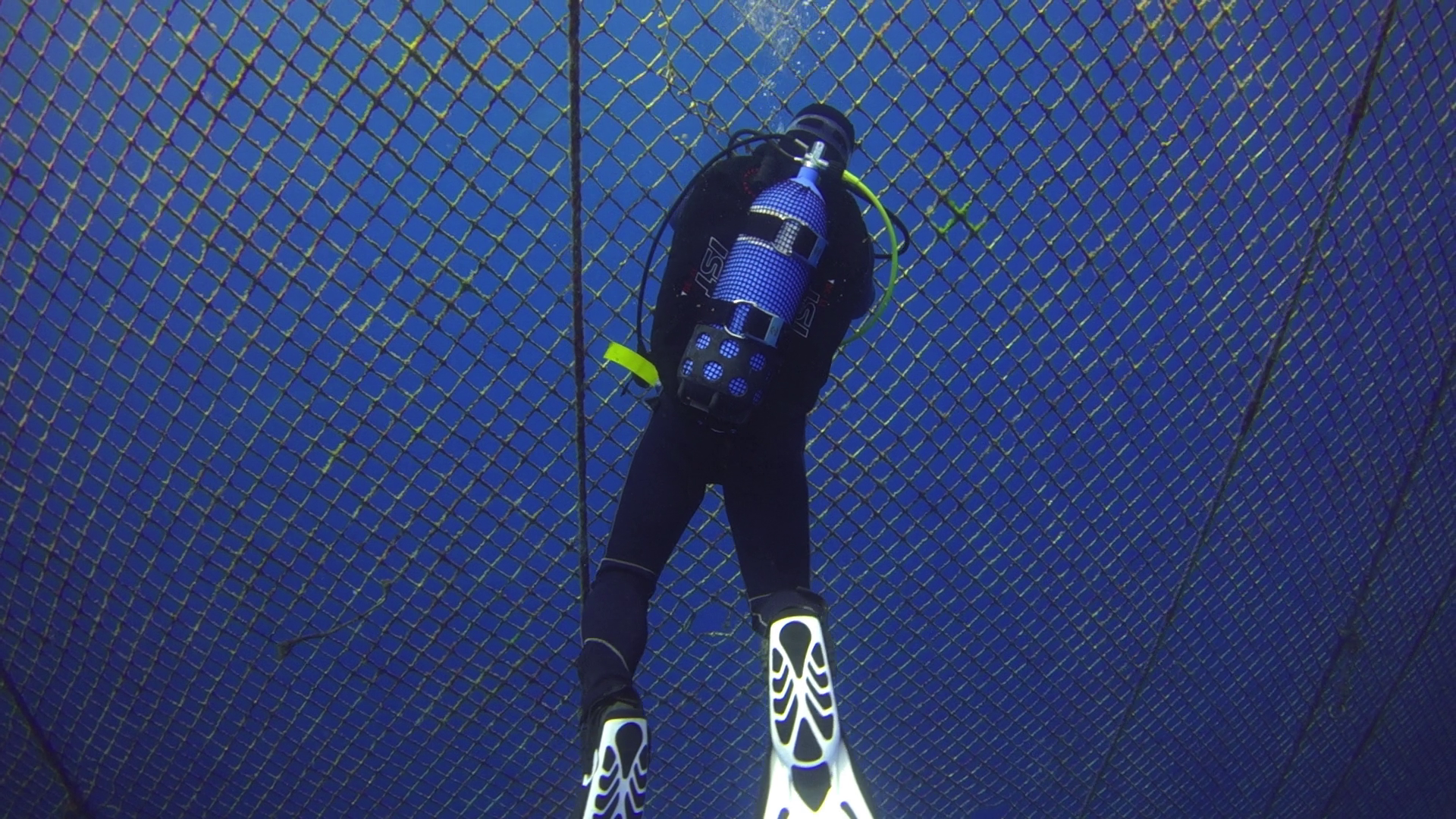
Opening the tuna farm
Opening the tuna farm – AWB with filter

For shots with lights I set up first colour temperature to 6500K and A1 to match the lights but then in some of the far shots this resulted a bit cold so I adjusted very slightly in post the temperature.

Seahorse
Seahorse – AWB UCL330

Only 40″ are adjusted in the whole video in essence is as shot and the editing took me half hour.

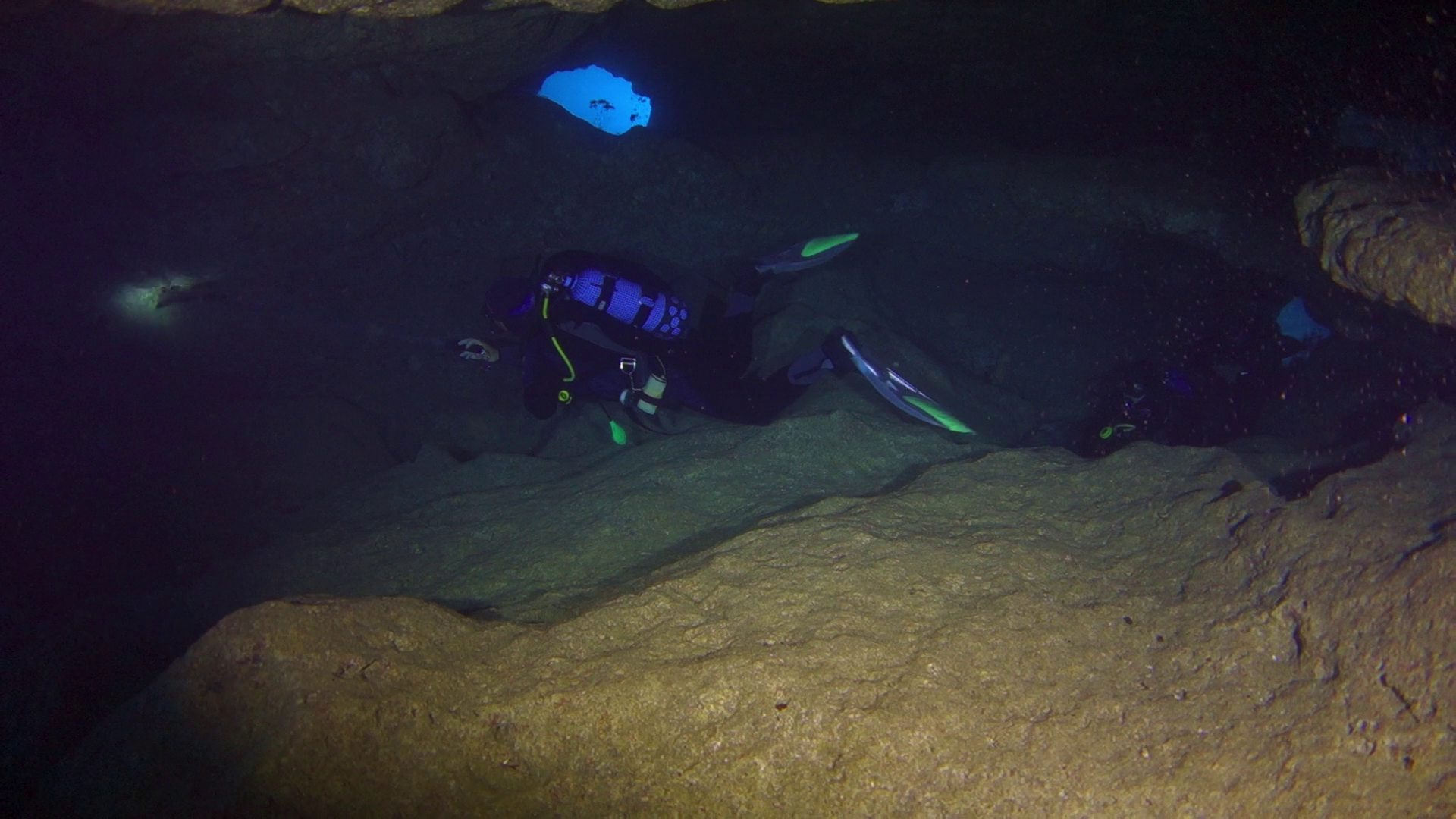
In cave
In cave –  AWB no filter

I did a bit of analysis and the camera was operating for most at ISO200 with aperture around f/3.5 – f/4.0 which is really the sweet spot of the lens.

I did have some challenges using the UCL330 for some nudibranches  that really required a stronger lens so they look a bit small, there was also surge so I had to fight with focus problems but all in all very happy.

Nudibranch
Nudibranch – AWB UCL330

The longer working distance of the UCL330 (20-30 cm or 8″ to 1′) proved challenging on walls as you are too far to hang on to anything or use a stick. I will bear this in mind in the future.

For the close up shots I used steady shot active.

I also wanted to say that a few times the camera did manage to white balance properly however the results were not exciting and frankly not worth the hassle. Using the filter is just so much better with the auto white balance.

Introducing the Sales Corner

I receive so many queries about equipment that I thought I would put some of my items on sale.

My cupboard is near enough to explode and I need to streamline the equipment I have. Currently I have 3 strobes, a huge selection of ball and clamp arms, 3/4 and 1/2 locline arms, float arms, floats, video lights, tray bases, around 15 clamps and some 6 macro wet lenses and 3 wide angle wet lenses with 3 different mounts.

I guess it is time for a clear up so I will add a section with items on sale where I will list some of the combination items.

The idea is to provide a full set of lenses or a tray + float solution as those seem to be the most asked for items in my set up.

So if you look on the menu you will see the link Sales items with details of the various sets. I can also sell the items individually but I think this makes little sense as I’d rather do that on ebay.

Many people read my posts and then go to gear shops but there there is always a little mistake or problem getting the whole set up from here you avoid that. I priced the items based on 50% of retail UK price and I would ship to UK and Europe, other overseas will attract import duty so it is not worth it in my opinion.

If there is anything you like  use the contact form on the relative page to inquiry

Tweaking the Sony RX100 Mark II Video Performance

I am currently in Malta for few days relaxing and I manage to squeeze in some dives. The Mediterranean sea is nothing sensational (from a pure diving point of view) but does offer clear water, and some brisk thermoclines, and a combination of algae, blue water, caves and silvery fish that is challenging on the dynamic range of our little RX100.

The purpose of this trip is mostly to refine the video settings and go more in depth in few topics. I wanted to try specifically the following:

  • Metering modes
  • Creative modes
  • Stabiliser modes
  • Tracking focus
  • Medium size fish portraits
  • White balance
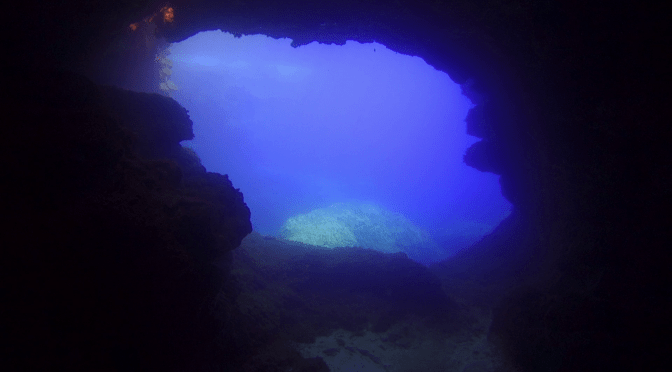
  • Caves and low light

Some of my settings will be the same and I am not intending to changed them those are:

Auto ISO: 160 – 800

DRO: Auto

Starting off with metering, the first attempt was to try and use the camera on 0 exposure compensation with centred weighted average metering.

Entering Cave Fairly Bright

Pretty soon I realised this gave issues of banding of the blue water, this was apparent not only in backlit shots but also in normal wide angle of fish in specific cases. So after dive number 1 I changed it to the standard -0.3 from dive 2.

I set a new creative style with contrast at -3 in the hope to recover detail and seem to be working fine with the shots still having plenty of contrast.

Lowered Constrast on -3

I also tried spot metering for close up but it makes no sense the video lights are too wide and ended up with burned highlights at the edges of the frame so back to centred weighted average for close up shots.

Spot metering
Spot metering

So when it comes to metering my settings are:

Wide angle: multi area

Close up: centered weighted average

I did some tests with stabiliser in steadyshot mode, this gives back some field of view and the lens offers 100 degrees diagonal and 90 horizontal, I actually think a bit more anyway with fairly stable conditions this worked fine. At longer focal length for close up I am still using active mode.

Schooling Fish 100 fov

I have a +3 diopter for this test as I realised in my last still trip I don’t have a lens for medium size fish, the lens worked very well and I also tried the camera tracking focus but it seems it won’t work with fireworms or similar. So either keep normal focus or manual with peaking.

Tracking focus fail
Tracking focus fail
Rock FIsh UCL 330
Rock FIsh UCL 330

White balance has been a subject of discussion, I did manage this time to white balance a few times but to be honest it was not worth the effort there is a better correction of the purple hue of the filter but this can be corrected setting Green to 1 or 2 in AWB. I also changed the AWB to include a correction with Amber 1 as per examples. Very happy with the results I think this is the final set up with this filter lacking a proper orange filter.

AWB corrected
AWB corrected

Shooting in low light was rewarding with ISO maxed out at 800. I am becoming less and less a fan of video lights in cave due to the amount of backscatter am getting. I think I will default at using the lights as dive torches instead of wide beams of even leaving them off for effect.

Backscatter
Backscatter
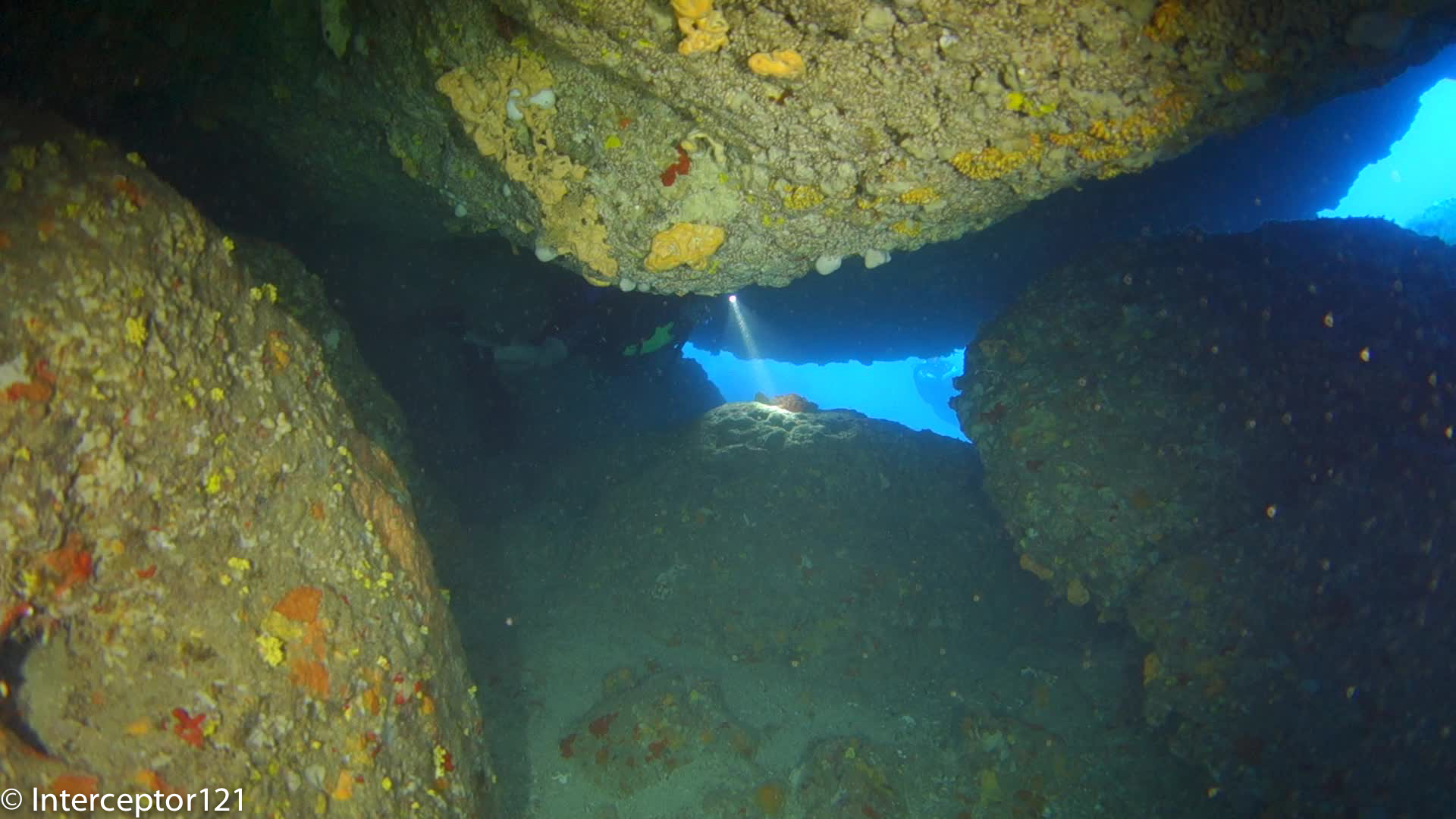
Cave in natural light


Underwater Photography Workshops – My Tips

I thought the Red Sea workshop with Alex Mustard was brilliant to I thought of writing down my notes and sharing them with you.

This final post is a general one and has my lesson learned from attending the workshop, those that follow are generic tips that I think would be beneficial to anyone wanting to attend a similar experience.

Before the Workshop

The experience actually starts before you even attend the sessions key points for me include:

  • Ask questions about the workshop and how it works
  • Know your equipment
  • Take all the gear you have
  • Be fit and self reliant
  • Set your self objectives

I did not really ask many questions before going as Dr Mustard sent a very comprehensive document however this is not standard and it is better to ask in advance about the conditions, the dives, the type of training and generally how the workshops is organized. Some have talks, other have one to one, other are just dive trips where you ask when you need. Not all types fit everyone so better to make sure you go to one that matches your need.

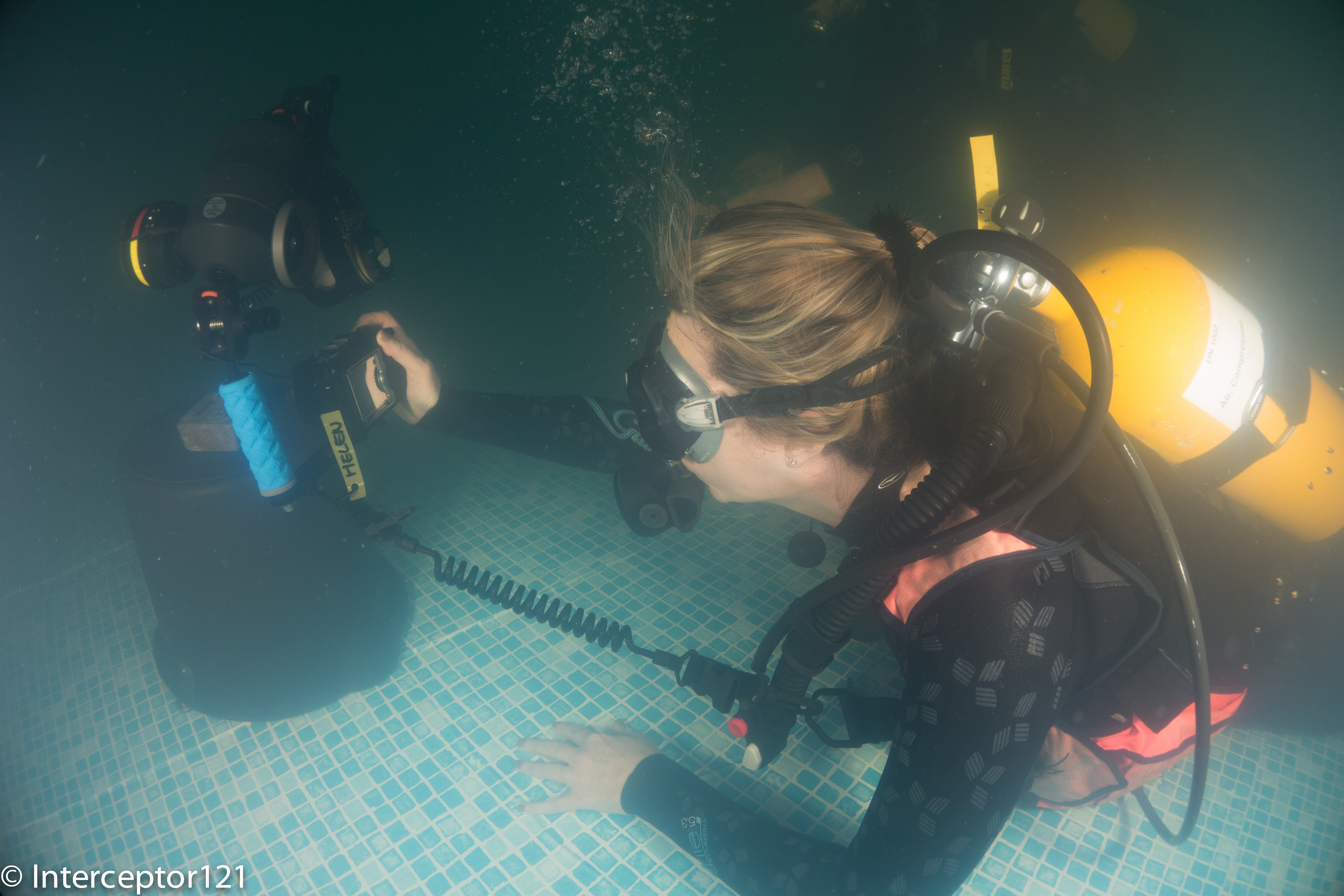
Sadly even this time like in every trip I have come across people using their equipment or part of their equipment for the first time. The end results is wasted dives and opportunities, I cannot stress enough that testing your rig in a pool before going allows you to familiarize with it and make any corrections you need.

Pool Conditions
Pool Practice

Also take all the possible lens, ports, parts that may be useful. Once you are there you don’t want to have regrets about something you have left home. In my case all was there but I did not know about remote strobes otherwise I would have got myself a trigger as I have 2 Z240s.

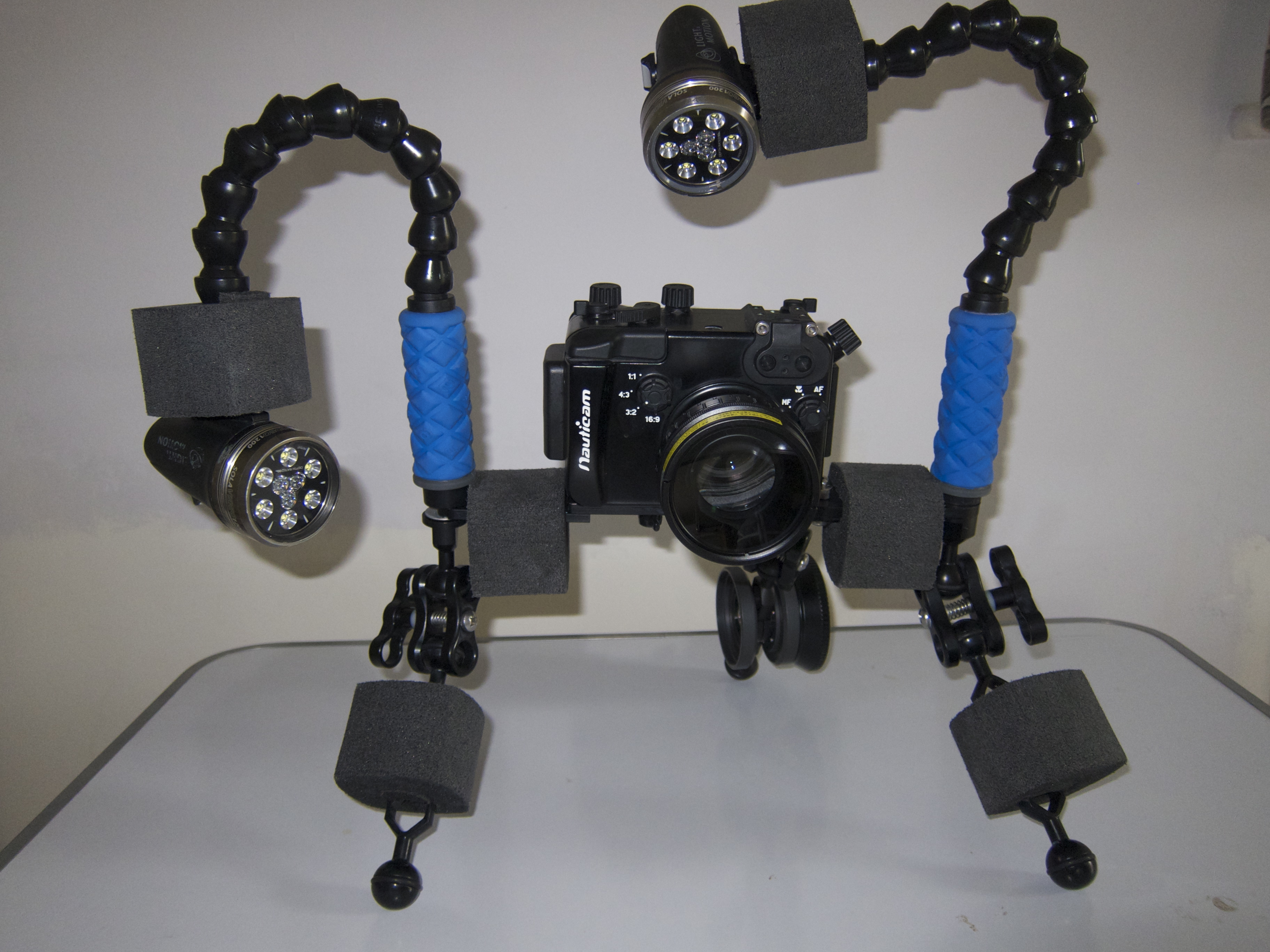
Transformer Tray
In case of doubt exceed with equipment

In most of those workshops buddy system does not really apply so make sure you are self reliant and fit as the conditions allow to avoid embarrassing or even dangerous incidents. Once there dive within your comfort limit and if you don’t really have a buddy dive with a guide.

It is useful to know before you go what your objectives are, for example what type of shots you want to work on. This means you have something to do over and above the assigned tasks.

During the workshop

Once there you need to stay focused on your performance. Those are additional points to think about:

  • Deliver the assigned tasks
  • Go off the beaten track
  • Learn from other participants
  • Take notes

Sometimes during those workshop there are challenges or set shot that are suggested, this is your opportunity to compare your work with others and therefore you should make sure you deliver those also to find out if there are limits with your equipment.
Eggs
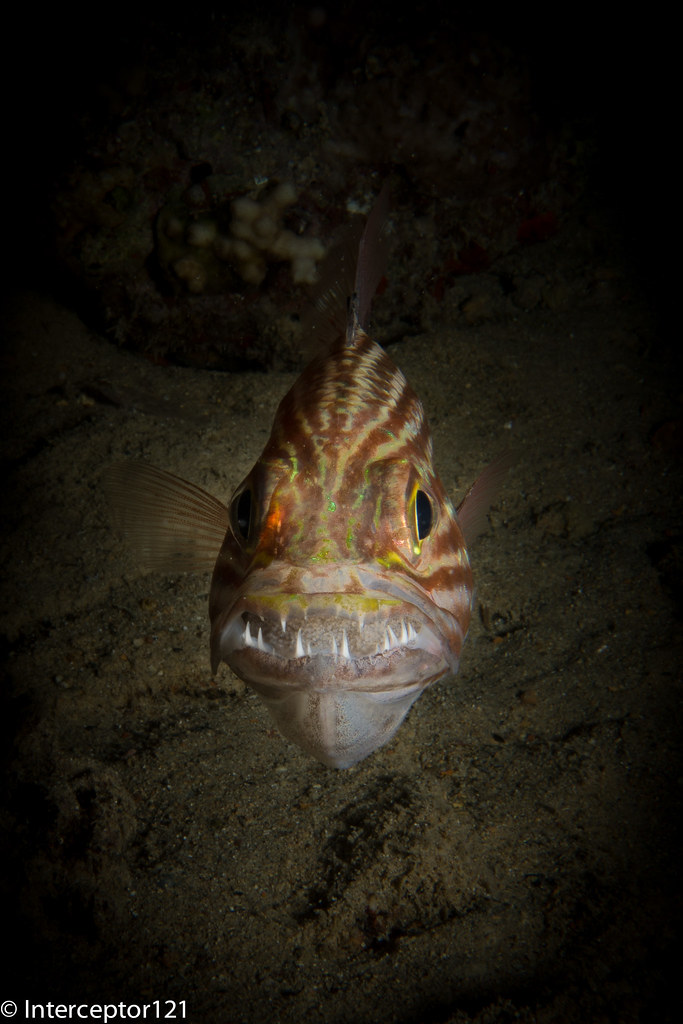
In the Red Sea workshop were given the task of taking pictures of cardinal fish with eggs in their mouth. I realized I could not fill the frame because I lacked a mid range close up lens and my camera would not focus closer.

In addition to the suggested shots you should make changes to those and try something different even if not totally different.

Ras Katy Sunset

There are many landscape split shots but not many portrait so why not try one results can be excellent and it is easier with a small dome.

Other participants also will give a go to the same shots or have better editing skills it is worth to watch and learn.

Trucks
My buddy was setting up a remote strobe I fired a few shots (unintentionally of course) so I got my own shot!

Finally take notes of what you did right and wrong and if you missed anything.

After the workshop

After the sessions are over still there is work to do over and above going over your pictures again.

  • Write down your lessons learned
  • Look at other people images
  • Order any equipment that you missed

Well it goes without saying that I put the notes together and summarized them here.

I also found great to connect to other people and then look at their gallery for other shots that we had not discussed before.

Finally I ordered myself an Inon UCL330, funny I had this lens and sold it not realizing the real use which is fish portraits!!!

That’s all for now if you go on a workshop soon I hope you find this useful.

Red Sea Workshop with Alex Mustard – Part VI Schooling Fish

On Friday we were up for our last 3 dives at Shark Reef the current had not changed but this time I decided to give more a go to the schooling fish after setting up all the backgrounds I wanted.

As you can see from the image on the title we had more of the usual divers chasing fish but this did not deter me this time as I developed a specific technique to do the dive that I used fully on the last two photo dives.

So after a bit of experimental shots like this one

Batfish school from Top

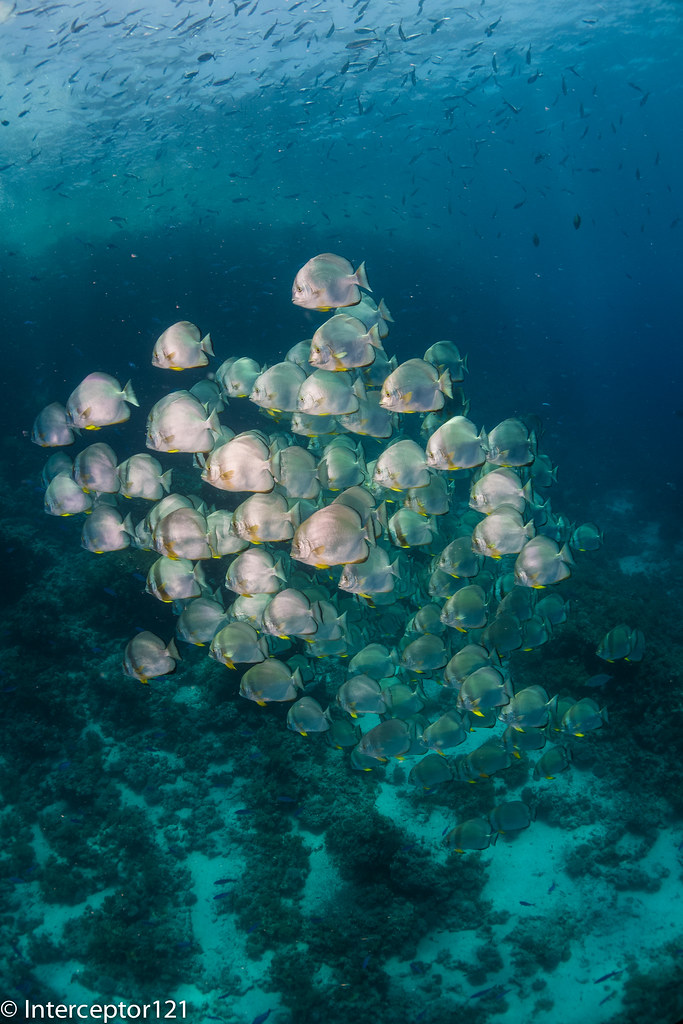
It was time to give it a proper go. To be honest is not that I like batfish that much and probably this is one fish that you can shoot in RAW in ambient light however if you do that you need to sacrifice quite a few ISO stops. With strobes the issue is to get the school in a formation that allows you to do a good job with lighting. This is my best shot for the session.
Schooling Batfish on Reef
What I like about this shot is the light on the fish or most of it where you can see yellow fins but also the background and a hint of surface.

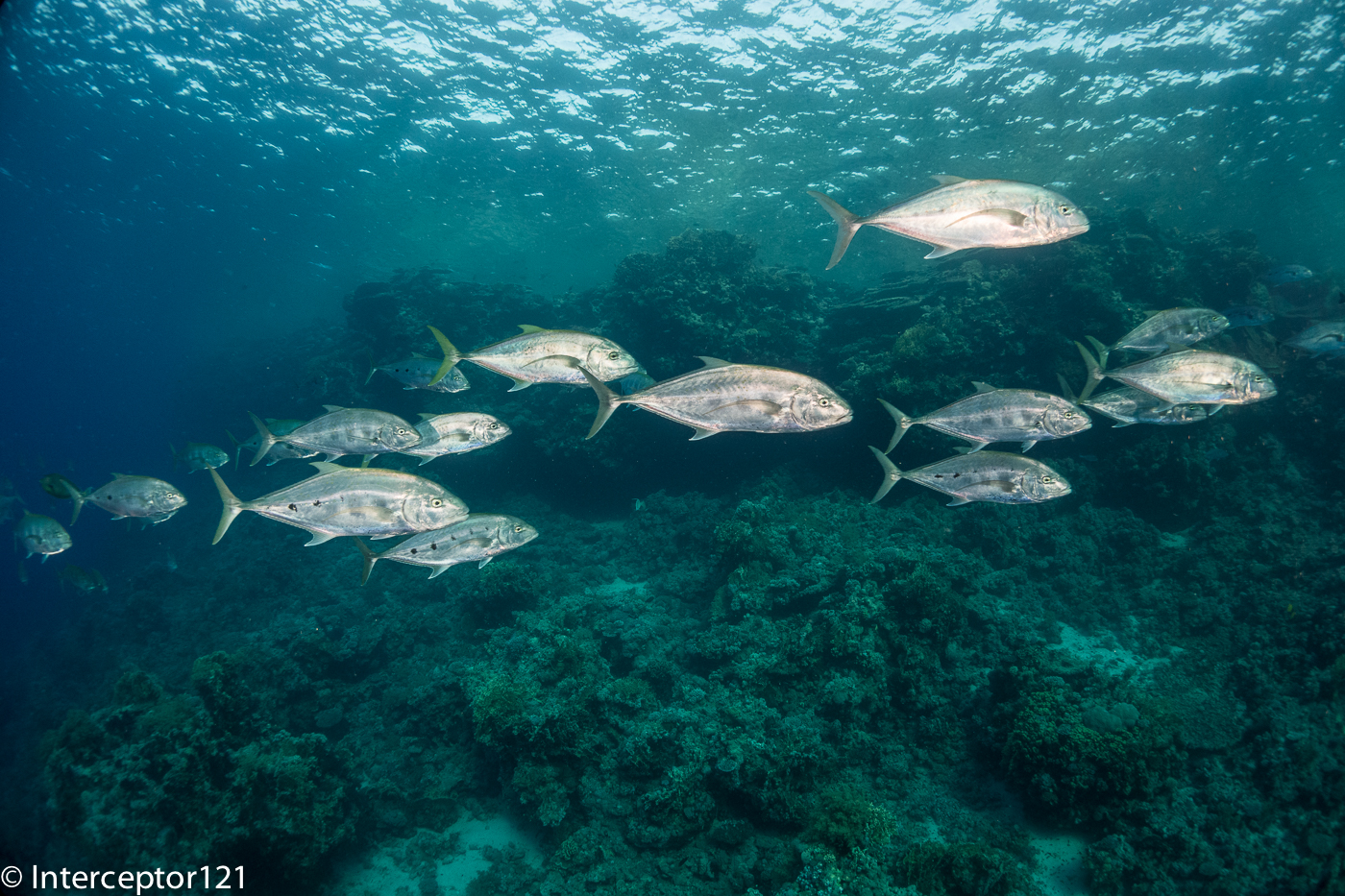
Other fish that featured on the day were jacks but catching a school of those running past is quite hard unless the school is really big and they circle you.

Jacks Schooling
Jacks Schooling

In those type of formation you have all sort of issues with hightlights form the strobes in fact I was shooting 1/4 of power.

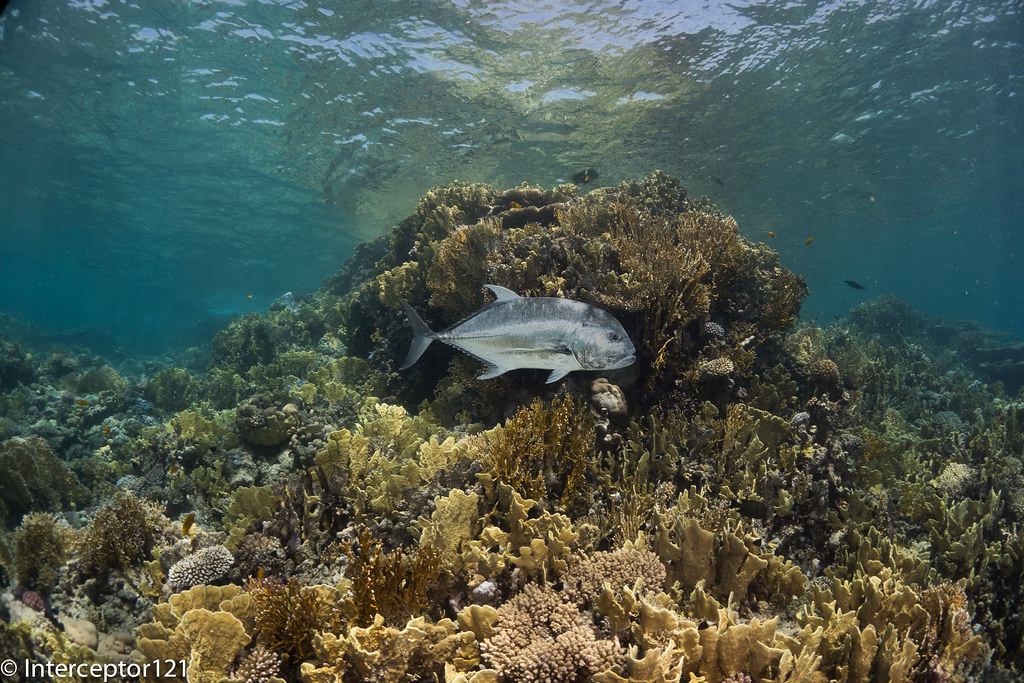
Giant trevallies made a more interesting single fish shot like this one.

Giant Trevally
Contrary to what you may think this is a shot with strobes otherwise you would not see the texture of the fish as you see it. Maybe a busy background but good technical exercise.

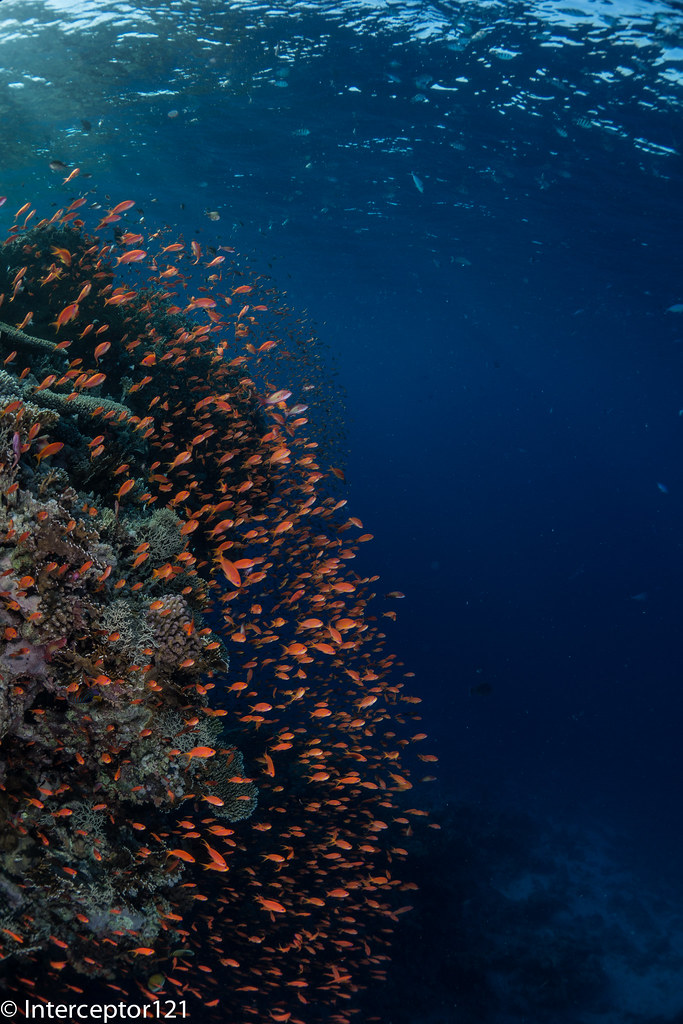
I also attempted a few anthias shots just to try a well tested technique to get them buzzing out the reef

Red Reefs
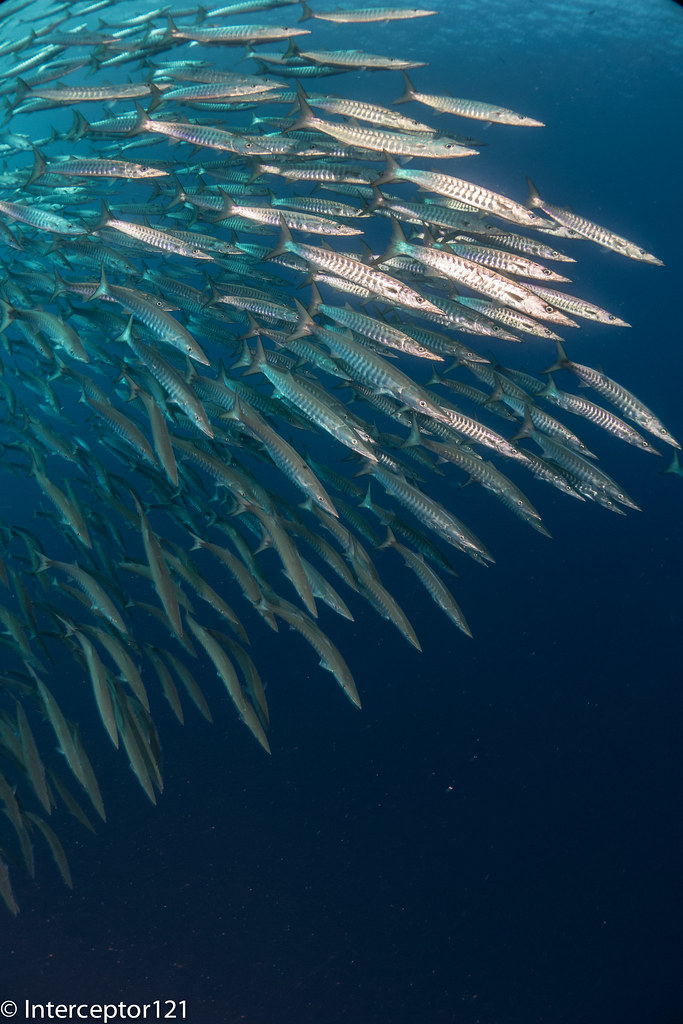
In the middle of the dives while I was waiting the barracuda school came out to play. Barracudas are quite tough as they require strobes to lit properly and I find the multitude of black and white shots that you see a bit boring as the fish texture is what makes the shot.

You have several challenges with the formation, if the school is big is difficult to take it all unless you are on the bottom or on the top. In the first case you need to control bubbles in the second you shoot the bottom so better be neat.

Anyway with a bit of patience I got the shot that I wanted

Arrows
It is impossible to illuminate properly all of them but this shot has got the right geometry and I think is quite pleasant.

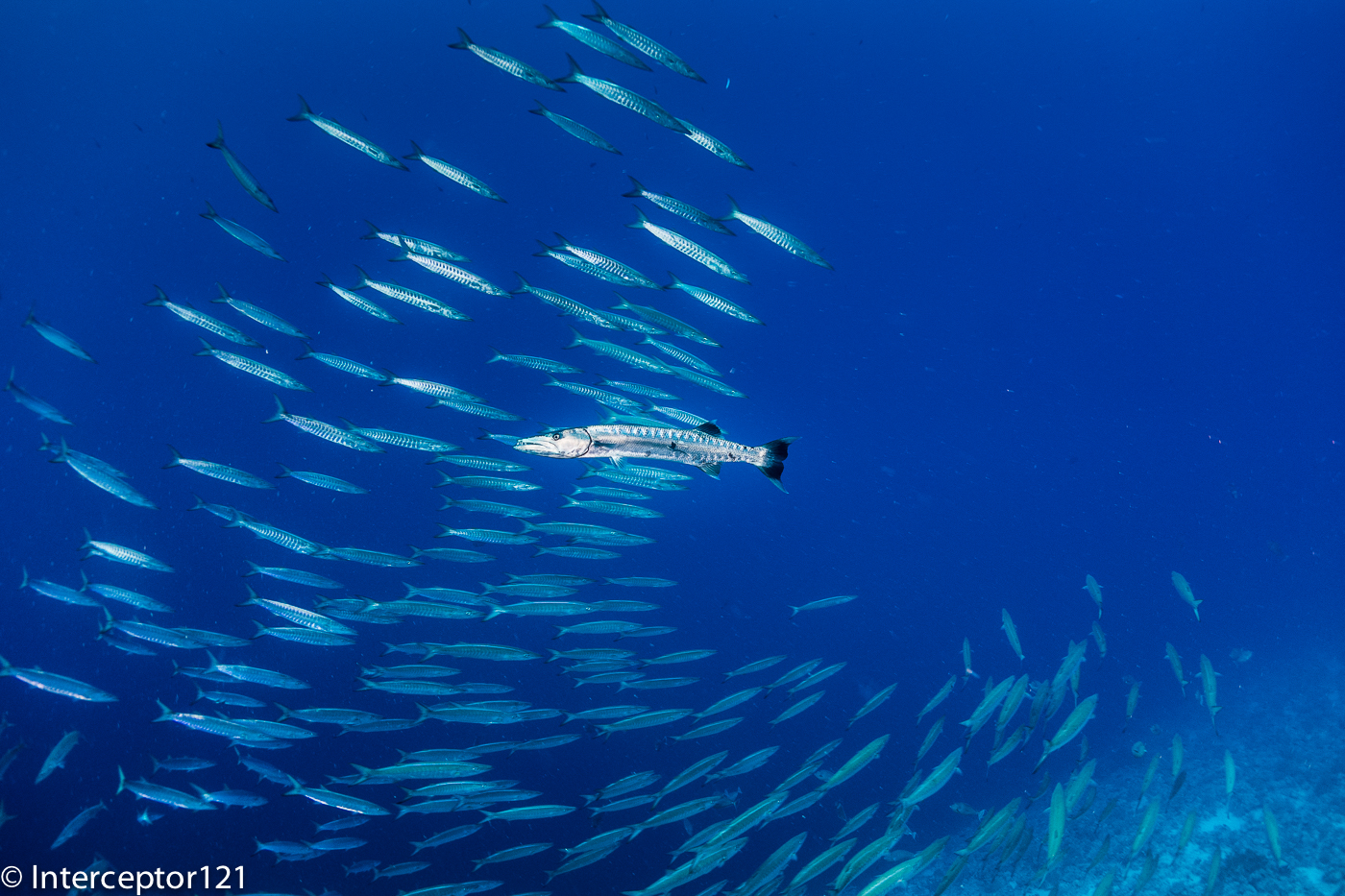
On the second dive I was lucky to spend some time with a Giant Barracuda that was literally commanding the school at sight, very rewarding from a diving point of view I got so excited that I kept shooting with a relatively slow shutter speed however the fish that is lit by the strobe is well crisp.

Giant Barracuda issuing orders

This shot is much deeper than the previous so the blue is colder but still makes for an interesting shot.

On dive 3 I decided to do a bit of video although I had not taken my favorite lens so I had to apply a filter directly on the camera lens. Moreover I had forgot the setting Toy effect on from some other experiment and whilst this is off in RAW it came back in video so the result is a soft warmer image…yuk still was fun to put it together so here it goes

It was time to rinse the gear (if you could call that hosing it quickly on the dive platform) and get ready to leave the day after. On the last day we were asked to put together a selection of our best 10 pictures and were give a video with some gopro footage taken by the ops manager plus our slideshow. Considering the time it was spent to do it the result is excellent.I hope this has given you an idea of the workshop that I definitely recommend, on the next post I will write my personal lessons learned from such experience.
Red Sea Workshop with Alex Mustard – Part V Tiran & Mermaids

As the currents were not playing ball we decided to head to Tiran to dive Jackson reef.
I love jackson as a dive and a video dive but I was a bit vary from a photography point of view as lighting can be a problem.

Anyway there was an option for a hammerhead dive in the early morning or a first dive on Jackson followed by a second before returning to Ras Katy for an afternoon and sunset dive.

Hammerhead are found on the back of Jackson reef when there are shallow thermoclines with the surface at 26C the chances were low however I had alternative ideas for that dive.

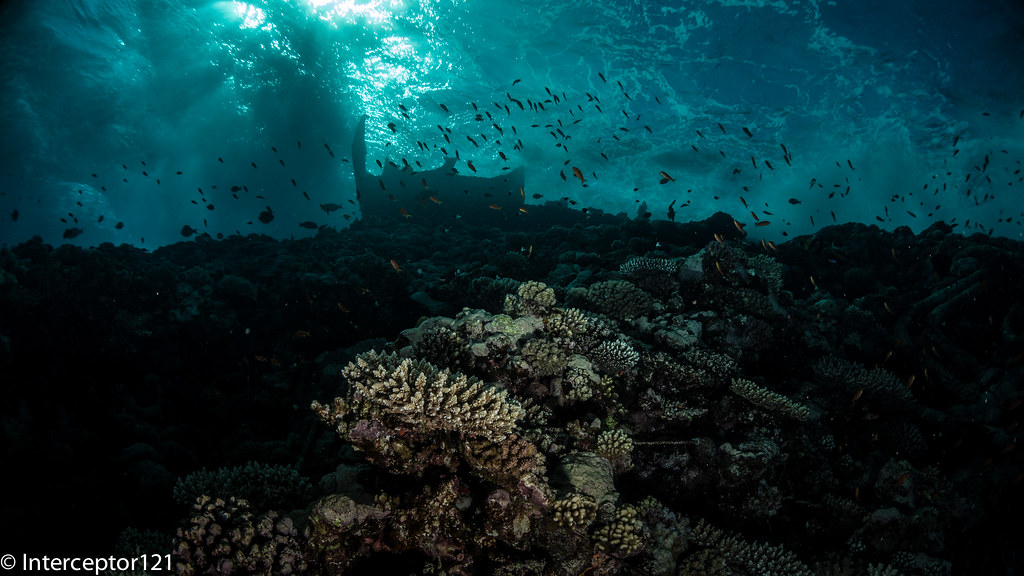
As foreseen there were no hammerheads so towards the end of the dive I tried a few shots of the Lara Wreck (that is on the surface) through the Snell window despite the strong surf.

The resulting shot is currently my desktop theme and is here.
Lara from the reef
I tried to get the wreck on the surface, the breaking surf, the sunball, some fish or at least silhouette of fish and the hard coral to give a dramatic moody look to the image.

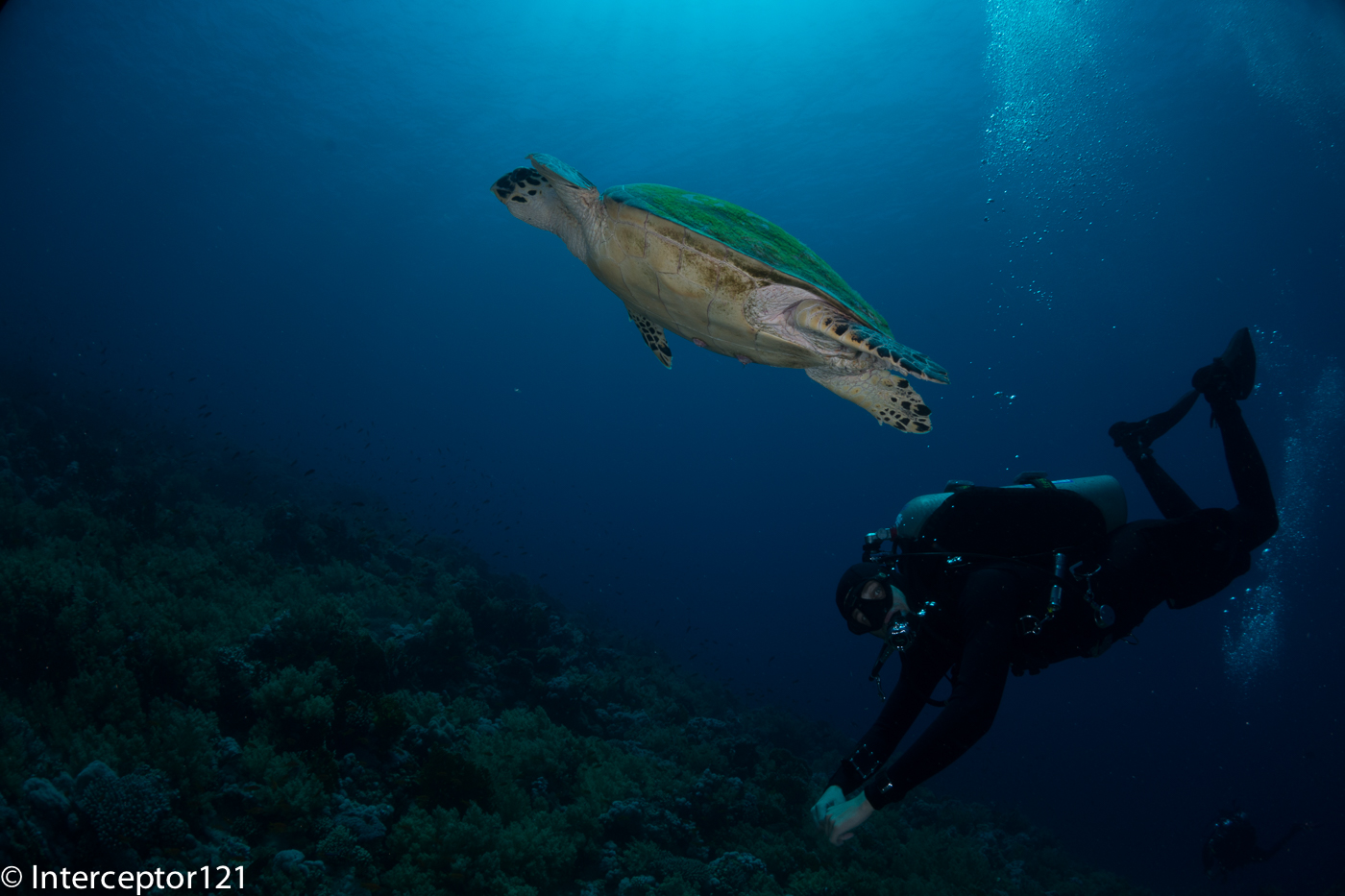
On dive two was time to have a relaxing dive with not much effort on photos. I saw few tunas at around 28 meters that is unusual and a turtle and some other critters though the shots are not particularly exciting.

In one occasion a dive guide came to be all excited as he had seen a turtle so I went there and bumped into our own guides that were out for a fun dive.

Turtle and Dive Guide

They usually are asked to get out of the frame instead I took the shot for their facebook perusal.

When the turtle had enough she shot off to the surface and I tried a silhouette however I forgot the strobe on

Failed Silhouette
Failed Silhouette

Nothing that lighroom can’t fix and this is the resulting shot after adjustment

Silhouette after lightroom

Not bad huh?

Back at Ras Katy I tried few more portraits like this one

Fish Portrait
Fish Portrait

Though my favorite is another
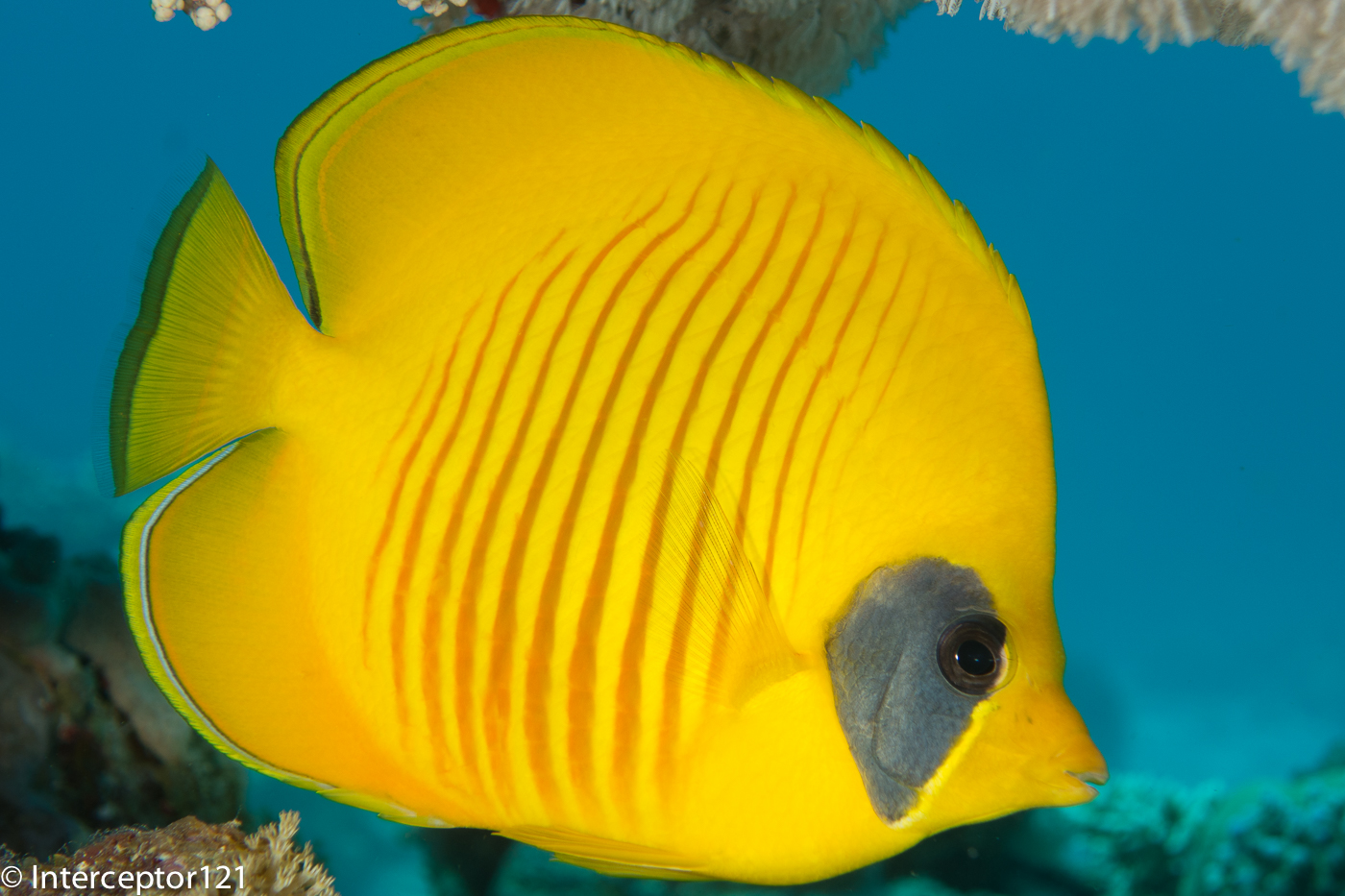
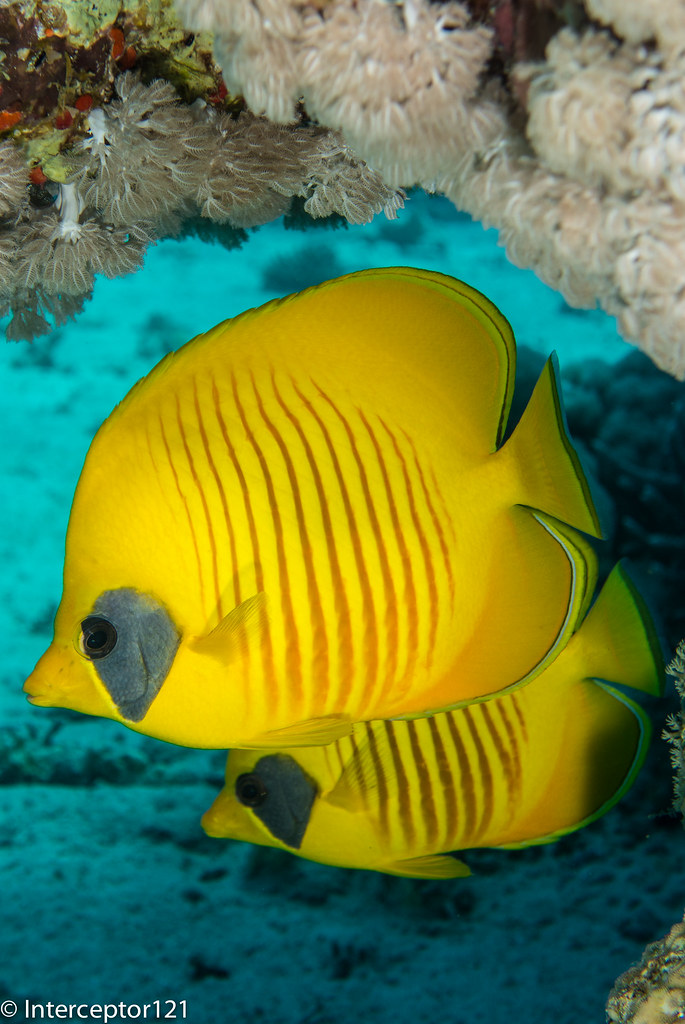
Masked Butterflies

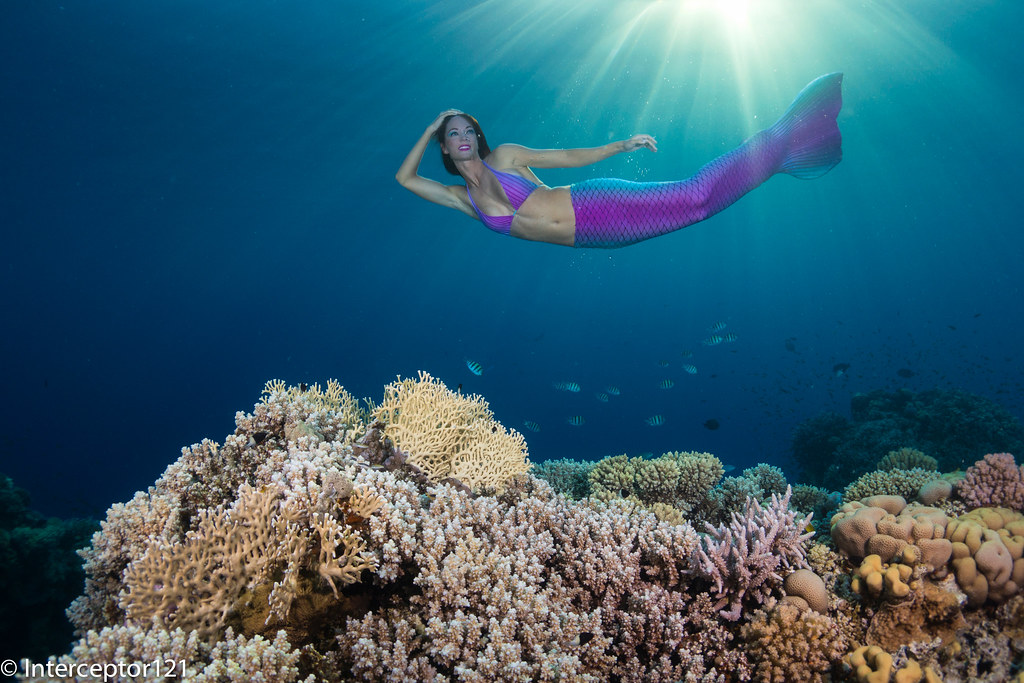
At sunset I was part of the mermaid group, we had a model Katrin Felton  suprising what a phenomena Mermaid tails have become.

We had a 2-3 shots in different poses however only the first was successful as the snell windows was ruined by one of the photographer that keept shooting with strobe…and getting in the way as she did not listen to the briefing properly well no big deal.

Anyway I gave it a shot afterwards Kat was not particularly happy about the barrel distortion that she said makes her look fat! Unfortunately I did not have a rectilinear lens anyway if you find yourself in this kind of set up make sure you have one.

Mermaid Kat I
All in all it was a bit of fun again I tried to include some fish, the reef, the mermaid, the sun rays. I looked at other pictures of the mermaid and I think she can’t appreciate how important is not to see the knees too much but I guess she likes to focus more on her figure on how slim she looks lol!

All in all another great day and a different perspective on shooting model underwater.


Red Sea Workshop with Alex Mustard – Part IV Shark Reef

After the first 3 days of workshop we got into the core of it and Alex talked about schooling fish and how to take shots.

We had 4-5 varieties to choose from:

  • Batfish
  • Surgeonfish
  • Barracuda
  • Jacks
  • Snappers

Detailed information was given in terms of how to best approach the fish depending on their behavior and also about the etiquette in terms of letting other people best positioned taking their shot first.

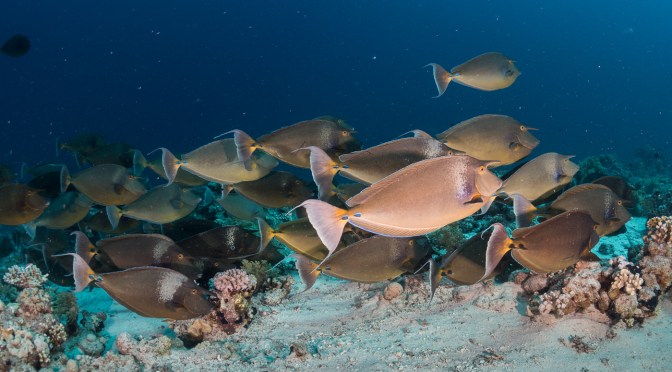
The surgeon fish are not that photogenic and actually quite messy I tried to take some shots when the current was pumping and they were all aligned close to the bottom at Yolanda however to me this is not that exciting as a shot. Other people got better results but I frankly was not that bothered about Surgeons. Probably as the fish is pretty dark and does not reflect the strobe much. The featured image close to the title shows what I mean.

During this trip the current was not going north to south as usual but there was near to no current at shark reef and current going outward at yolanda corner. This means the snappers that usually sit at the edge of shark reef were not out to play.

We were left with barracuda, batfish and jacks to choose from. On day 4 I only see few giant trevally but not many schooling jacks so had to focus on barracuda and batfish.

Unfortunately the barracuda were far from the reef and a bit too deep and did not really want to entertain chasing them so I tried with the batfish. Obviously there were not only us but also other boats so it was a bit of a competition for fish.

Encirclement
Encirclement

Also you always managed to get someone in the frame or bubbles

Shooting Batfish Below

So I focused on trying to get the best backgrounds for the pictures to come like in this case.

Bommie

Also had some fun taking images of the others and the batfish one or two came out pretty good.

Bats Photography

Creative angles
Creative angles

It is quite hard to have the discipline to respect rules when you are with other 18 photographer on the boat so the competitions had to be expected and I was not that bothered.

In the evening we headed back to Ras Katy and I borrowed a Nikon D7100 from Nauticam UK. I asked to have a 9″ dome for the split shot and jumped in the water with the idea of just doing that.

This is my best  shot

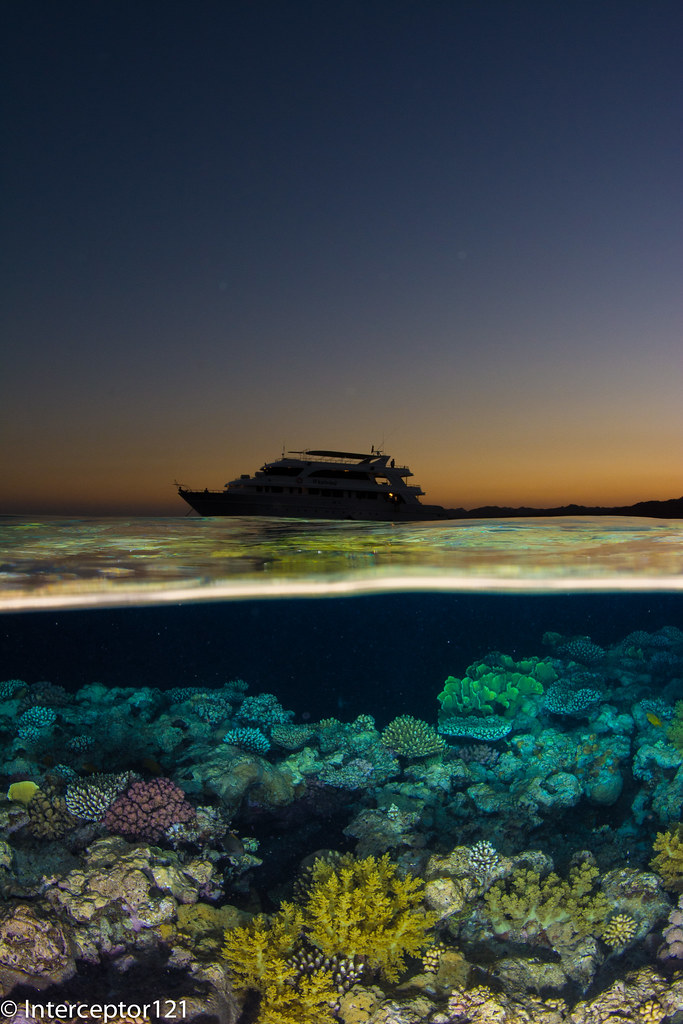
Ras Katy Sunset

Personally I do not like split shots where the surface line is very distorted to avoid that you need to make sure your lens is near to rectilinear and it is better to shoot portrait as there is little distortion on that axis. What I wanted to capture in this shot is layers, the reef, water under and over, the boat and sunset colors.

I think it came out pretty good but it is painful to take 100 shots just to get one right and I wish I had some fish in the frame but never mind is good enough like this. The water was not really flat so that was an additional challenge as you can see the wave breaks on the lens creating a little thicker line but overall a good shot.